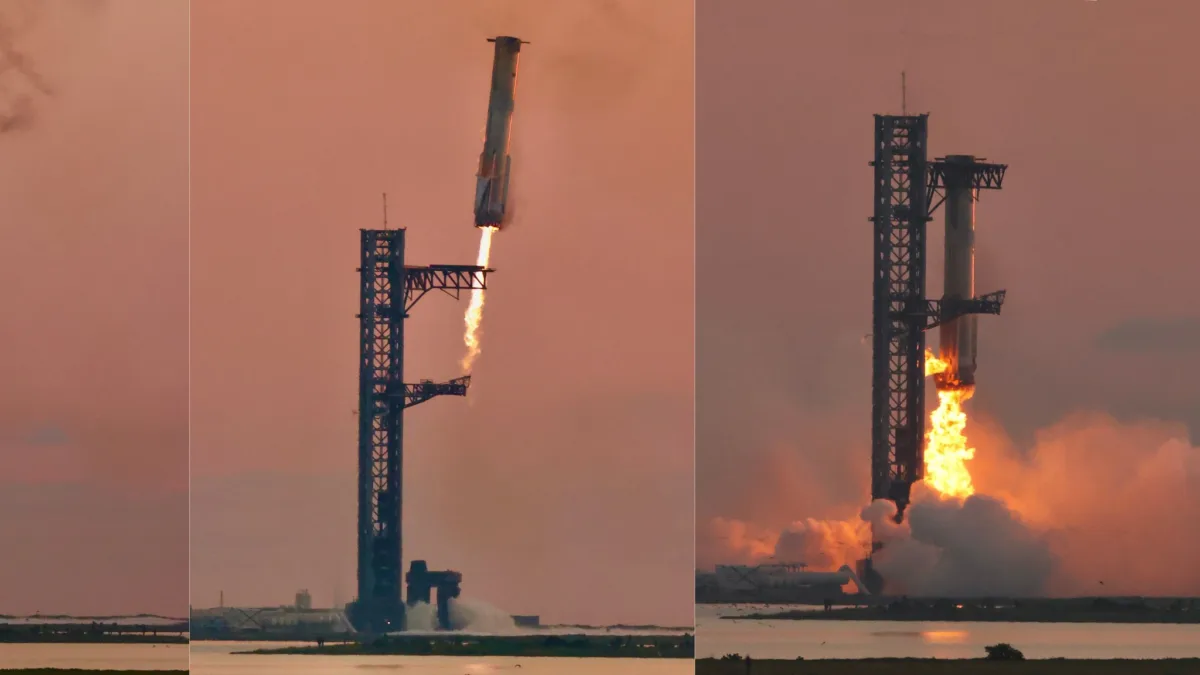
SpaceX launched its giant Starship rocket on its 15th test flight on Friday, aiming for a first that no orbital rocket has ever achieved: catching both halves of the vehicle back at the launch tower. The booster catch failed, but the Starship spacecraft reached orbit and is still flying, with a first-ever attempt to catch the ship itself planned for Saturday.
The 407-foot (124-metre) rocket lifted off from SpaceX’s Starbase site in South Texas at about 4:47 p.m. Central time (5:47 p.m. Eastern). Its Super Heavy booster, powered by 33 Raptor engines, pushed the vehicle out of the thick lower atmosphere before separating about two minutes and 20 seconds into the flight.
The booster, known as Booster 22, then turned back towards the launch site, where the tower’s mechanical arms were waiting to catch it about six and a half minutes after liftoff. But SpaceX called off the catch during the booster’s return flight and sent it to a splashdown in the Gulf of Mexico instead.
01. What went wrong with the catch
SpaceX has not yet said why the catch was aborted. Scientific American reported that the booster ran into trouble with some of its engines on the way back. Company spokesman Dan Huot said experts would look into what led to the decision, according to reports of the live webcast.
Despite the setback, the main part of the mission stayed on plan. The Starship upper stage, Ship 42, finished its climb with all six of its Raptor engines and reached orbit, where SpaceX confirmed it was “go for orbit”. The ship is carrying 26 Starlink V3 satellites, which it is due to release in orbit.
02. Ship catch attempt on Saturday
The spacecraft will now spend about 22 hours in space, circling the Earth roughly 14 times, before attempting to return to Starbase. SpaceX plans to try to catch the ship with the tower’s arms on Saturday afternoon, at around 4:15 p.m. Eastern. If it works, it will be the first time a Starship upper stage has ever been caught.
Flight 15 is only the second Starship flight to carry an operational payload, and it came less than two months after Flight 14. The US Federal Aviation Administration issued the launch licence on Friday, including permission for both stages to return to Starbase. Had both catches worked, the flight would have marked the first complete recovery of an orbital launch system, a key step towards SpaceX’s goal of a fully reusable rocket.