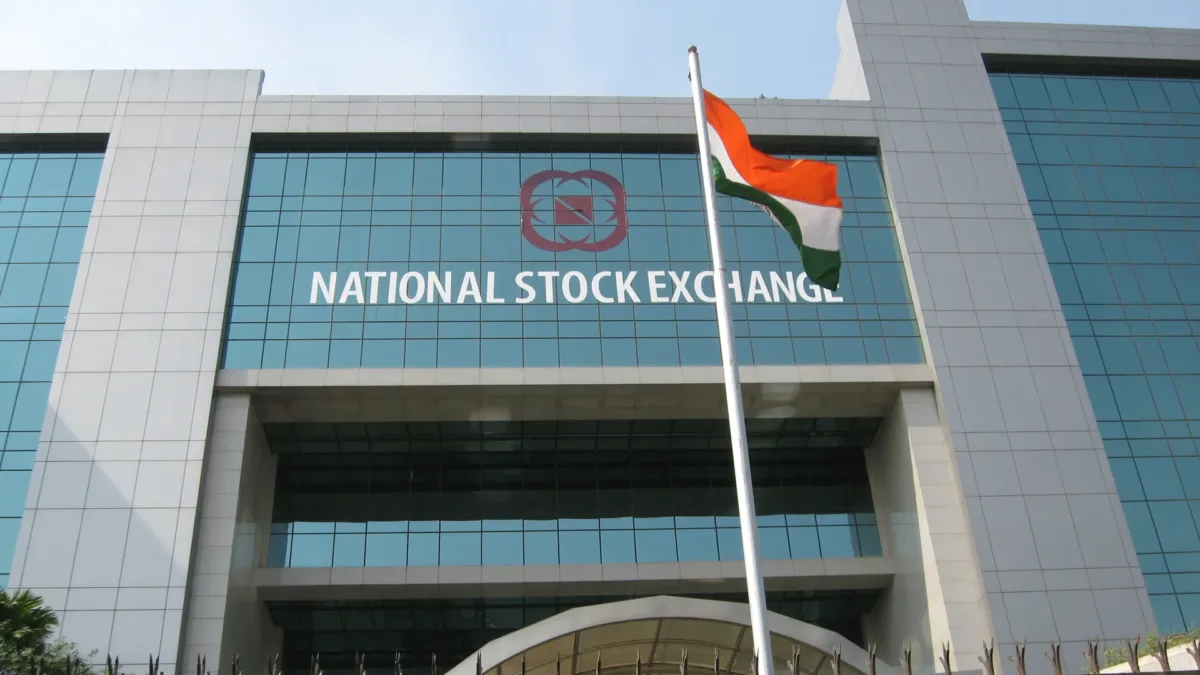
The stock market is a marketplace where people buy and sell small pieces of companies, called shares. When you buy a share, you own a tiny part of that company. Prices move up and down through the day as buyers and sellers agree on what each share is worth. In India, almost all of this trading happens electronically on two exchanges — the National Stock Exchange (NSE) and the Bombay Stock Exchange (BSE) — between 9:15 am and 3:30 pm on weekdays, under rules set by the regulator SEBI. This guide explains how the stock market works, step by step, in plain English.
What is a share, and why do companies sell them?
A share is a unit of ownership in a company. If a company has 10 crore shares in existence and you own 100 of them, you own a very small slice of that business. As a shareholder you may receive a part of the company’s profits, paid out as a dividend, and you usually get a vote at the company’s annual meeting.
Companies sell shares to raise money. When a company first offers its shares to the public, it is called an initial public offering, or IPO. This is the primary market: the money paid by investors goes to the company, which can use it to build factories, pay off debt or expand.
Once the shares are listed on an exchange, investors trade them with each other. This is the secondary market, and it is what most people mean when they talk about “the stock market”. In these trades the money goes to the seller, not to the company. The company is no longer involved — the price is set purely by what buyers are willing to pay and sellers are willing to accept.
The two exchanges: NSE and BSE
India has two main stock exchanges. Both are based in Mumbai, both run fully electronic trading, and both are regulated by the Securities and Exchange Board of India (SEBI), which was given statutory powers under the SEBI Act of 1992.
| BSE (Bombay Stock Exchange) | NSE (National Stock Exchange) | |
|---|---|---|
| Founded | 9 July 1875 — Asia’s oldest stock exchange | Incorporated 27 November 1992; equity trading began 3 November 1994 |
| Benchmark index | Sensex (30 companies) | Nifty 50 (50 companies) |
| Size | Nearly 5,700 companies listed, one of the largest exchanges in the world by number of listings | The world’s largest derivatives exchange by number of contracts traded |
| Known for | Dalal Street, Phiroze Jeejeebhoy Towers, and the Sensex | India’s first fully electronic exchange; the NSE itself listed on the BSE on 24 September 2026 |
Most shares list on both exchanges, and prices on the two are usually almost identical. For a beginner, which exchange you use barely matters — your broker routes the order for you.
How the stock market works, step by step
A trade that takes you seconds to place passes through several hands behind the scenes. Here is the full journey.
1. Open a demat and trading account. You buy shares through a SEBI-registered broker. You need a PAN card, KYC documents and a bank account. Your shares are held electronically in a demat account with one of India’s two depositories, NSDL (since November 1996) or CDSL (since February 1999). There were more than 21 crore demat accounts in India as of October 2025.
2. Place an order. You tell your broker what to buy, how many shares, and at what price. A market order buys at the best price available right now. A limit order buys only at your price or lower — if the price never reaches your limit, the order simply does not execute.
3. The exchange matches buyers and sellers. Your order goes into the exchange’s electronic order book. The system matches it with the best-priced sell order available, and when several orders sit at the same price, the earliest one goes first. There is no trading floor with shouting brokers any more; it is all done by computer in a fraction of a second.
4. The clearing corporation guarantees the trade. Once matched, a clearing corporation — NSCCL for the NSE and ICCL for the BSE — steps in between the buyer and the seller and guarantees that both sides keep their side of the deal, even if one of them defaults.
5. Settlement, on T+1. The shares and the money change hands on the next working day after the trade. This is called T+1 settlement, and it has applied to all listed stocks in India since 27 January 2023, making India one of the fastest-settling large markets in the world. Sell shares on a Monday, and the money is generally available to you on Tuesday.
What are the Sensex and the Nifty 50?
The Sensex and the Nifty 50 are indices — single numbers that summarise how a basket of large companies is doing. Instead of tracking thousands of shares, you can look at one number and know whether the market as a whole rose or fell.
| Sensex | Nifty 50 | |
|---|---|---|
| Exchange | BSE | NSE |
| Companies tracked | 30 of the largest BSE-listed companies | 50 of the largest NSE-listed companies |
| Launched | 1 January 1986 | 22 April 1996 |
| Base value | 100 in 1978–79 | 1,000 on 3 November 1995 |
| How it is calculated | Free-float market capitalisation — bigger companies move it more | Free-float market capitalisation — bigger companies move it more |
Free-float market capitalisation means the index counts only shares available for the public to trade, not shares locked up with promoters or the government. That is why a giant company moves the index far more than a small one.
The Sensex is always a much bigger number than the Nifty — around 81,000 against around 25,000 in mid-November 2026 — but that says nothing about which exchange is bigger: the two indices simply started from different base values, 100 and 1,000, in different years. And a “1,000-point fall” sounds dramatic, but when the Sensex is near 81,000 it is a move of only about 1.2%. What matters is the percentage, not the points.
When does the market open?
Indian stock exchanges trade on weekdays only, Monday to Friday, except on exchange holidays. The timetable, published by the NSE, runs like this:
| Session | Time (IST) | What happens |
|---|---|---|
| Pre-open session | 9:00 – 9:15 am | Orders are collected and matched to set the opening price |
| Regular trading | 9:15 am – 3:30 pm | The main session, when most buying and selling happens |
| Closing session | 3:40 – 4:00 pm | Orders are matched at the closing price |
Once a year there is a special one-hour Muhurat session on Diwali evening. Orders placed outside market hours sit with your broker until the market opens.
What makes share prices move?
Over years, share prices mostly follow company profits. A business that keeps earning more is usually worth more, and its share price tends to reflect that. Over days and weeks, though, prices move on much noisier things: company results, interest rate decisions, government policy, global markets, foreign investor flows, and plain sentiment.
That is why prices can fall even when nothing is wrong with a company — a bad day for the world economy drags good shares down with bad ones. A rising market is called a bull market; a long, broad fall of 20% or more from a recent peak is a bear market. The wider economy matters too: when GDP is growing, company earnings usually grow with it, which is one reason investors watch the economy as closely as they watch individual companies.
How to start investing in the stock market
There is no fixed minimum amount. You can buy a single share, and some shares cost less than a cup of tea. That said, a sensible start looks like this: open a demat and trading account with a SEBI-registered broker, start small with money you will not need for years, and learn how the market behaves before putting in larger sums. Costs to know about are brokerage, securities transaction tax and GST on the brokerage — your broker’s contract note lists them all.
Many beginners do not pick individual shares at all. They buy diversified index funds or mutual funds, which spread money across dozens or hundreds of companies at once, so one bad company cannot sink them — the simplest way to own a slice of the whole market.
The risks beginners should know
Shares can fall as well as rise, and there is no guaranteed return. The regulator’s own data is blunt: in a SEBI study published in July 2025, about 91% of individual traders in equity futures and options lost money in FY25, with total net losses of about ₹1.06 lakh crore. Derivatives — futures and options — are leveraged bets, not beginner products, and most people who trade them lose money.
The market does have safety valves. If the Sensex or the Nifty moves 10%, 15% or 20% in a day, trading is halted for a set period under SEBI’s circuit breaker rules, to stop panic selling from feeding on itself. Individual stocks also have daily price bands that limit how far they can move in one session.
Finally, beware of anyone promising guaranteed returns, “sure-shot” tips or secret stock picks. Genuine advisers and research analysts must be registered with SEBI, and no one can promise you a return. If something goes wrong with a broker or an adviser, SEBI’s SCORES portal is the official place to complain. And never borrow money to invest — a fall then costs you twice over.
Frequently asked questions
Do I need a demat account to buy shares?
Yes, for delivery-based buying. Your shares are held electronically in a demat account with NSDL or CDSL, opened through your broker. Intraday trades, where you buy and sell on the same day, do not touch the demat account.
How much money do I need to start investing?
There is no minimum set by the exchanges. You can buy a single share, though brokerage and taxes apply to every trade, so very small trades can be inefficient. Many people start with a few thousand rupees.
What is the difference between the Sensex and the Nifty?
The Sensex tracks 30 large companies on the BSE and started from a base value of 100 in 1978–79. The Nifty 50 tracks 50 large companies on the NSE and started from a base value of 1,000 in November 1995. Both measure the same thing — how India’s biggest companies are doing — just with different baskets.
Is the stock market open on weekends?
No. Indian exchanges trade Monday to Friday, 9:15 am to 3:30 pm, and are closed on Saturdays, Sundays and exchange holidays, with the single exception of the one-hour Muhurat session on Diwali.
Last verified: 27 November 2026.