Updated 9 November 2026: Monday morning figures added.
01. Tuesday update: air improves to ‘poor’ at 299
Updated 11 November 2026: Tuesday’s average AQI settled at 299 (‘poor’), down from 376 (‘very poor’) on Monday, after wind picked up — but the morning was still ‘very poor’ at 304–307.
Delhi’s air improved on Tuesday, 10 November. The Central Pollution Control Board (CPCB) put the day’s average AQI at 299, which is ‘poor’. Monday’s average was 376, which is ‘very poor’. The change came as wind speed picked up.
The morning was still bad. At 7–8 am the hourly average was still 304–307, which is ‘very poor’. Pusa and Chandni Chowk were 395 each at 7 am.
The settled daily average is 299. The highest station was Pusa at 385, then Chandni Chowk at 381. Twenty-three stations were still ‘very poor’. Readings came from 57 of the 59 stations.
Neighbouring cities were worse: Noida 313, Gurugram 321 and Faridabad 313 — all ‘very poor’.
Stage III of the Graded Response Action Plan (GRAP) remains in force across Delhi-NCR. It started on 6 November.
Note on numbers: 299 is the day’s settled average, not a morning reading. Do not compare it with private monitors such as weather.com (365) or AQI.in (389), which use different scales.
Delhi’s air turned severe on Monday morning, 9 November. The ITO monitoring station recorded an AQI of 406 at about 4:20 am, the Central Pollution Control Board said. An AQI of 401 to 500 is “severe”. Sunday’s average for Delhi was 376, which is “very poor”. It was 369 on Saturday.
02. Key takeaways
- Monday 9 November: ITO recorded AQI 406 at about 4:20 am — “severe”. Delhi’s overall AQI was 366 at 6:15 am, “very poor”.
- Sunday 8 November: Delhi’s average AQI was 376, “very poor”. Nineteen of 59 stations were severe on Sunday evening, 33 very poor. Jahangirpuri was worst at 460.
- Delhi’s overall AQI: 384 at 6 am on Sunday, “very poor”.
- 11 of 23 stations recorded AQI above 400, which is “severe”.
- Worst spots: Jahangirpuri at 450, Punjabi Bagh at 449 or 450, RK Puram at 448 or 449.
- GRAP Stage III restrictions are in force across Delhi-NCR since 6 November.
- Experts say the air may get worse. Firecrackers and weak winds could push the AQI past 400.
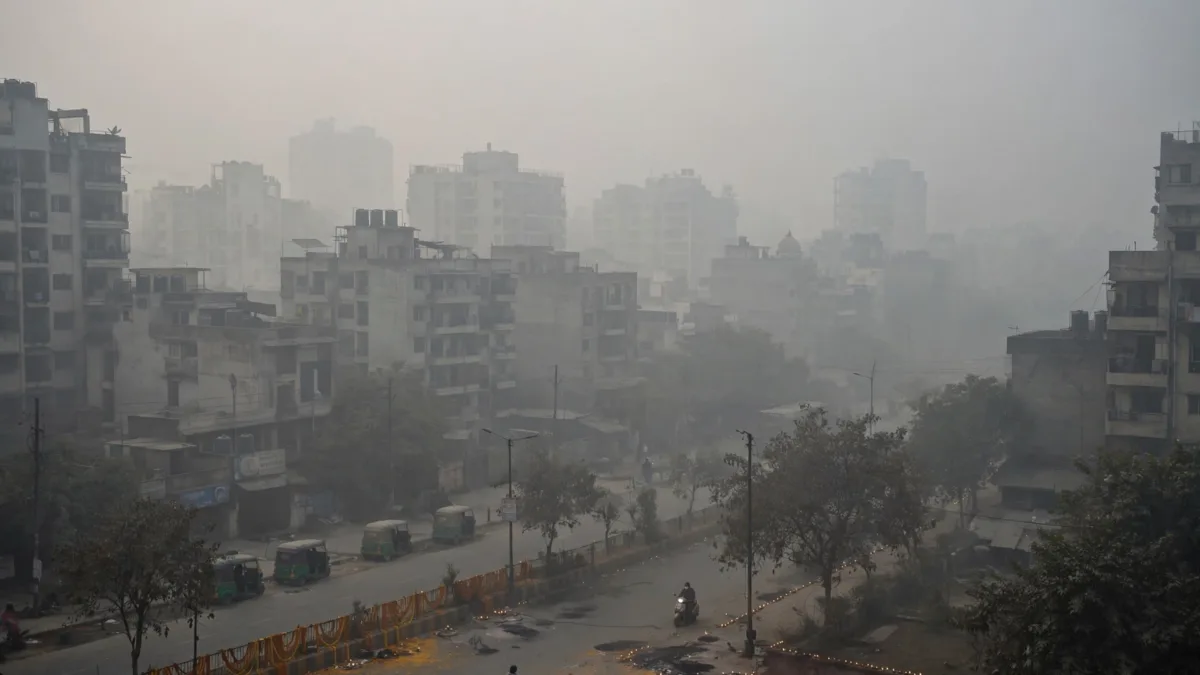
Delhi began Diwali under a thick blanket of smog. The air was bad on Sunday morning.
The city’s overall Air Quality Index (AQI) was 384 at 6 am, as per the Central Pollution Control Board (CPCB). That puts Delhi in the “very poor” range. An AQI of 301 to 400 is “very poor”. Anything above 400 is “severe”.
Eleven of the 23 monitoring stations in the morning update recorded AQI above 400. Jahangirpuri was the worst, at 450. Punjabi Bagh was at 449 or 450, as per different reports. RK Puram was at 448 or 449. IIT Delhi was at 445 or 446.
Saturday was bad too. The AQI at 4 pm on Saturday was 369. That was the highest pre-Diwali reading since 2016, as per News9.
03. Monday morning: the air turned severe
What the forecast warned about has happened. Delhi’s air turned severe on Monday morning, a day after Diwali. The ITO station recorded an AQI of 406 at about 4:20 am, as per the Central Pollution Control Board. At 7 am, Bawana stood at 424 and Burari at 441. Chandni Chowk hit 481.
Sunday’s average AQI for Delhi was 376, which is “very poor”. It was 369 on Saturday. On Sunday evening, 19 of the 59 monitoring stations in Delhi reported severe air. Thirty-three more were very poor. Jahangirpuri was the worst, at 460.
The Air Quality Early Warning System says the air could stay severe for several days, because calm winds are not clearing the smoke and dust.
04. Why it got worse
Firecrackers on Diwali night, weak winds, and stubble burning in nearby states all added to the pollution.
The Indian Institute of Tropical Meteorology had said the city-wide AQI could cross 400 and reach about 406 by early Monday morning. That is exactly what happened at ITO.
Stage III of the Graded Response Action Plan (GRAP) is already in force across Delhi-NCR. It started on 6 November. It includes curbs on construction and vehicles, and hybrid classes for young school children.
Only certified green crackers are allowed in Delhi-NCR on 7 and 8 November, and only at set hours. The wider firecracker ban comes back on 9 November.
05. Update: Tuesday, 11 November – air improves a little, but stays bad
Delhi’s air improved a little on Tuesday, 10 November. The city’s average AQI fell to 299, from 376 the day before, according to Central Pollution Control Board (CPCB) data. Stronger winds helped clear some of the pollution. An AQI of 299 is in the “poor” range, just below “very poor”.
The relief was only partial. Twenty-three of the 57 monitoring stations still recorded “very poor” air on Tuesday. Pusa Road was the worst at 385, followed by Chandni Chowk at 381.
The smog also hit flights. Around 44% of departing flights were delayed between midnight on 8 November and 8 pm on 9 November, with an average delay of about 20 minutes, NDTV reported. Delhi airport activated its first low-visibility procedure of the winter season on Diwali night. Disruption continued on Tuesday, with 197 delayed flights and 32 cancellations recorded by midday, according to Flightradar24 data.
Doctors say the damage is already showing. Hospitals in Delhi are seeing more children with breathing problems after Diwali, including coughs, eye irritation and difficulty concentrating. Dr Vijay Hadda, a lung specialist at AIIMS, said Delhi’s AQI had reached four digits at some monitoring locations.
Stage III of the Graded Response Action Plan (GRAP) remains in force across Delhi-NCR.
06. FAQs
What was Delhi’s AQI on Diwali morning?
384 at 6 am on Sunday, 8 November. That is “very poor”.
Which areas were worst?
Jahangirpuri at 450, Punjabi Bagh at about 449, and RK Puram at about 448. Eleven stations were above 400, in the “severe” range.
Did the air get worse on Monday?
Yes. ITO recorded an AQI of 406 at about 4:20 am on Monday, which is “severe”. The early warning system says the air could stay severe for several days.