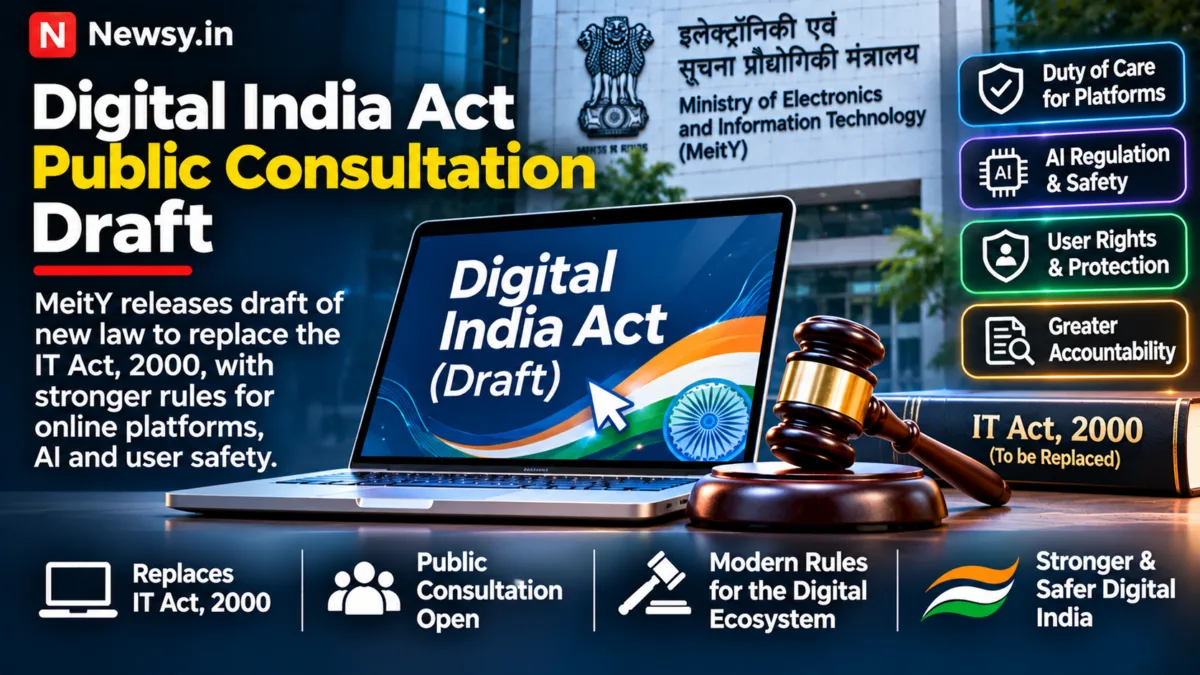
The Ministry of Electronics and Information Technology (MeitY) has released the extensive public consultation framework for the Digital India Act (DIA), India’s upcoming umbrella cyber legislation designed to replace the 26-year-old Information Technology Act, 2000.
The proposed legislative framework introduces fundamental structural shifts in internet governance, replacing generic platform rules with differentiated intermediary classifications, establishing an enforceable statutory ‘online duty of care’, codifying algorithmic transparency standards, and re-evaluating blanket safe harbour legal immunity. Read our earlier coverage of intermediary liabilities in India Reviews Social Media Safe Harbour Under Section 79.
01. Digital India Act (DIA) vs. IT Act 2000: Core Regulatory Framework
| Governance Pillar | Legacy IT Act, 2000 | Proposed Digital India Act (DIA) Architecture |
|---|---|---|
| Core Regulatory Approach | Reactive enforcement & post-incident penalties | Proactive, rights-based governance with mandatory ‘online duty of care’ |
| Platform Classification | Monolithic category for all ‘intermediaries’ | Differentiated buckets: Social Media, Cloud Providers, AI/GenAI, E-commerce, EdTech, and OTT platforms |
| Safe Harbour Immunity | Blanket conditional immunity under Section 79 | Recalibrated immunity: Conditional on active algorithmic accountability, deepfake filtering, and grievance redressal |
| Artificial Intelligence & ML | No statutory mention or governance clauses | Dedicated AI framework, algorithmic bias audits, and mandatory C2PA provenance tracking |
| Enforcement Authority | Central Government bureaus & Adjudicating Officers | Specialized Digital India Regulatory Authority (DIRA) and fast-track appellate tribunals |
| Child Safety Online | General obscenity provisions | Prohibition of targeted profiling, behavioral ads, and dark patterns aimed at minors |
| Content Virality & Misinformation | Reactive takedown notices (36-hour window) | Circuit breakers for viral misinformation and expedited 2-3 hour takedown windows |
02. Key Pillars of the Digital India Act
The draft consultation paper outlines a multi-tiered legal architecture structured around contemporary digital realities:
- Differentiated Intermediary Regulation: Moving away from treating search engines, telecom conduits, cloud hosts, and social media apps under a single legal umbrella, the DIA creates bespoke compliance schedules based on service functionality, risk profile, and user footprint.
- Statutory ‘Online Duty of Care’: Platforms will be legally required to proactively identify, assess, and mitigate systemic risks—including cyberbullying, non-consensual synthetic media, impersonation fraud, and coordinated harassment campaigns.
- Algorithmic Accountability & Bias Audits: Recommendation engines that amplify content will be subject to periodic algorithmic audits to ensure non-discrimination, transparency, and prevention of deceptive dark patterns.
- Interoperability with Allied Digital Laws: The DIA is architected to operate synergistically with the Digital Personal Data Protection (DPDP) Act and the Bharatiya Nyaya Sanhita (BNS) for criminal cyber offenses.
03. Frequently Asked Questions (FAQ)
What is the Digital India Act and what does it replace?
The Digital India Act (DIA) is India’s proposed comprehensive cyber legislation designed to supersede the Information Technology Act, 2000, addressing modern internet challenges including AI governance, algorithmic feeds, and digital platform accountability.
How does the Digital India Act handle platform safe harbour?
The DIA moves away from blanket safe harbour protections, making legal immunity conditional upon platforms actively enforcing due diligence, curbing malicious deepfakes, and remaining transparent about algorithmic recommendation models.
What is the ‘online duty of care’ principle in the DIA?
The ‘online duty of care’ mandates that digital intermediaries take reasonable, proactive technical and organizational measures to protect users from foreseeable online harms such as cyber fraud, identity theft, and non-consensual deepfakes.
04. Related NewsY Coverage
Explore digital intermediary liability debates in India Reviews Social Media Safe Harbour Under Section 79, read about semiconductor investment roadmaps in India Opens Semicon 2.0 Applications & Approves ₹7,503 Cr Projects, track foreign investment inflows in FPIs Pump ₹38,971 Crore into Indian Equities, and check entertainment headlines in Aishwarya Rai & Abhishek Bachchan Shut Down Separation Rumors.
05. Sources
- Ministry of Electronics and Information Technology (MeitY): Digital India Act Consultation Paper: Principles and Legislative Architecture, New Delhi, 2026.
- Press Trust of India & SFLC: India Advances Comprehensive Digital India Act to Overhaul IT Rules and Platform Accountability, 2026.
NewsY Tech Policy Desk: Governance frameworks, statutory provisions, and regulatory definitions reflect official MeitY consultation documents and published legislative briefs.


