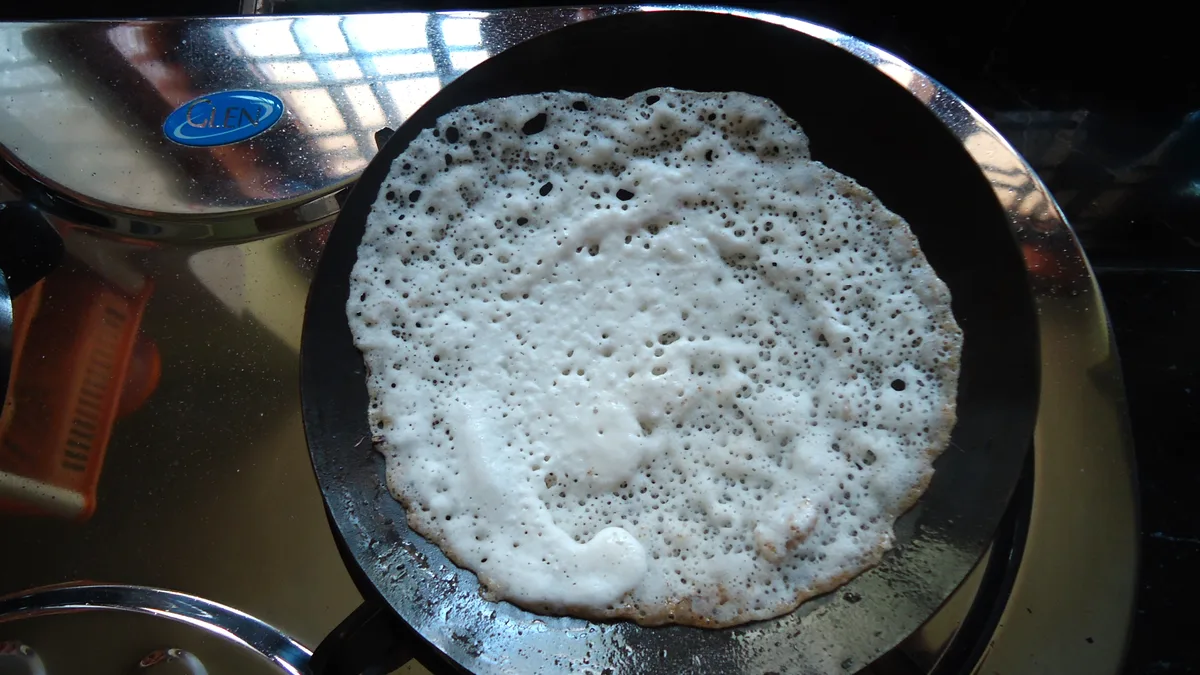
This appam recipe makes palappam, the Kerala hopper: a bowl-shaped pancake with lacy, crisp edges and a soft, spongy centre, made from rice batter fermented overnight and cooked in an appachatti, the small wok-like pan that gives it its shape. Appam is the breakfast of Kerala’s Syrian Christian homes and the partner of every coconut-milk stew and chicken curry in the state — the crisp edges are for tearing and dipping, and the soft centre soaks up the gravy. Be honest about the time from the start, though: this is not a quick recipe. With dry active yeast, the rice must soak for 4 to 8 hours and the batter must ferment for 8 to 12 hours, so appam is a dish you start the day before and eat the next morning. There is a shortcut — instant yeast, which ferments in 1 to 2 hours — but it is a shortcut with a flavour difference from the traditional ferment, and this post says so rather than pretending the two are the same.
Soaking time: 4-5 hours (or overnight, about 8 hours) | Fermentation: 8-12 hours (dry active yeast) or 1-2 hours (instant yeast shortcut) | Cook time: 1-2 minutes per appam | Serves: 4, at 2-3 appams each
Appam Ingredients
- 1½ cups regular white rice (sona masuri, parmal or ponni; half raw and half parboiled also works)
- 2 cups water, for soaking
- ¼ cup poha (flattened rice)
- ½ cup grated fresh coconut (or about 1 cup thick coconut milk instead)
- ¾ cup water, for grinding
- ½ teaspoon instant yeast, or ¾ teaspoon dry active yeast
- ½ teaspoon salt
- 2 tablespoons sugar
- ½ teaspoon oil, for the pan
How to Make Appam
Step 1: Soak the rice for 4-5 hours. Rinse the rice and soak it in 2 cups of water for 4 to 5 hours, or overnight for about 8 hours. The soak is only to soften the rice so it grinds smooth — there is no fermentation yet — but it cannot be skipped, and a short soak leaves a gritty batter that will not spread thin.
Step 2: Grind to a smooth, flowing batter. Drain the rice and grind it with the poha, grated coconut (or coconut milk), salt, sugar and ¾ cup of water, to a smooth batter that flows from a ladle in a steady stream. The batter should be thinner than dosa batter and completely smooth, with no grit at all — run it through your fingers to check.
Step 3: Ferment 8-12 hours, or 1-2 hours with instant yeast. If you are using dry active yeast, dissolve ¾ teaspoon in 1 to 2 tablespoons of lukewarm water, stir it into the batter, and leave the batter in a warm place for 8 to 12 hours, depending on the temperature, until it has doubled and is full of air pockets. If you are using instant yeast, sprinkle ½ teaspoon directly into the batter and ferment for 1 to 2 hours, until doubled — in a warm climate one source’s own test took 1 hour 15 minutes, and cooler weather takes longer. Traditionally the ferment came from toddy, the palm-flower drink, and yeast is the modern substitute; the flavour is not identical, and the overnight ferment is the closer of the two.
Step 4: Cook 1-2 minutes per appam. Heat an appachatti or a small kadhai on medium-low to medium heat and grease it very lightly with ½ teaspoon of oil. Pour in a ladleful of batter — about ¼ to ⅓ cup — and swirl the pan at once so the batter coats the sides and leaves a thicker pool in the centre. Cover with a lid and cook for about 2 minutes, until the base is light golden, the edges are lacy and crisp, and the centre is set and fluffy. Lift it out gently and serve at once. Repeat until the batter is finished.
Step 5: Serve with a curry or stew. Appam is eaten with a coconut-milk curry or stew — chicken curry, vegetable stew, or egg curry — and the centre is made for soaking up gravy. Serve the appams hot, one at a time off the pan, because they soften and stick together if they are stacked and left to sit. Leftover batter keeps in the fridge for a day, and up to two days by one source.
Tips for the Best Appam
Trust the doubling, not the clock, for this appam recipe: fermentation depends on the temperature of your kitchen, and a batter that has not doubled will make flat, dense appams. Swirl the pan the moment the batter goes in — the lacy edges form in that first swirl, and a slow swirl leaves a thick, heavy pancake instead of a hopper. Do not use a large pan: the appachatti’s small, curved shape is what makes the bowl, and a flat tawa makes a flat pancake. One source’s card lists a prep time of 24 hours, but its own method is a soak of about 8 hours plus a ferment of 8 hours — about 16 hours before cooking — so the 24-hour figure is not used here. And do not expect a yield number from this post: neither source states how many appams the batch makes, only that 2 to 3 appams is a serving per person, so the serving count here is worked out from that, not from a stated total.
The method follows Dassana’s Veg Recipes’ appam (1½ cups regular white rice, 2 cups water for soaking, ¼ cup poha, ½ cup grated fresh coconut, ¾ cup water for grinding, ½ teaspoon instant yeast or ¾ teaspoon dry active yeast, ½ teaspoon salt, 2 tablespoons sugar; soak 4-5 hours, grind to a smooth flowing batter; dry active yeast dissolved in 1-2 tablespoons lukewarm water, ferment 8-12 hours until doubled; instant yeast sprinkled in, ferment 1-2 hours until doubled with air pockets, 1 hour 15 minutes in her own warm-climate test; cook with ½ teaspoon oil, ¼-⅓ cup batter, swirl to coat the sides, medium-low to medium heat, cover, cook about 2 minutes; 2-3 appam per person; coconut milk may replace grated coconut, about 1 cup thick; traditionally fermented with toddy) and Kannamma Cooks’ Kerala appam (2 cups raw rice, ½ cup fresh shredded coconut, ¾ teaspoon active dry yeast, 2 tablespoons sugar, 1½ teaspoons salt; soak overnight around 8 hours, grind with 1 cup water, make a kanji porridge from 1 cup batter and 1 cup water, grind another 10-15 minutes, total wet-grinder time 30-40 minutes; yeast activated in ½ cup barely-warm water with sugar, foamed 5 minutes; thick coconut milk made from ½ cup shredded coconut ground with 1½ cups water; ferment 8 hours until foamy and yeasty; cook 1 minute on medium flame in an appachatti, done when the sides are brown; batter keeps in the fridge up to 2 days). The two agree on the overnight ferment with dry active yeast, on coconut in the batter, and on swirling and covering to cook. They disagree on rice (1½ cups against 2 cups), on the soft-centre technique (poha against a kanji porridge), on salt (½ teaspoon against 1½ teaspoons) and on cooking time per appam (about 2 minutes against 1 minute) — so this recipe publishes Dassana’s quantities, the 1-to-2-minute cooking range, and a salt range that both sources support in practice, and notes the kanji method as the alternative.
Serve this appam with our Malabar chicken curry for the classic Kerala pairing, or with our Kerala beef stew for a coconut-milk stew to mop up.


