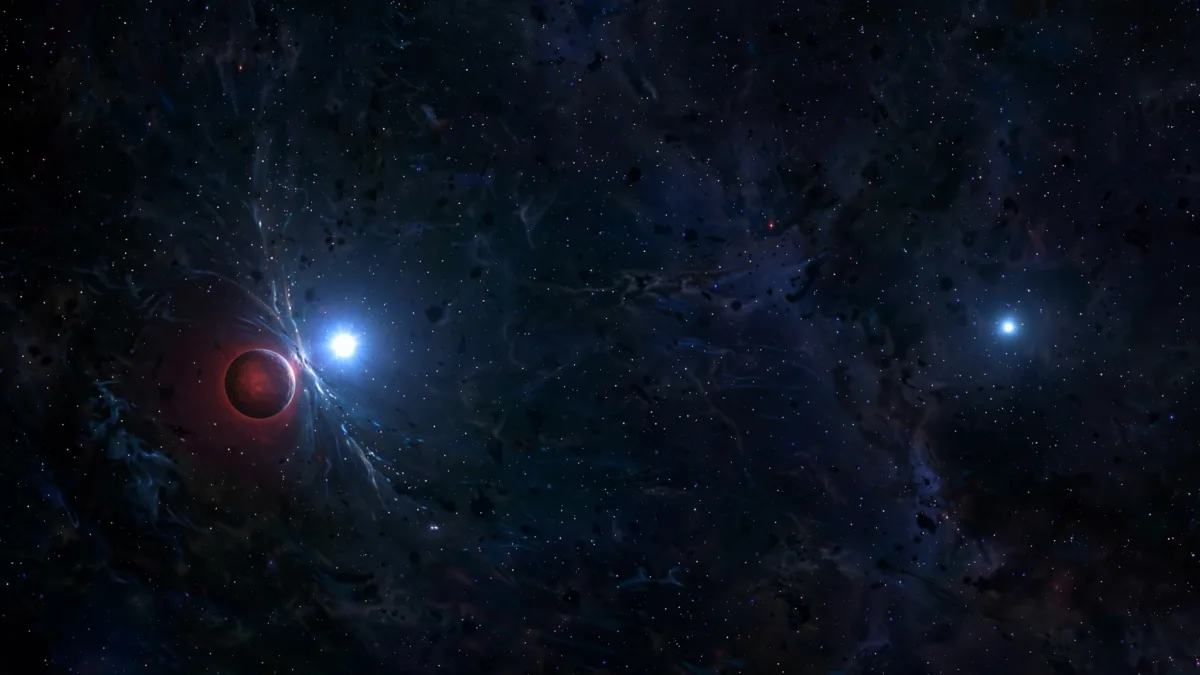
Astronomers have found a remarkable triple-star system just 28 light-years from Earth, arranged in a way that current theories of how stars evolve say should not exist. The Welopoai triple star system, officially named Welopōʻai, contains a red dwarf and two white dwarfs, making it the closest known triple-star system containing two white dwarfs.
The discovery was made by an international team led by researchers at the Trottier Institute for Research on Exoplanets (IREx) at the Université de Montréal, and is published in the journal Astronomy & Astrophysics.
Welopoai triple star system: how it was found
The team was not looking for stars at all. It was hunting for planets around a red dwarf, known as IRAS 21500+5903, using the SPIRou instrument on the Canada-France-Hawaii Telescope on Maunakea, Hawaii. Instead of the tiny wobble a planet would cause, the star’s velocity swung by nearly 16 kilometres per second — more than 1,000 times larger than expected.
“We were actually looking for planets,” said lead author Étienne Artigau, an IREx researcher. “Instead, we found something much more surprising.”
Almost five years of observations showed the unseen companion had more than half the mass of the Sun. That combination — high mass and very low brightness — left only one plausible explanation: the remains of a dead star. The team then turned to the Gemini North telescope, also on Maunakea, whose ‘Alopeke instrument directly detected the faint companion: a white dwarf, the dense remnant of a Sun-like star that has exhausted its fuel.
But the newly found white dwarf was not alone. The system was already known to contain a second white dwarf much farther away. Together, the three stars form a rare hierarchy: a red dwarf and a white dwarf orbit each other closely, while the second white dwarf circles the pair from a much greater distance. No comparable system is known within 100 light-years of Earth.
The puzzle is how the close pair survived. Before becoming a white dwarf, the dead star would have swollen into a giant large enough to reach its red dwarf companion. The two stars should have spiralled together and merged long ago. “This system should not exist,” said co-author Patrick Dufour, an astrophysicist at the Université de Montréal. “We have no clean explanation for how it got here.”
The team measured the new white dwarf’s mass with an uncertainty of less than 1%, giving astronomers a precise test of models of stellar evolution and the physics of matter at extreme densities. The system sits 8.46 parsecs — about 28 light-years — from the Sun.
The name Welopōʻai was chosen through A Hua He Inoa (“Calling Forth a Name”), a programme run by the ‘Imiloa Astronomy Center of Hawai’i that pairs Hawaiian language and cultural practitioners with astronomers to name new discoveries. It means “path of family traits”.
Read the announcement from the Université de Montréal and the report at Phys.org. Also read: New Malaria Vaccine Trial Shows 87% Efficacy and Memory Improves Across Generations: Study of 219,000.