Arizona GDP reached $592.1 billion in 2025, the 15th-largest state economy in the United States. The state grew 1.5% in real terms in 2025, below the national pace of 2.3%, and added $25.3 billion of output in current prices. GDP per person was $77,665, 34th among the states, on a population of about 7.62 million that grew by more than 67,000 in the year.
For most of the last century, Arizona’s economy was summed up as the five C’s: cotton, cattle, citrus, copper and climate. The state is now adding a sixth: chips. Metro Phoenix has become one of the most important places in the world for making the semiconductors that power artificial intelligence, and that single shift is remaking the state’s industrial base.
| Figure | Value |
|---|---|
| GDP 2025 (current prices) | $592.1 billion |
| GDP 2024 | $566.8 billion |
| Nominal increase on 2024 | +$25.3 billion (+4.5%) |
| Real GDP 2025 (chained 2017 dollars) | $451.5 billion |
| Real growth 2025 | +1.5% |
| GDP per capita 2025 | $77,665 |
| GDP per capita 2024 | $75,006 |
| Population 2025 | 7.62 million |
| Rank by GDP | 15th of 50 states |
| Share of US GDP | 1.9% |
| Growth since 2021 | +34.7% |
Chips in the desert
TSMC, the Taiwanese company that makes the advanced chips inside iPhones and Nvidia’s AI processors, picked Phoenix for its first major US factory in 2020. The first fab began mass-producing 4-nanometre chips in late 2024, the first time leading-edge chips had been made on American soil, and TSMC raised its Arizona commitment to $165 billion in March 2025, for six fabrication plants, two packaging facilities and a research centre. Intel has been making chips at its Ocotillo campus in Chandler since 1979 and is now ramping up its new Fab 52 there, while Amkor Technology broke ground in 2025 on a packaging campus in Peoria.
The scale is hard to overstate: more than $100 billion of semiconductor investment has been announced in metro Phoenix, and the state has attracted more than 70 semiconductor-related expansions since 2020. Manufacturing is still only 7.4% of Arizona’s output in the BEA figures, because the fabs are new, but the direction of travel is clear.
Arizona GDP by industry
For now, finance, insurance, real estate, rental and leasing dominates, at 26.7% of output, reflecting the housing and population boom in the Phoenix and Tucson metros. Professional and business services contribute 11.2%, government 9.7%, and education, health care and social assistance 9.6%. Copper mining remains significant in the state’s history and identity, though it is a small share of output today, and tourism around the Grand Canyon and the desert resorts is a steady earner.
The chip boom brings a problem the desert state cannot ignore: water. A single fab uses millions of gallons a day, and TSMC broke ground in August 2025 on a water-reclamation plant designed to recycle about 85% of the water its Phoenix site uses. How the state balances factory growth against water supply is the central policy question of the next decade.
Arizona GDP since 2021
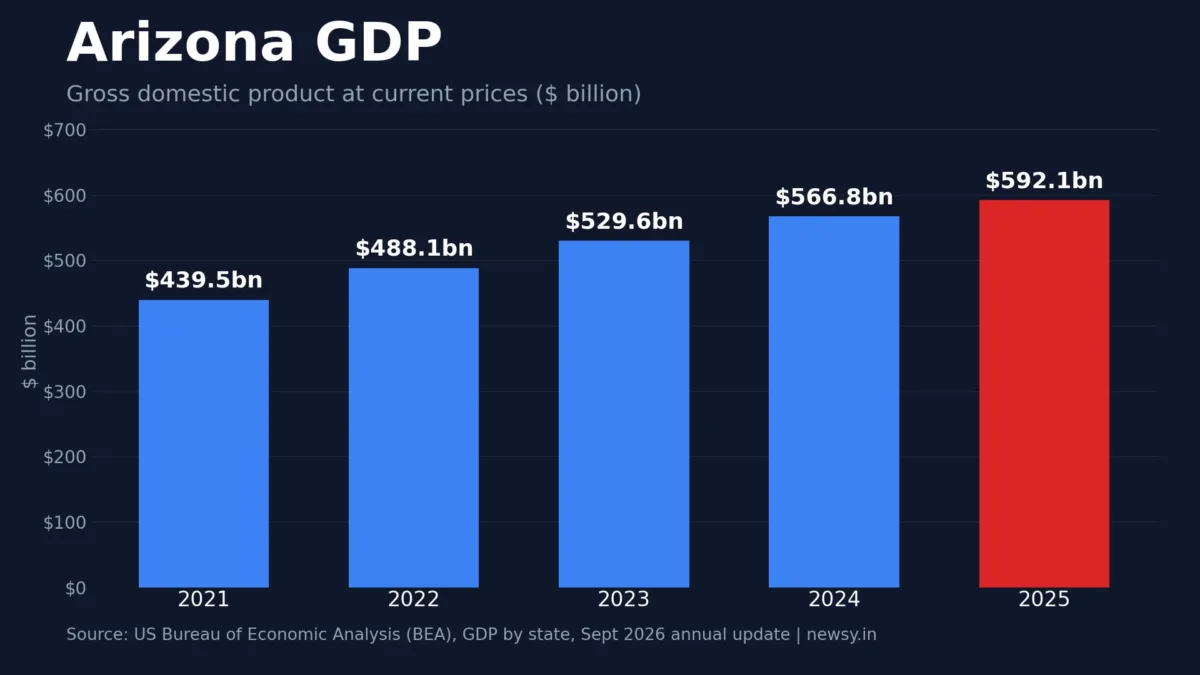
Arizona’s economy was worth $439.5 billion in 2021, $488.1 billion in 2022, $529.6 billion in 2023, $566.8 billion in 2024 and $592.1 billion in 2025, a five-year increase of 34.7%, one of the strongest among the 20 largest states. GDP per person rose from $75,006 in 2024 to $77,665 in 2025. The state sits between Michigan ($733.9 billion) and Tennessee ($586.2 billion) in the national ranking, and its economy is larger than that of most countries, as the countries by GDP ranking shows. If the fabs keep coming, the next five years could look very different from the last five, with manufacturing a far bigger share of the total.
Sources: US Bureau of Economic Analysis (BEA), GDP by state, table SAGDP1, annual update released 30 September 2026; population from BEA table SAINC1. Figures are at current prices unless stated as real (inflation-adjusted) growth. See the BEA GDP by state data.
Last updated: 25 November 2026.