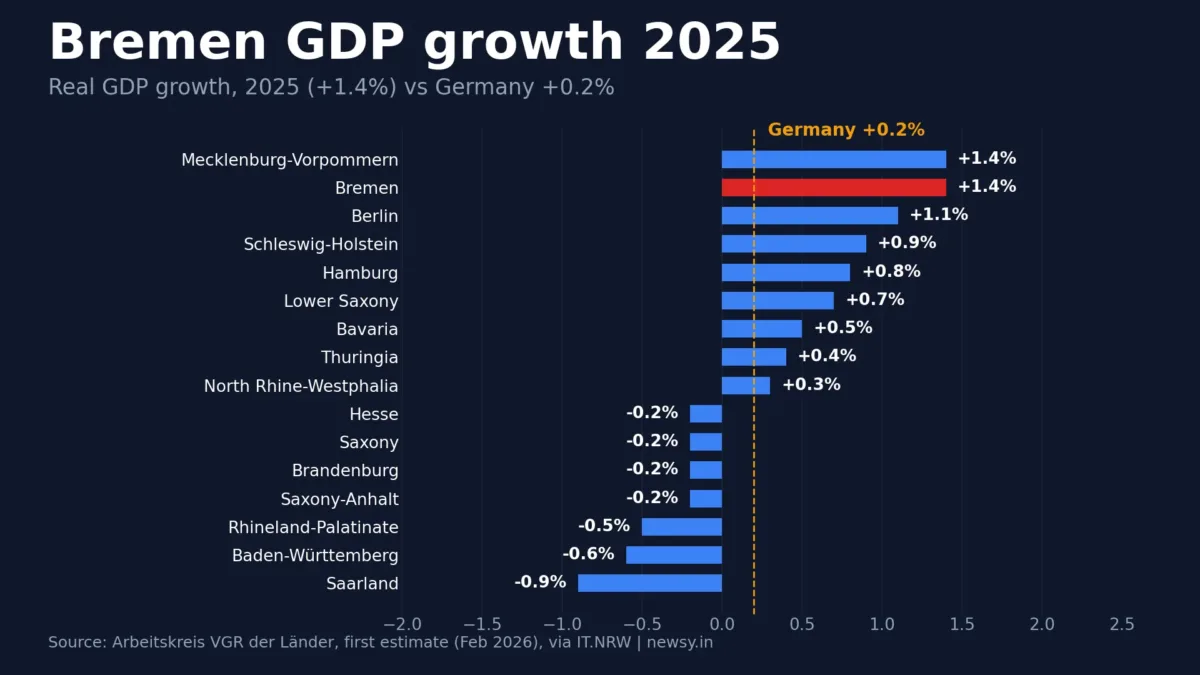
Bremen GDP reached €43.01 billion in 2025, making Bremen the 16th-largest — and smallest — economy among Germany’s 16 states. The figure is 0.96% of Germany’s total output of €4,469.91 billion. Bremen grew 1.4% in real terms in 2025 — the joint-fastest growth in Germany, level with Mecklenburg-Vorpommern — according to the first estimate from the Arbeitskreis Volkswirtschaftliche Gesamtrechnungen der Länder (VGR der Länder), published on 28 May 2026.
| GDP, current prices (2025) | €43,011 million (€43.01 billion) |
| Real growth (2025) | +1.4% — joint-fastest of all 16 states |
| Nominal growth (2025) | +4.2% |
| GDP per capita (2025) | €61,019 |
| Rank among 16 states | 16th — smallest economy |
| Share of Germany GDP | 0.96% |
Reading the figures. GDP is the total value of goods and services produced in the state. The headline figure is at current prices, which includes the effect of rising prices. Real growth strips out price rises, so it shows whether the economy actually expanded. GDP per capita divides output by population: a rough picture of average output per person, not average income.
Bremen GDP growth in 2025
Bremen had the best year of any German state in 2025 — at least in growth terms. Its +1.4% real growth, shared with Mecklenburg-Vorpommern, was seven times the national rate of 0.2%, and its nominal growth of 4.2% was the third-highest in Germany, behind Berlin (+4.7%) and Mecklenburg-Vorpommern (+4.5%). It is a remarkable result for Germany’s smallest state, a two-city state — Bremen and Bremerhaven — whose economy is barely a hundredth of the national total. Nine states grew in real terms in 2025 and seven shrank; Bremen and its fellow port economies on the north coast, Hamburg (+0.8%) and Schleswig-Holstein (+0.9%), all grew.
What drives Bremen’s economy
Bremen’s economy is built on what moves through it. Its ports form Germany’s second-largest seaport: Bremerhaven is the fourth-largest container port in northern Europe, and its car terminal, the second-largest in Europe, handles more than 1.7 million vehicles a year, according to the state’s economic development agency WFB Bremen. Around a fifth of all jobs in the state are connected to the ports. Cars are the biggest business: the Mercedes-Benz plant in Bremen is the world’s second-largest Mercedes plant, and the automotive industry generates around €25 billion in revenue. Aerospace is the second pillar — Bremen is Germany’s second-largest aerospace hub, with more than 140 companies including Airbus and ArianeGroup employing 12,000 people and generating over €4 billion a year; the wing equipment for Airbus aircraft is fitted here. Steel from ArcelorMittal, food processing and coffee — Bremen is Germany’s leading coffee import port, and every second cup of coffee drunk in Germany arrives through its ports — complete an industrial economy with the highest export rate of any German state, at 55.2%.
Bremen GDP per capita
At €61,019, Bremen has the third-highest GDP per capita in Germany, behind only Hamburg (€90,359) and Bavaria (€62,212), and about €7,500 above the national average of €53,482. That is the arithmetic of a city-state: a large industrial and port economy concentrated in two cities, with the output of the Mercedes plant, the Airbus works and the container terminals divided among a small resident population. It is a measure of output per person, not of typical incomes — but it explains why Germany’s smallest economy by total output can still rank near the top by output per person. The full dataset behind these figures is published by the Arbeitskreis VGR der Länder, via IT.NRW, and Germany’s place in the world is on the Countries by GDP 2026 ranking.
Elsewhere in the ranking: Mecklenburg-Vorpommern GDP, Saarland GDP. Compare them on the Germany states by GDP 2025 ranking page, which covers all 16 states with the same figures.
How the figures are made
The figures are the first estimate for 2025 from the Arbeitskreis Volkswirtschaftliche Gesamtrechnungen der Länder (VGR der Länder), the working group of the state statistical offices that compiles state GDP, with calculation status February 2026 and published on 28 May 2026 (IT.NRW press release 145/26). Real growth is adjusted for price changes; nominal growth is not. Nominal GDP and per capita figures were cross-checked against the Wikipedia List of German states by GRDP table and macrodatahub’s Arbeitskreis-sourced table; real growth comes only from the Arbeitskreis table published by IT.NRW. The state figures are first estimates and will be revised. One revision is already known: Destatis’s summer revision of 2026 (25 August 2026, confirmed in press release 409 of 25 November 2026) raised the national 2025 total to €4,529.71 billion, but the Arbeitskreis has not yet published state figures on the revised basis, so the state figures on this page remain the latest official state-level release. This page will be updated when the Arbeitskreis publishes revised state data, expected around March 2027.
Sources: Arbeitskreis VGR der Länder, first estimate for 2025, calculation status February 2026, published via IT.NRW (press release 145/26, 28 May 2026); Destatis, national GDP.
Last updated: 30 November 2026.