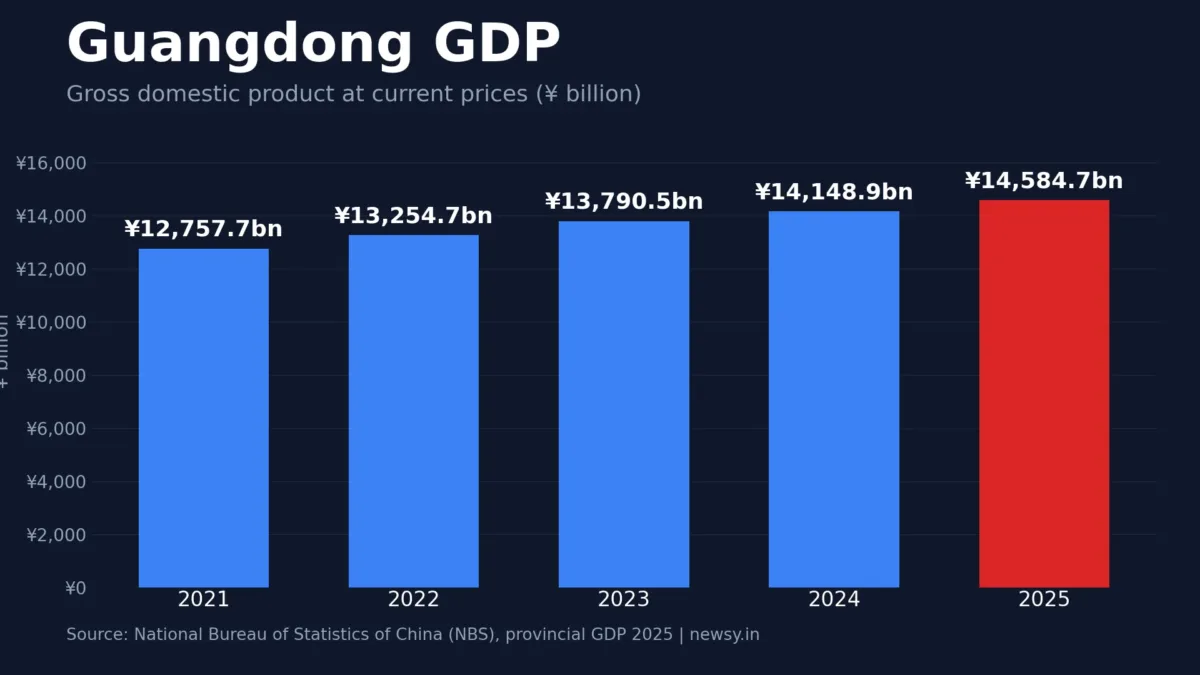
Guangdong GDP reached ¥14,584.68 billion ($2.04 trillion) in 2025, keeping Guangdong the largest provincial economy in China for the 37th consecutive year. The figure, from the National Bureau of Statistics of China (NBS), is 10.40% of everything China produced — but the lead has never looked thinner. Guangdong grew 3.9% in real terms in 2025, the slowest growth of any of the eight largest provinces and below the national rate of 5.0%, while Jiangsu, in second place, closed to within ¥349.53 billion.
| GDP, current prices (2025) | ¥14,584.68 billion ($2,041.84 billion) |
| GDP, current prices (2024) | ¥14,148.89 billion ($1,980.83 billion) |
| Real growth (2025) | 3.9% |
| Nominal change (2025) | 3.08% |
| Added in 2025 | ¥435.79 billion |
| Population (mid-2025) | 128.20 million |
| GDP per capita (2025) | ¥113,769 ($15,928) |
| Per capita rank (of 31) | 7th |
| Rank by GDP (of 31) | 1st |
| Share of China GDP | 10.40% |
Some terms, explained simply. GDP is the total value of goods and services produced in a province. The headline figure is at current prices, which includes the effect of rising prices. Real growth strips out price rises, so it shows how much the economy actually expanded. GDP per capita divides output by population — a rough picture of average output per person, not average income.
Guangdong GDP growth in 2025: the lead is narrowing
In money terms, Guangdong added ¥435.79 billion of output in 2025, rising from ¥14,148.89 billion to ¥14,584.68 billion — the fourth-largest money addition in the top eight, behind Jiangsu, Shandong and Zhejiang. Over five years the economy has grown 14.3%, from ¥12,757.7 billion in 2021 to ¥14,584.7 billion in 2025, also the slowest five-year rise in the group. The drag is well documented: a property downturn that began in 2022 and pressure on the province’s sprawling export sector from overseas volatility. Provincial officials have pointed to an artificial intelligence boom and less reliance on property investment as the route back to faster growth, and the mayor of Shenzhen has said value added in AI, robotics and semiconductors posted double-digit growth last year.
What drives the Guangdong economy
Guangdong is China’s workshop and its tech shopfront at the same time. The province has all 31 major manufacturing categories, and its foreign trade reached ¥9.49 trillion in 2025, up 4.4%, contributing 24.1% of the country’s incremental trade growth — the largest share of any province. Shenzhen is the centre of the tech story, home to Huawei, Tencent and DJI, while BYD, also based in Shenzhen, overtook Tesla in 2025 to become the world’s top electric vehicle seller. Exports of chip-making equipment, electric vehicles, lithium batteries and solar products together hit a record high of more than ¥1 trillion in 2025. Guangzhou, the provincial capital, plays a different role: its service sector accounts for more than 70% of the city’s economy, and its retail sales passed ¥1.1 trillion for a third straight year. Fifty-four Guangdong companies made China’s Top 500 Enterprises list in 2025, and the Shenzhen-Hong Kong-Guangzhou area is ranked the world’s top innovation cluster.
Guangdong GDP per capita
At ¥113,769 ($15,928), Guangdong’s GDP per person ranks 7th of China’s 31 provinces, above the national average of ¥99,665 but far below Jiangsu’s ¥167,040. The gap between Guangdong’s size ranking (first) and its per capita ranking (seventh) is the story of a province whose economy is huge because so many people live and work there — 128.20 million, more than any other province — rather than because each person produces the most. The full NBS release behind these figures is the NBS Statistical Communiqué on 2025 National Economic and Social Development, and China’s place in the world is on the Countries by GDP 2026 ranking.
Neighbouring provinces in the ranking: Jiangsu GDP, Shandong GDP. Compare them on the China provinces by GDP 2025 ranking page, which covers all 31 provinces with the same figures.
Sources: National Bureau of Statistics of China (NBS), provincial GDP 2025 (preliminary data); population from NBS mid-year estimates.
Last updated: 26 November 2026.