Guangxi GDP reached ¥2,972.74 billion ($416.2 billion) in 2025, making the Guangxi Zhuang Autonomous Region the 19th-largest provincial economy in China and 2.12% of all Chinese output. The region grew 5.1% in real terms — above the national rate of 5.0% — and with 50.06 million people it is the most populous province in this group, according to the National Bureau of Statistics (NBS).
| GDP, current prices (2025) | ¥2,972.74 billion ($416.18 billion) |
| GDP, current prices (2024) | ¥2,869.41 billion ($401.71 billion) |
| Real growth (2025) | 5.1% |
| Nominal change (2025) | 3.60% |
| Population (mid-2025) | 50.06 million |
| GDP per capita (2025) | ¥59,384 ($8,314) |
| Rank among 31 provinces | 19th |
| GDP per capita rank | 29th of 31 |
| Share of China GDP | 2.12% |
Some terms, explained simply. GDP is the total value of goods and services produced in a province. The headline figure is at current prices, which includes the effect of rising prices. Real growth strips out price rises, so it shows how much the economy actually expanded. GDP per capita divides output by population — a rough picture of average output per person, not average income. Dollar figures use the NBS 2025 average exchange rate of 7.1429 yuan to the dollar.
Guangxi GDP growth beat the national rate
In money terms, Guangxi added ¥103.33 billion of output in 2025, rising from ¥2,869.41 billion to ¥2,972.74 billion. The five-year run is steady rather than spectacular: ¥2,531.2 billion in 2021, ¥2,642.0 billion in 2022, ¥2,750.2 billion in 2023, ¥2,869.4 billion in 2024 and ¥2,972.7 billion in 2025 — a rise of 17.4% over four years, with an increase in every year. The region’s economy is still built on farms and factories more than services, and that mix kept it growing while the property-driven provinces slowed. See where China sits globally on the Countries by GDP 2026 ranking.
Sugar, steel and cars: what Guangxi makes
Guangxi’s claim to fame starts in the fields: about two-thirds of all the sugar consumed in China comes from the region, and its fruit output has ranked first in the country for eight consecutive years. The industrial base is broader than the farm stereotype suggests. Guangxi has ten industrial sectors each generating more than ¥100 billion of output, including non-ferrous metals, steel, food processing, paper and timber, petrochemicals, machinery, electric power, automobiles, electronic information and building materials. It ranks first in China for loader and engineered wood panel output, second for internal combustion engines and stainless steel, and seventh for new energy vehicles. The big names are Liuzhou Steel, the machinery maker Liugong, the engine maker Yuchai and SAIC-GM-Wuling, the carmaker based in Liuzhou. The region is also a hub of non-ferrous metals: reserves of nine minerals, including rare earths, antimony, indium and gallium, rank among the top five nationally. And Guangxi is China’s front door to South-East Asia: Nanning hosts the China–ASEAN Expo, and the New International Land–Sea Trade Corridor runs through the region to the Beibu Gulf ports.
Guangxi GDP per capita
At ¥59,384, Guangxi’s GDP per person ranks 29th of the 31 provinces — the lowest GDP per capita in this group of eight provinces, and well below the national average of ¥99,665. The ten-place gap between Guangxi’s size ranking (19th) and its per-capita ranking (29th) is the widest downward gap in this group, and it comes down to population: 50.06 million people share an economy built on farming, sugar, metals and mid-value manufacturing. The full NBS dataset behind these figures is published at NBS Statistical Communiqué on 2025 National Economic and Social Development.
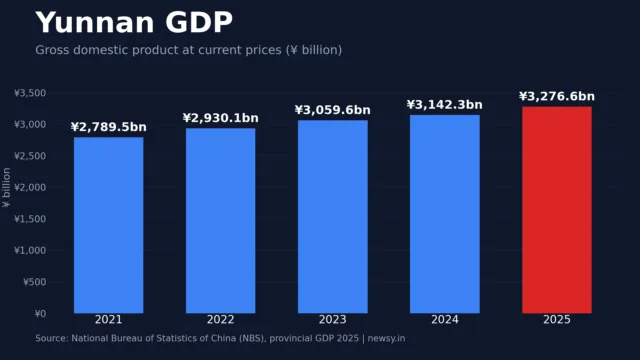
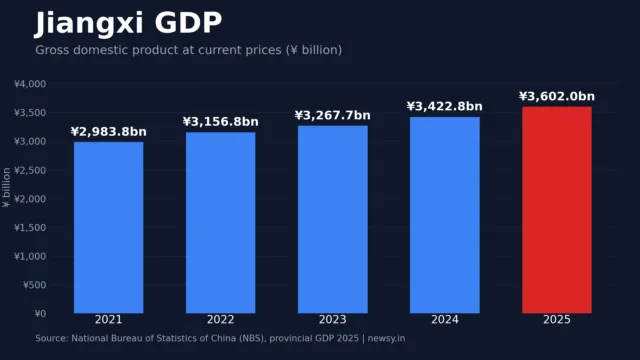
Neighbouring provinces in the ranking: Yunnan GDP, Inner Mongolia GDP, Shanxi GDP. Compare them on the China provinces by GDP 2025 ranking page, which covers all 31 provinces with the same figures.
Sources: National Bureau of Statistics of China (NBS), provincial GDP 2025 (preliminary data); population from NBS mid-year estimates.
Last updated: 26 November 2026.