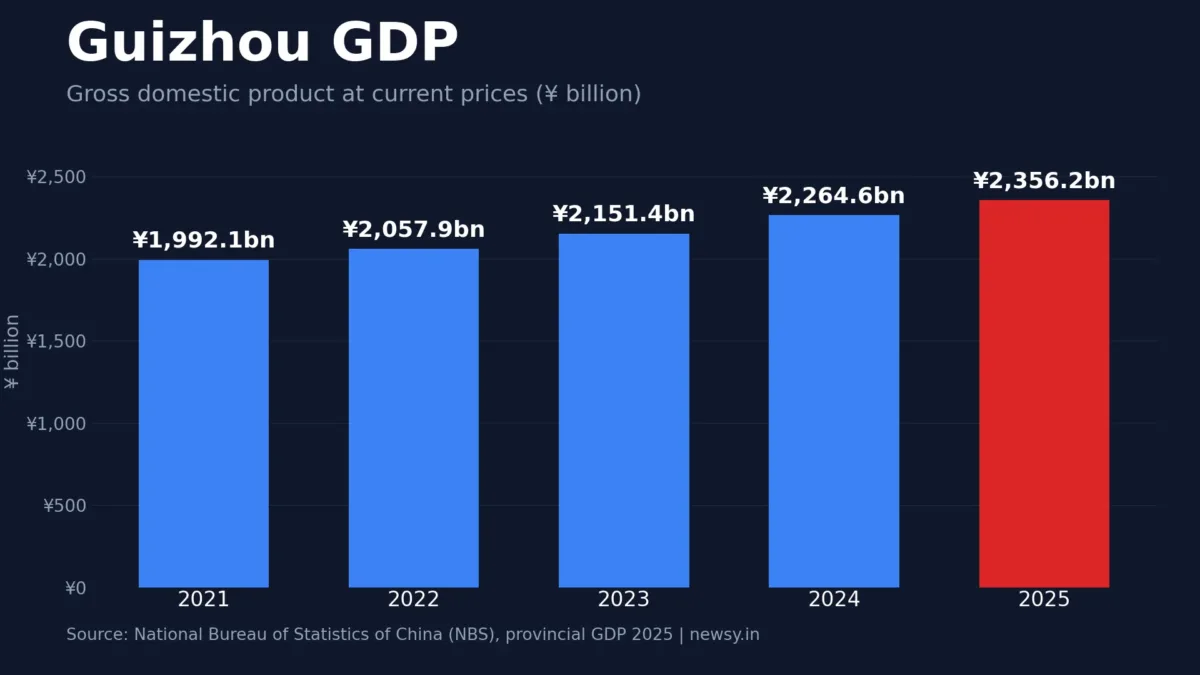
Guizhou GDP reached ¥2,356.22 billion ($329.9 billion) in 2025, making Guizhou the 22nd-largest provincial economy in China and 1.68% of all Chinese output. The mountainous south-western province grew 4.9% in real terms, just short of the national rate of 5.0%, and its economy now rests on two unlikely pillars — the world’s most valuable liquor, and the data centres of China’s tech giants, according to the National Bureau of Statistics (NBS).
| GDP, current prices (2025) | ¥2,356.22 billion ($329.87 billion) |
| GDP, current prices (2024) | ¥2,264.57 billion ($317.04 billion) |
| Real growth (2025) | 4.9% |
| Nominal change (2025) | 4.05% |
| Population (mid-2025) | 38.59 million |
| GDP per capita (2025) | ¥61,066 ($8,549) |
| Rank among 31 provinces | 22nd |
| GDP per capita rank | 28th of 31 |
| Share of China GDP | 1.68% |
Some terms, explained simply. GDP is the total value of goods and services produced in a province. The headline figure is at current prices, which includes the effect of rising prices. Real growth strips out price rises, so it shows how much the economy actually expanded. GDP per capita divides output by population — a rough picture of average output per person, not average income. Dollar figures use the NBS 2025 average exchange rate of 7.1429 yuan to the dollar.
Guizhou GDP growth: steady, not spectacular
In money terms, Guizhou added ¥91.65 billion of output in 2025, rising from ¥2,264.57 billion to ¥2,356.22 billion. The five-year run has been steady: ¥1,992.1 billion in 2021, ¥2,057.9 billion in 2022, ¥2,151.4 billion in 2023, ¥2,264.6 billion in 2024 and ¥2,356.2 billion in 2025 — a rise of 18.3% over four years, with an increase in every year. Guizhou has never been a fast-growth story, and it does not need to be one: its bet is on a small number of high-value industries rather than on scale. See where China sits globally on the Countries by GDP 2026 ranking.
Moutai money and big-data servers
The first pillar is baijiu. Kweichow Moutai, headquartered in Renhuai in Guizhou, is the world’s most valuable liquor maker, and its 2025 revenue of ¥168.84 billion — down 1.2% on the year, its first annual decline since listing in 2001 — is still worth about 7% of the entire province’s GDP. The second pillar is data. Guizhou is China’s first national big-data pilot zone, and its cool climate, cheap hydropower and stable geology have drawn data centres from Apple, Huawei and Tencent and all three national telecom carriers to Gui’an New Area, near the capital Guiyang. The province now has 50 major data centres in operation or under construction, computing services revenue reached ¥82.4 billion in 2025, and the digital and intelligent industries were worth about ¥280 billion, growing 9.8% and employing more than 163,000 people. The Five-hundred-meter Aperture Spherical Radio Telescope — FAST, the world’s largest single-dish telescope — also sits in Guizhou’s mountains.
Guizhou GDP per capita
At ¥61,066, Guizhou’s GDP per person ranks 28th of the 31 provinces — the second-lowest in this group, behind only Guangxi, and well below the national average of ¥99,665. The gap between Guizhou’s size ranking (22nd) and its per-capita ranking (28th) reflects a large rural population of 38.59 million in a province where much of the land is mountain. The full NBS dataset behind these figures is published at NBS Statistical Communiqué on 2025 National Economic and Social Development.
Neighbouring provinces in the ranking: Shanxi GDP, Xinjiang GDP, Tianjin GDP. Compare them on the China provinces by GDP 2025 ranking page, which covers all 31 provinces with the same figures.
Sources: National Bureau of Statistics of China (NBS), provincial GDP 2025 (preliminary data); population from NBS mid-year estimates.
Last updated: 26 November 2026.