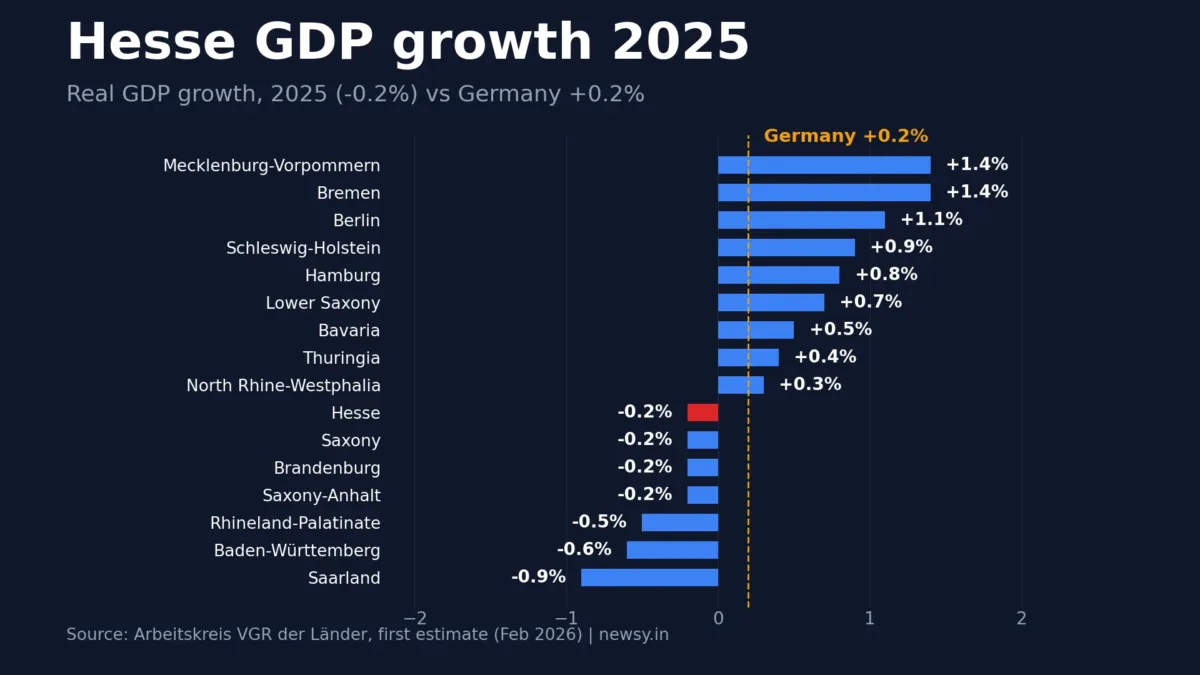
Hesse GDP reached €382,411 million (€382.41 billion) in 2025, making Hesse the fifth-largest state economy in Germany. Hesse accounts for 8.55% of Germany’s economy, but it shrank 0.2% in real terms in 2025, while Germany as a whole grew 0.2%, according to the Arbeitskreis Volkswirtschaftliche Gesamtrechnungen der Länder, first estimate, published on 28 May 2026. Hesse is a small state in central Germany — Wiesbaden is its capital, but Frankfurt am Main, its largest city, is where almost all of its economic weight sits.
| GDP, current prices (2025) | €382,411 million (€382.41 billion) |
| Real growth (2025) | −0.2% |
| Nominal growth (2025) | +3.0% |
| GDP per capita (2025) | €60,567 |
| Rank among 16 states | 5th |
| Share of Germany GDP | 8.55% |
Some terms, explained simply. GDP is the total value of goods and services produced in a state. The headline figure is at current prices, which includes the effect of rising prices. Real growth strips out price rises, so it shows how much the economy actually expanded. GDP per capita divides output by population — a rough picture of average output per person, not average income. Figures are the first estimate for 2025 and may be revised when the Arbeitskreis publishes its next release.
Finance, flights and chemicals drive Hesse GDP
Hesse’s economy is Frankfurt’s economy, and Frankfurt is the financial centre of continental Europe. More than 250 financial institutions are based in the city, including the headquarters of the European Central Bank and the Bundesbank, the Frankfurt Stock Exchange and the Eurex derivatives exchange, and around 72,000 people work in the city’s financial sector. Deutsche Bank, DZ Bank, KfW and Commerzbank are all headquartered there, alongside the European Insurance and Occupational Pensions Authority and the banking supervision arm of the ECB. No other German city comes close to that concentration of financial power.
The second pillar is movement. Frankfurt Airport is Germany’s largest airport, handling around 61.6 million passengers in 2024, and it is the country’s largest single workplace, with around 80,000 direct employees. Frankfurt’s DE-CIX is the world’s largest internet exchange point, and Messe Frankfurt is one of the world’s largest trade-fair companies. Away from Frankfurt, the state’s industry is led by chemicals and pharmaceuticals — the sector accounts for 28.9% of Hesse’s export volume, with Sanofi and Merck among the leading names — and by Opel’s car plant in Rüsselsheim and the optics and precision-engineering cluster around Wetzlar, home to Leica. Wiesbaden, the capital, is the centre of the state’s insurance industry. It is a services-led economy, and in 2025 services were not enough to keep it growing.
Hesse GDP per capita
At €60,567, Hesse’s GDP per person sits well above the national average of €53,482 — the fourth-highest of any state, behind Hamburg (€90,359), Bavaria (€62,212) and Bremen (€61,019). It ranks ahead of Baden-Württemberg (€59,320) and Berlin (€59,233), and far ahead of Lower Saxony (€49,646), its neighbour in the ranking. The figure reflects Frankfurt: a financial centre generates very high output per worker, and the Rhine-Main region around it has the second-highest industrial density in Germany after the Ruhr. Hesse’s problem in 2025 was not prosperity but growth — output per person stayed high while the economy as a whole shrank slightly, a reminder that a rich state can still have a bad year. Germany’s place in the world economy is on the Countries by GDP 2026 ranking.
Neighbouring states in the ranking: Lower Saxony GDP, Berlin GDP. Compare them on the Germany states by GDP 2025 ranking page, which covers all 16 states with the same figures.
Sources: Arbeitskreis Volkswirtschaftliche Gesamtrechnungen der Länder (VGR der Länder), first estimate for 2025, calculation status February 2026, published by IT.NRW in press release 145/26 on 28 May 2026. No population figures are published here: GDP divided by GDP per capita gives inconsistent totals across states, so population is omitted unless verified directly from Destatis. The official state table is published by the Arbeitskreis (IT.NRW), and the national figure by Destatis.
Last updated: 30 November 2026.