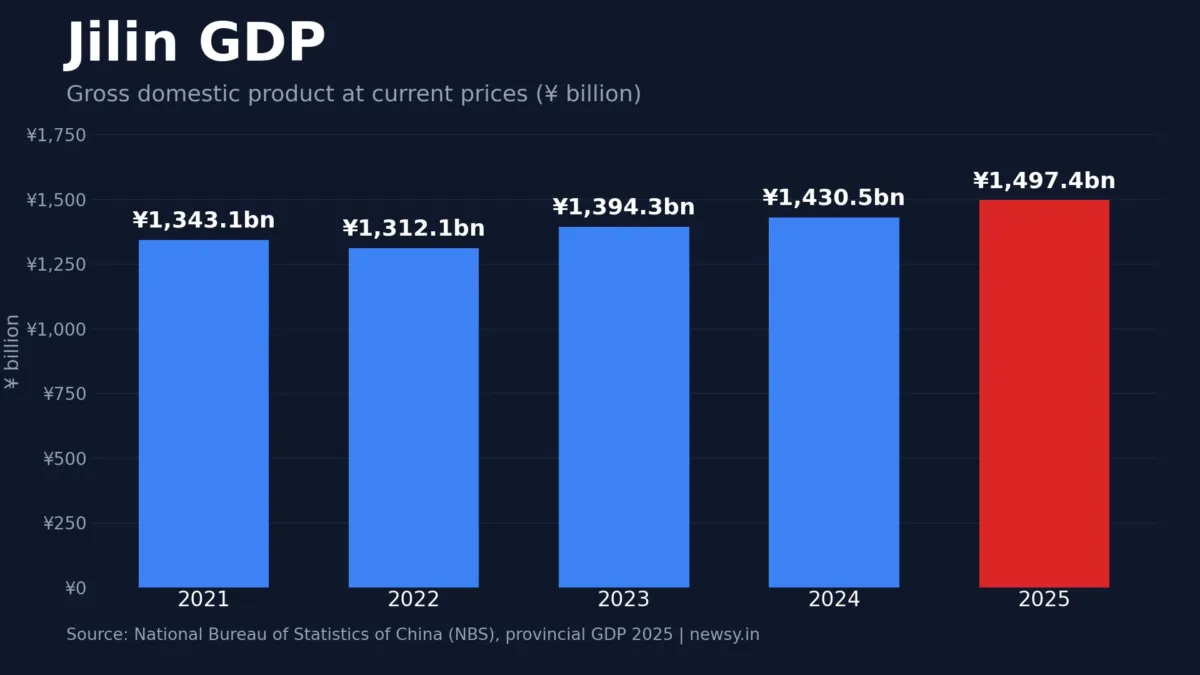
Jilin GDP reached ¥1,497.39 billion (about $209.6 billion) in 2025, making Jilin the 26th-largest provincial economy in China. The figure is 1.07% of China’s total output. The province grew 5.0% in real terms in 2025 — exactly in line with the national rate — according to the National Bureau of Statistics of China (NBS), a solid year for a province whose fortunes rise and fall with the car industry.
| GDP, current prices (2025) | ¥1,497.39 billion ($209.63 billion) |
| GDP, current prices (2024) | ¥1,430.50 billion ($200.27 billion) |
| Real growth (2025) | 5.0% |
| Nominal change (2025) | 4.68% |
| Population (mid-2025) | 23.07 million |
| GDP per capita (2025) | ¥64,906 ($9,087) |
| GDP per capita (2024, approx.) | ¥62,007 ($8,681) |
| Rank among 31 provinces | 26th |
| Rank by GDP per capita | 27th |
| Share of China GDP | 1.07% |
Some terms, explained simply. GDP is the total value of goods and services produced in a province. The headline figure is at current prices, which includes the effect of rising prices. Real growth strips out price rises, so it shows how much the economy actually expanded. GDP per capita divides output by population — a rough picture of average output per person, not average income. Figures are converted to US dollars at the 2025 average rate of 7.1429 yuan per dollar.
Jilin GDP growth in 2025
In money terms, Jilin added ¥66.89 billion of output in 2025, rising from ¥1,430.50 billion to ¥1,497.39 billion — the biggest single-year cash increase of the seven smallest provincial economies. Over five years the economy has grown 11.5%, from ¥1,343.1 billion in 2021 to ¥1,497.4 billion in 2025, though the run was not smooth: output dipped in 2022, to ¥1,312.1 billion, before recovering in each of the three years since. GDP per person rose ¥2,899 in a year, from about ¥62,007 to ¥64,906. Jilin’s population of 23.07 million makes it the smallest of the three northeastern provinces, and its economy is the smallest of the three as well.
Cars are the backbone of Jilin GDP
Jilin is the cradle of China’s car industry. China FAW Group, headquartered in Changchun, the provincial capital, is the country’s oldest carmaker: its First Automobile Works broke ground in 1953 and built China’s first domestically produced vehicle, the Jiefang truck, in 1956, followed by the first Hongqi luxury sedan in 1958. FAW sold 3.3 million vehicles in 2025, with revenue of more than ¥541.5 billion, and its Hongqi brand alone sold over 460,000 cars. The Changchun auto cluster, designated a national advanced manufacturing cluster in 2022, produced ¥461 billion of output in 2024. FAW’s Hongqi Fanrong plant in Changchun turns out a new-energy vehicle roughly every 54 seconds. Alongside cars, Jilin is a major grain province — corn is its leading crop on the same black soil belt as Heilongjiang — and the Changbai Mountains in the southeast draw winter visitors for skiing and hot springs, part of an ice and snow economy the province aims to grow past ¥200 billion.
Jilin GDP per capita
At ¥64,906 ($9,087), Jilin’s GDP per person ranks 27th of the 31 provinces — ahead of its northeastern neighbour Heilongjiang (30th) but behind Liaoning (19th), and still well below the national average of ¥99,665. The per capita figure reflects the province’s make-up: a car industry that is high-value but concentrated in one city, Changchun, and a large farming population elsewhere. The full NBS dataset behind these figures is published at NBS Statistical Communiqué, and China’s place in the world is on the Countries by GDP 2026 ranking.
Neighbouring provinces in the ranking: Heilongjiang GDP, Gansu GDP. Compare them on the China provinces by GDP 2025 ranking page, which covers all 31 provinces with the same figures.
Sources: National Bureau of Statistics of China (NBS), provincial GDP 2025 (preliminary data); population from NBS mid-year estimates.
Last updated: 26 November 2026.