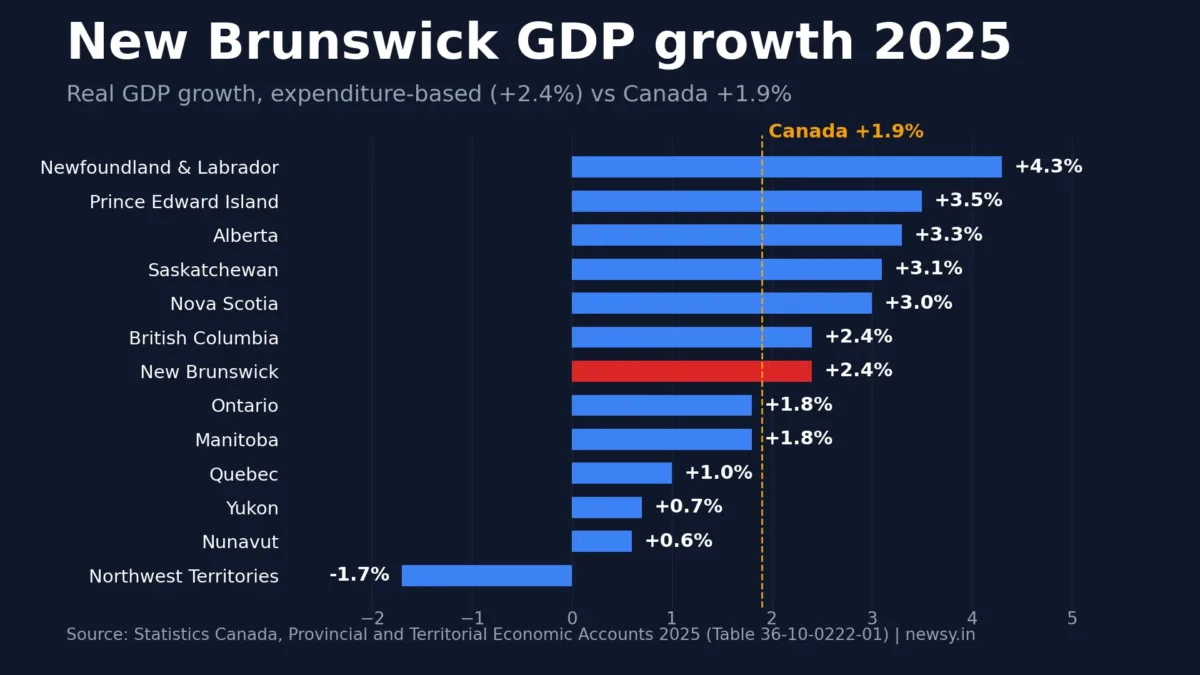
New Brunswick GDP reached C$52.36 billion in 2025, making New Brunswick the 8th-largest provincial economy in Canada. The figure is 1.61% of Canada’s total output of C$3,247.21 billion. The province grew 2.4% in real terms in 2025 — above the national rate of 1.9% — according to Statistics Canada’s Provincial and Territorial Economic Accounts 2025, released on 5 November 2026.
| GDP, current prices (2025) | C$52,357 million (C$52.36 billion) |
| Real growth (2025) | 2.4% |
| Population (1 July 2025) | 874,711 |
| GDP per capita (2025) | C$59,856 |
| Rank among 13 provinces and territories | 8th |
| Share of Canada GDP | 1.61% |
Some terms, explained simply. GDP is the total value of goods and services produced in a province. The headline figure is at current prices, which includes the effect of rising prices. Real growth strips out price rises, so it shows how much the economy actually expanded — measured here in chained 2017 dollars. GDP per capita divides output by population, a rough picture of average output per person, not average income. The figures are preliminary and may be revised by Statistics Canada.
New Brunswick GDP growth in 2025
New Brunswick’s 2.4% real growth in 2025 beat the national rate of 1.9% by half a point — a solid year for the smallest of the three Maritime provinces by output. The province’s economy is anchored in processing industries that turn raw materials into exports: crude oil into refined fuel, trees into lumber and pulp, potatoes into frozen food, and fish into seafood exports. With a population of about 875,000, New Brunswick is the third-smallest province by population, and its growth depends heavily on a handful of large employers and export markets, above all the United States.
Refining, forestry and fries drive New Brunswick GDP
Saint John is home to the Irving Oil refinery, Canada’s largest oil refinery, with crude-processing capacity of more than 320,000 barrels per day, and most of its output is exported to the United States. Forestry is the province’s other old pillar: J.D. Irving and other operators run sawmills, pulp mills and tissue plants across a province where forests cover most of the land, and the sector supports thousands of jobs in small communities. In Florenceville, McCain Foods — the world’s largest manufacturer of frozen potato products — is headquartered, and roughly one in four french fries eaten worldwide is a McCain fry. Lobster and snow crab lead a seafood sector that ships around the world, and Port Saint John is Eastern Canada’s largest port by tonnage. New Brunswick is also Canada’s only officially bilingual province, and its capital is Fredericton, with Saint John and Moncton as the main commercial centres.
New Brunswick GDP per capita
At C$59,856, New Brunswick’s GDP per person is the lowest of any province in Canada. Output per person trails the national average of C$78,041 by a wide margin, reflecting an economy built on resource processing and manufacturing in small communities, with a smaller share of high-value services than the big-city provinces. The full dataset behind these figures is published by Statistics Canada, Table 36-10-0222-01, and Canada’s place in the world is on the Countries by GDP 2026 ranking.
Elsewhere in the ranking: Nova Scotia GDP, Newfoundland and Labrador GDP. Compare them on the Canada provinces by GDP 2025 ranking page, which covers all 13 provinces and territories with the same figures.
Sources: Statistics Canada, Provincial and Territorial Economic Accounts 2025 (Table 36-10-0222-01, released 5 November 2026); population from Statistics Canada July 1, 2025 estimates.
Last updated: 27 November 2026.