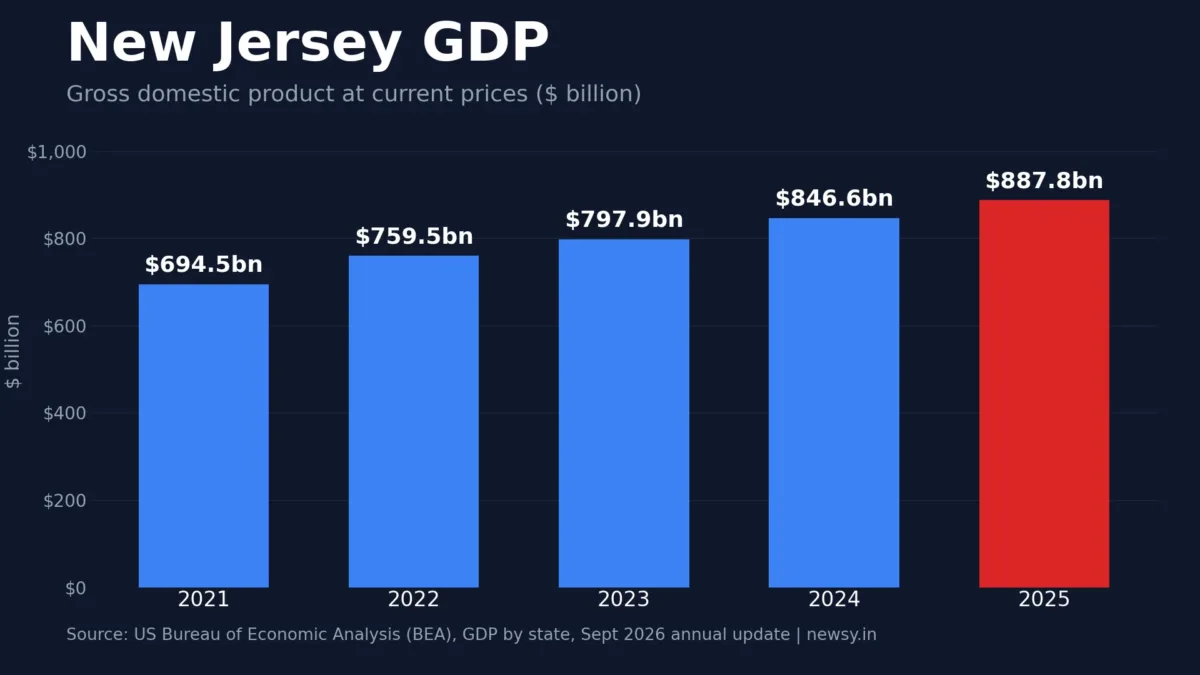
New Jersey GDP reached $887.79 billion in 2025, the 11th-largest state economy in the United States and 2.9% of all US output. The state grew 2.0% in real terms in 2025, according to the US Bureau of Economic Analysis (BEA). New Jersey is the smallest state in the top ranks by area and the most densely populated in the country — its economy is built on being between New York and Philadelphia, with the drug makers, the port and the warehouses that geography makes possible.
| GDP, current prices (2025) | $887.79 billion |
| GDP, current prices (2024) | $846.57 billion |
| Real GDP, chained 2017 dollars (2025) | $688.76 billion |
| Real growth (2025) | 2.0% |
| Nominal change (2025) | 4.9% |
| Population (2025) | 9,548,215 |
| GDP per capita (2025) | $92,980 |
| GDP per capita (2024) | $89,053 |
| Rank among 50 states | 11th |
| Share of US GDP | 2.9% |
Some terms, explained simply. GDP is the total value of goods and services produced in a state. The headline figure is at current prices, which includes the effect of rising prices. Real growth strips out price rises, so it shows how much the economy actually expanded. GDP per capita divides output by population — a rough picture of average output per person, not average income.
The Medicine Chest of the World
If New Jersey has a signature industry, it is pharmaceuticals. Johnson & Johnson is headquartered in New Brunswick, Merck in Rahway and Bristol Myers Squibb in Princeton, and the state’s economic development agency says eight of the ten largest pharmaceutical companies have a home in New Jersey. The cluster runs along the Route 1 corridor from Princeton to New Brunswick — nicknamed “Einstein Alley” — and is anchored by Rutgers and Princeton universities. Life sciences employs about 84,000 workers in the state, and the pay is far above the state average. The BEA industry split shows the broader shape: finance, insurance and real estate is the largest slice at 22.1% ($196.54 billion), professional and business services adds 16.0% — the highest professional-services share among the ten largest states — and health care and education 9.8%.
The port and the warehouses behind New Jersey GDP
The second pillar is logistics. The Port of New York and New Jersey is the largest container port on the East Coast and the third-busiest in the United States, and combined container volume through the port complex exceeded 9.2 million TEUs in 2025 — a record. Behind the port sits a warehouse belt that has expanded by roughly half since 2014, and the state’s largest employers by headcount are the logistics and health giants: Amazon at about 43,000 New Jersey workers, RWJBarnabas Health at about 43,000 and the Wakefern food cooperative at about 39,700. Newark adds a third hub: Prudential Financial is headquartered there, and the Hudson waterfront across from Manhattan holds banks and asset managers that treat Jersey City as a second financial centre. In money terms, New Jersey added $41.23 billion of output in 2025, and over five years the economy has grown 27.8%, from $694.5 billion in 2021 to $887.8 billion in 2025.
New Jersey GDP per capita
At $92,980, New Jersey’s GDP per person ranks 12th among the states, up from $89,053 in 2024. That is a strong per capita figure for a state whose total economy ranks 11th, and it reflects the high-value work in the state: drug research, finance and professional services pay far above the national average. The full BEA dataset is published at BEA GDP by state, and the United States’ global position is on the Countries by GDP 2026 ranking.
Neighbouring states in the ranking: Washington GDP, Georgia GDP. Compare them on the US states by GDP 2025 ranking page, which covers all 50 states with the same figures.
Sources: US Bureau of Economic Analysis (BEA), GDP by state, table SAGDP1, annual update released 30 September 2026; population from BEA table SAINC1.
Last updated: 25 November 2026.