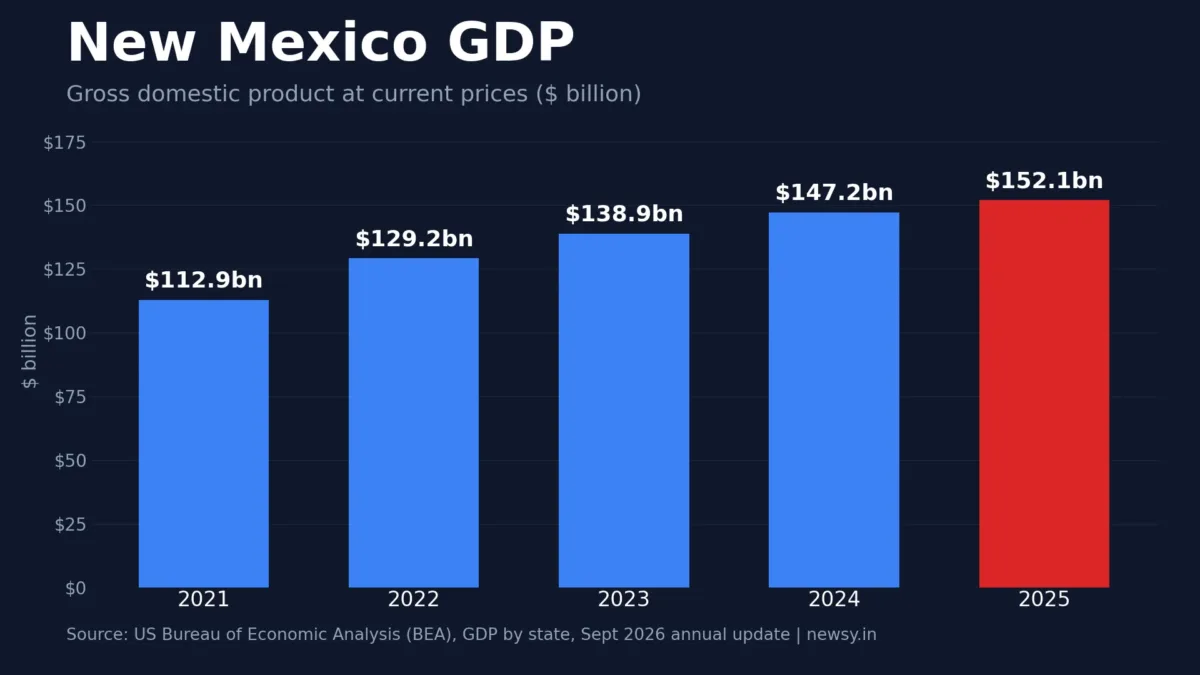
New Mexico GDP reached $152.1 billion in 2025, ranking the state 37th among the 50 states. The US Bureau of Economic Analysis (BEA) figure is up from $147.2 billion in 2024, a nominal rise of $4.9 billion, or 3.3%. New Mexico produces 0.5% of total US output. The full ranking is on our US states by GDP 2025 page.
| Measure | Figure |
|---|---|
| GDP 2025 (current prices) | $152.1 billion |
| GDP 2024 | $147.2 billion |
| Rank among US states | 37 of 50 |
| Share of US GDP | 0.5% |
| Real GDP 2025 (chained 2017 dollars) | $122.6 billion |
| Real growth 2025 | +1.8% |
| Nominal change 2025 | +3.3% |
| Population 2025 | 2,125,498 |
| GDP per capita 2025 | $71,569 |
| GDP per capita 2024 | $69,214 |
GDP trend, 2021-2025
| Year | GDP |
|---|---|
| 2021 | $112.9 billion |
| 2022 | $129.2 billion |
| 2023 | $138.9 billion |
| 2024 | $147.2 billion |
| 2025 | $152.1 billion |
A federal economy: labs, bases and the Permian
New Mexico is the most federal of state economies. Government and government enterprises produced 21.5% of GDP in 2025 — the largest government share of any state in this group, and one of the largest in the country. The reason is a cluster no other state can match: Los Alamos National Laboratory and Sandia National Laboratories, which together employ more than 25,000 people, most of them scientists and engineers, plus Kirtland Air Force Base in Albuquerque, White Sands Missile Range and Holloman Air Force Base. Los Alamos spent nearly $3 billion in New Mexico in fiscal 2025 and planned to hire 800 to 1,000 more people in fiscal 2026.
Finance, insurance, real estate, rental and leasing is second at 15.8% of GDP. Mining, quarrying, and oil and gas extraction is third at 12.3%, professional and business services fourth at 11.5% and education, health care and social assistance fifth at 7.9%.
Oil pays the bills in Santa Fe
The other half of New Mexico’s economy sits in the southeast corner, over the Permian Basin. Lea and Eddy counties produce oil from some of the most productive shale fields in the world, and in 2024 New Mexico became the nation’s second-largest crude oil-producing state, after Texas, accounting for 15% of all US crude output. Production reached a record of just over 2 million barrels a day in 2024, nearly six times the level of a decade earlier, according to the US Energy Information Administration.
That boom funds the state government to an unusual degree: oil and gas revenue supplied close to half of New Mexico’s general fund in fiscal 2024. It is a windfall with a catch — when oil prices fall, the state’s budget falls with them, and the 2025 figures already show the strain, with the smallest nominal GDP gain of any state in this group.
There are other bets on the table. Intel is spending $3.5 billion expanding its Rio Rancho campus into what is planned to be the largest advanced chip-packaging facility in the United States, and Santa Fe and Taos draw a film and arts economy built on the state’s tax credits and desert light. But for now, New Mexico’s economy is what its two poles make it: federal science in the north, oil in the southeast.
New Mexico GDP per capita and growth
GDP per person in New Mexico was $71,569 in 2025, up from $69,214 in 2024, a rise of $2,355, ranking 41st of the 50 states. The population edged down slightly, to about 2.13 million — one of the few states where the population fell in 2025. Real GDP grew 1.8% in 2025, to $122.6 billion in chained 2017 dollars, and over five years the economy has grown 34.7% in current dollars, from $112.9 billion in 2021, driven almost entirely by the Permian boom.
Among its neighbours in the ranking, New Mexico sits between Mississippi GDP, Idaho GDP, New Hampshire GDP. See the full list on our US states by GDP 2025 page, and how the United States compares with the world’s largest economies.
Sources: US Bureau of Economic Analysis (BEA), GDP by state, table SAGDP1, annual update released 30 September 2026; population from BEA table SAINC1.
Last updated: 25 November 2026.