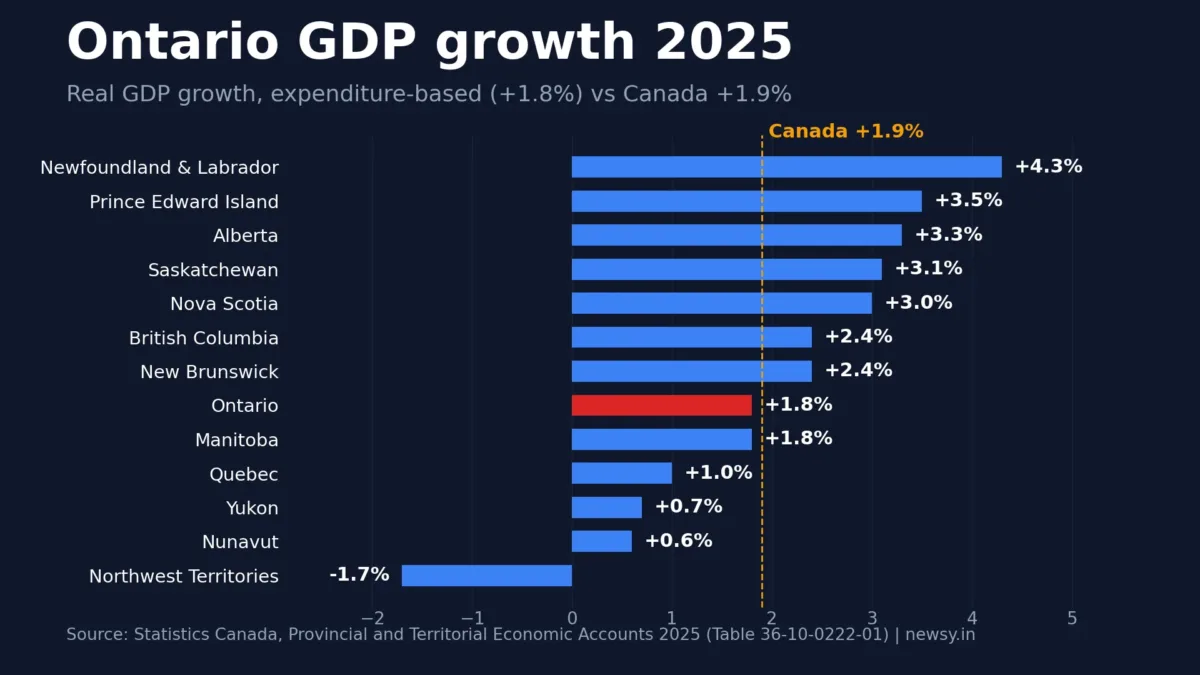
Ontario GDP reached C$1,258,597 million (C$1.26 trillion) in 2025, making Ontario the largest provincial economy in Canada by a wide margin. Ontario accounts for 38.76% of Canada’s entire economy — more than Quebec and Alberta combined — and grew 1.8% in real terms in 2025, according to Statistics Canada’s Provincial and Territorial Economic Accounts, released on 5 November 2026. With 16,216,961 people, Ontario is also Canada’s most populous province, home to nearly two in five Canadians.
| GDP, current prices (2025) | C$1,258,597 million (C$1.26 trillion) |
| Real growth (2025) | +1.8% |
| Population (1 July 2025) | 16,216,961 |
| GDP per capita (2025) | C$77,610 |
| Rank among 13 provinces and territories | 1st |
| Share of Canada GDP | 38.76% |
Some terms, explained simply. GDP is the total value of goods and services produced in a province. The headline figure is at current prices, which includes the effect of rising prices. Real growth strips out price rises, so it shows how much the economy actually expanded. GDP per capita divides output by population — a rough picture of average output per person, not average income. Figures are preliminary and may be revised when Statistics Canada publishes its next release.
Toronto finance and services drive Ontario GDP
Ontario’s economy is built first on services, and Toronto is its engine. Toronto is Canada’s largest financial centre, home to the Toronto Stock Exchange and the operational headquarters of the country’s five largest banks — Royal Bank of Canada, Toronto-Dominion, Bank of Nova Scotia, Bank of Montreal and Canadian Imperial Bank of Commerce — all clustered in the Bay Street financial district. Finance, insurance, professional services and technology together form the largest part of the province’s output, and the Toronto-Waterloo corridor has become one of North America’s densest concentrations of technology companies, anchored by the University of Waterloo and a large pool of software talent. The provincial capital, Toronto, is also Canada’s largest city and the headquarters of many of the country’s biggest corporations, which is why Ontario’s economy looks so different from the resource-led economies of the west: it earns its living mainly by selling services, not by extracting resources.
Manufacturing and mining round out Ontario GDP
Manufacturing remains Ontario’s second pillar. Auto plants in southern Ontario — around Windsor, Oshawa and the Greater Toronto Area — form the heart of Canada’s vehicle industry, built on a century of integration with the Detroit car industry across the border. The province also makes food products, chemicals, machinery and steel, much of it in the industrial cities along Lake Ontario and Lake Erie. In the north, mining adds a very different kind of output: the Canadian Shield around Sudbury and Timmins produces nickel, copper, gold and other minerals, and Sudbury is one of the world’s great nickel-mining centres. Agriculture matters too, particularly in the farmland of southwestern Ontario, but it is a small share of an economy dominated by services and manufacturing. That mix is why Ontario grew at 1.8% in 2025 — close to the national rate of 1.9% — rather than at the faster pace of the energy-led west or the slower pace of Quebec.
Ontario GDP per capita
At C$77,610, Ontario’s GDP per person sits just below the national average of C$78,041, despite the province producing the largest total economy in the country. The reason is population: 16.2 million people share the output, so per capita output is middling even though the total is enormous. Ontario ranks well behind Alberta (C$96,001) and British Columbia (C$78,574) on this measure, and ahead of Quebec (C$71,426). Canada’s place in the world economy is on the Countries by GDP 2026 ranking.
Neighbouring provinces in the ranking: Quebec GDP, Alberta GDP. Compare them on the Canada provinces by GDP 2025 ranking page, which covers all 13 provinces and territories with the same figures.
Sources: Statistics Canada, Provincial and Territorial Economic Accounts 2025 (Table 36-10-0222-01, released 5 November 2026); population from Statistics Canada July 1, 2025 estimates. The official data table is published by Statistics Canada (Table 36-10-0222-01).
Last updated: 27 November 2026.