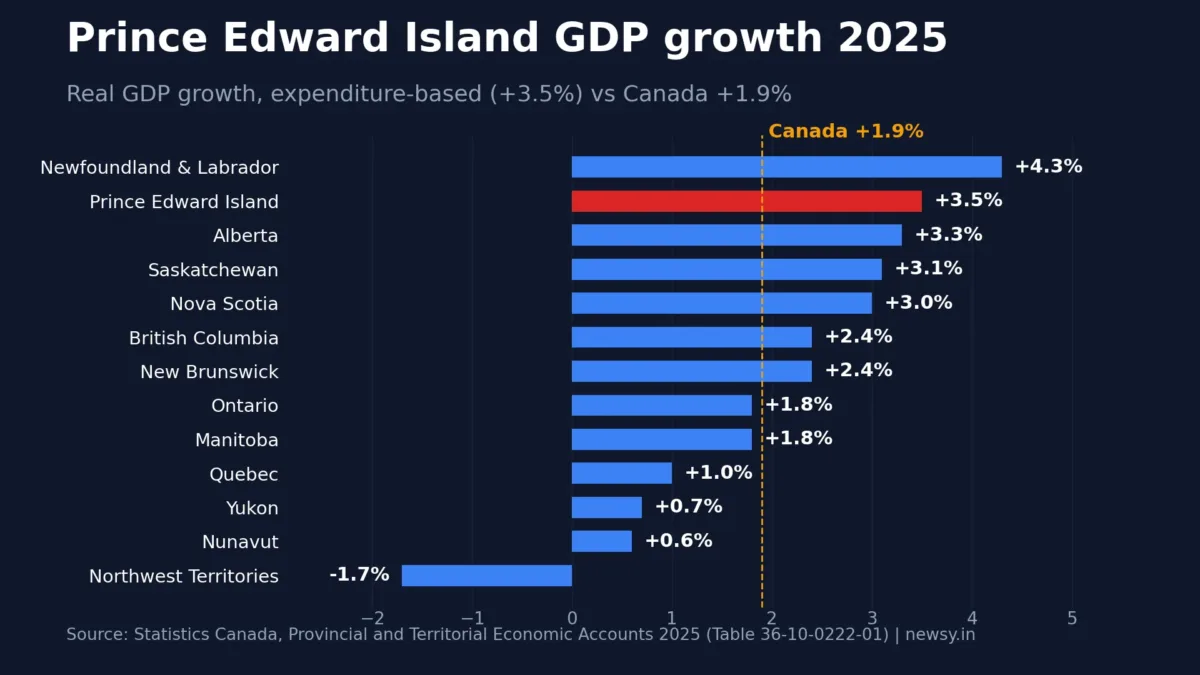
Prince Edward Island GDP reached C$11.47 billion in 2025, making Prince Edward Island the 10th-largest provincial economy in Canada — and the smallest of the ten provinces. The figure is 0.35% of Canada’s total output of C$3,247.21 billion. The province grew 3.5% in real terms in 2025 — well above the national rate of 1.9% — according to Statistics Canada’s Provincial and Territorial Economic Accounts 2025, released on 5 November 2026.
| GDP, current prices (2025) | C$11,469 million (C$11.47 billion) |
| Real growth (2025) | 3.5% |
| Population (1 July 2025) | 181,594 |
| GDP per capita (2025) | C$63,157 |
| Rank among 13 provinces and territories | 10th — smallest provincial economy |
| Share of Canada GDP | 0.35% |
Some terms, explained simply. GDP is the total value of goods and services produced in a province. The headline figure is at current prices, which includes the effect of rising prices. Real growth strips out price rises, so it shows how much the economy actually expanded — measured here in chained 2017 dollars. GDP per capita divides output by population, a rough picture of average output per person, not average income. The figures are preliminary and may be revised by Statistics Canada.
Prince Edward Island GDP growth in 2025
Prince Edward Island’s 3.5% real growth in 2025 was the second-fastest among the ten provinces, behind only Newfoundland and Labrador’s 4.3%. For Canada’s smallest province, that is a strong year: the island’s economy is built on farming, fishing and visitors, and all three are sensitive to seasons and to demand from the rest of Canada and the United States. With a population of about 182,000 — the smallest of any province — even modest dollar gains translate into fast percentage growth.
Potatoes, tourism and seafood drive Prince Edward Island GDP
Prince Edward Island is Canada’s leading producer of potatoes, growing about a quarter of the national crop on the island’s fertile red soil, and potatoes remain the province’s signature industry, feeding processing plants as well as fresh markets. Tourism is the second pillar: visitors come for the red-sand beaches, golf courses and seafood, and for the literary landscape of Anne of Green Gables, whose Green Gables Heritage Place in Cavendish draws fans from around the world. Charlottetown, the capital, is where the 1864 conference that led to Confederation was held, and its historic waterfront anchors the visitor economy. The fishery adds lobster, mussels and oysters, and the island is also building newer sectors in aerospace and bioscience. The Confederation Bridge links the island to the mainland, carrying the visitors and the produce that the economy depends on.
Prince Edward Island GDP per capita
At C$63,157, Prince Edward Island’s GDP per person sits below the national average of C$78,041. The island’s economy is built on farming, fishing and tourism — industries that employ many people at modest output per worker — so per capita output trails the resource-rich western provinces even in a fast-growing year. The full dataset behind these figures is published by Statistics Canada, Table 36-10-0222-01, and Canada’s place in the world is on the Countries by GDP 2026 ranking.
Elsewhere in the ranking: Newfoundland and Labrador GDP, Nunavut GDP. Compare them on the Canada provinces by GDP 2025 ranking page, which covers all 13 provinces and territories with the same figures.
Sources: Statistics Canada, Provincial and Territorial Economic Accounts 2025 (Table 36-10-0222-01, released 5 November 2026); population from Statistics Canada July 1, 2025 estimates.
Last updated: 27 November 2026.