Tibet GDP reached ¥303.19 billion (about $42.4 billion) in 2025, making Tibet the 31st and smallest provincial economy in China. The figure is 0.22% of China’s total output. But Tibet also grew faster than anywhere else in the country: real growth of 7.0% in 2025 was the fastest of all 31 provinces, two points above the national rate, according to the National Bureau of Statistics of China (NBS). It is the smallest economy in China, and the fastest-growing one.
| GDP, current prices (2025) | ¥303.19 billion ($42.45 billion) |
| GDP, current prices (2024) | ¥278.91 billion ($39.05 billion) |
| Real growth (2025) | 7.0% |
| Nominal change (2025) | 8.70% |
| Population (mid-2025) | 3.72 million |
| GDP per capita (2025) | ¥81,502 ($11,410) |
| GDP per capita (2024, approx.) | ¥74,976 ($10,497) |
| Rank among 31 provinces | 31st — smallest in China |
| Rank by GDP per capita | 16th |
| Share of China GDP | 0.22% |
Some terms, explained simply. GDP is the total value of goods and services produced in a province. The headline figure is at current prices, which includes the effect of rising prices. Real growth strips out price rises, so it shows how much the economy actually expanded. GDP per capita divides output by population — a rough picture of average output per person, not average income. Figures are converted to US dollars at the 2025 average rate of 7.1429 yuan per dollar.
Tibet GDP: the fastest growth in China
In money terms, Tibet added ¥24.28 billion of output in 2025, rising from ¥278.91 billion to ¥303.19 billion — nominal growth of 8.7%, the highest of any province. Over five years the economy has grown 41.3%, from ¥214.5 billion in 2021 to ¥303.2 billion in 2025 — by far the fastest five-year rise of the seven smallest provincial economies, and the fastest in China. GDP per person jumped ¥6,526 in a single year, from about ¥74,976 to ¥81,502, the biggest per capita gain in this group. The growth is driven by central-government investment: 2025 marked the 60th anniversary of the Tibet Autonomous Region, and Beijing pledged to step up infrastructure investment, led by state-owned enterprises, with the Yarlung Tsangpo hydropower project and the Sichuan-Tibet Railway at the centre.
Tourism and hydropower drive Tibet GDP
Tourism is the industry visitors see. Lhasa, the capital, draws travellers to the Potala Palace and Jokhang Temple, and the region’s mountains — including Mount Everest from the Tibetan side — and lakes such as Yamdrok and Namtso anchor a tourism sector that has grown year after year. The industry visitors do not see is the one that will shape the next decade: in July 2025 China began construction of the Yarlung Tsangpo hydropower project in Nyingchi, a roughly ¥1.2 trillion investment in five cascade power stations that is set to become the world’s largest hydropower complex, generating up to 300 billion kilowatt-hours a year — about three times the output of the Three Gorges Dam. The Sichuan-Tibet Railway is also under construction, and a new Xinjiang-Tibet Railway project was launched in 2025. Traditional plateau industries — highland barley, yak herding and animal husbandry — still support much of the rural population of 3.72 million.
Tibet GDP per capita
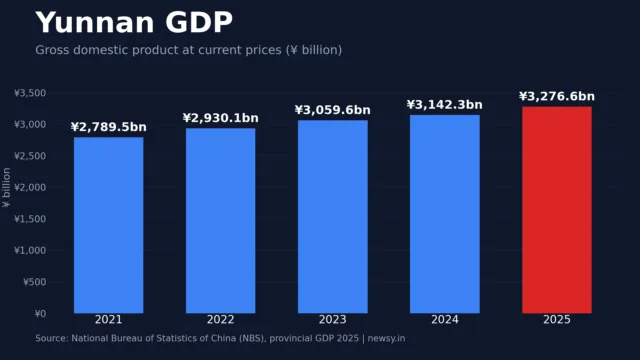
At ¥81,502 ($11,410), Tibet’s GDP per person ranks 16th of the 31 provinces — the best per capita standing of the seven smallest economies, and above the economies of much larger provinces such as Sichuan (17th) and Yunnan (23rd). The contrast with Tibet’s last-place total ranking is the widest in China: a tiny population of 3.72 million, the smallest in the country, shares an economy that is growing at 7% a year and is backed by large-scale central investment. The full NBS dataset behind these figures is published at NBS Statistical Communiqué, and China’s place in the world is on the Countries by GDP 2026 ranking.
Neighbouring provinces in the ranking: Qinghai GDP. Compare them on the China provinces by GDP 2025 ranking page, which covers all 31 provinces with the same figures.
Sources: National Bureau of Statistics of China (NBS), provincial GDP 2025 (preliminary data); population from NBS mid-year estimates.
Last updated: 26 November 2026.