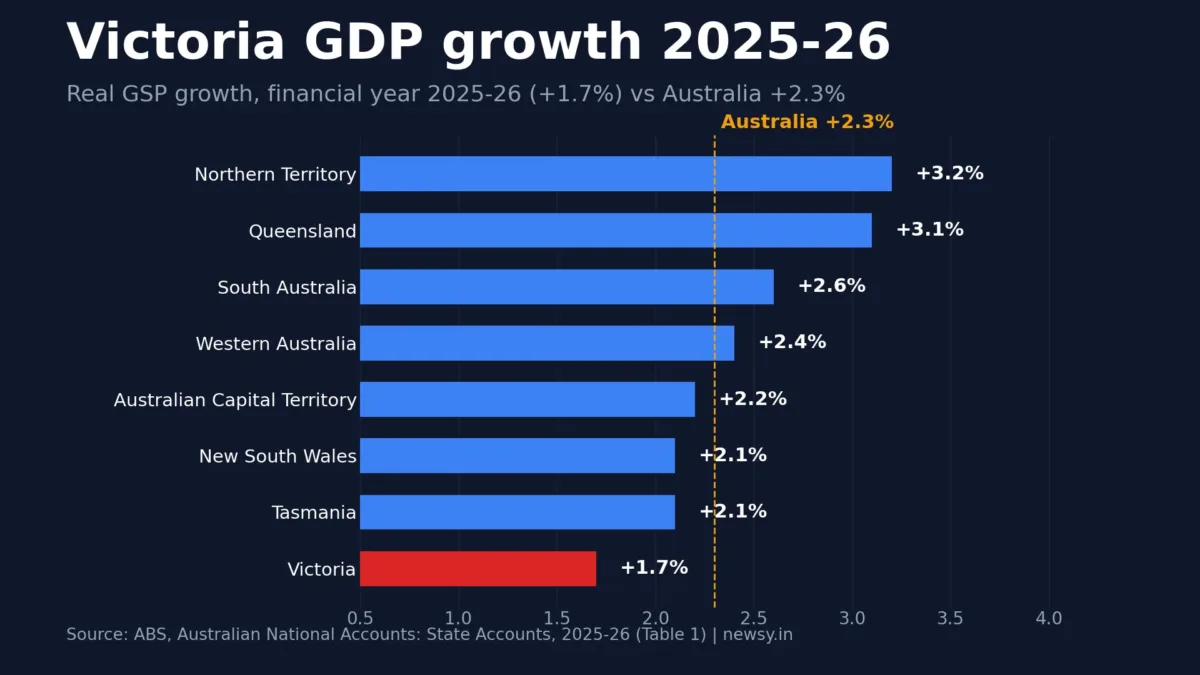
Victoria GDP reached A$674,894 million (A$674.89 billion) in the 2025-26 financial year, making Victoria the second-largest state economy in Australia. Victoria accounts for 22.97% of Australia’s economy — just under a quarter — but it grew only 1.7% in real terms in 2025-26, the slowest growth of any state or territory, according to the Australian Bureau of Statistics’ State Accounts, released on 18 November 2026. With 7,121,915 people, Victoria is Australia’s second-most populous state, and Melbourne is its economic centre.
| GSP, current prices (2025-26 financial year) | A$674,894 million (A$674.89 billion) |
| Real growth (2025-26) | +1.7% |
| Population (implied) | 7,121,915 |
| GSP per capita (2025-26) | A$94,763 |
| Rank among 8 states and territories | 2nd |
| Share of Australia GDP | 22.97% |
Some terms, explained simply. GSP is the total value of goods and services produced in a state or territory. The headline figure is at current prices, which includes the effect of rising prices. Real growth strips out price rises, so it shows how much the economy actually expanded. GSP per capita divides output by population — a rough picture of average output per person, not average income. Figures are the first annual estimates for the 2025-26 financial year and may be revised when the ABS publishes its next release. The ABS notes that state figures are estimates apportioned from the national accounts using indicators, so their accuracy is lower than the national estimates.
Finance, health and education drive Victoria GDP
Victoria’s economy, like New South Wales’, is built first on services. Financial and insurance services grew 4.7% in the 2025-26 financial year, and Melbourne — the state capital and Australia’s second-largest city — is the other half of the country’s financial system, home to major banks, superannuation funds and the headquarters of many large companies. Health care and social assistance grew 2.0%, reflecting the size of Victoria’s hospital and care sector, and education and training grew 2.5%, with Melbourne’s universities drawing large numbers of international students. The drag on the state’s growth came from mining, down 5.8% on weaker oil and gas extraction. That mix explains Victoria’s 2025-26 result: a large, services-led economy that grew slowly, at 1.7%, while the mining-led states of the north and west grew faster.
Victoria GDP per capita
At A$94,763, Victoria’s GSP per person is below the national average of A$105,717, and the lowest of Australia’s four largest states — behind New South Wales (A$105,013) and Queensland (A$98,528) as well as Western Australia (A$155,276). The gap reflects both slower growth and a large population of 7.12 million sharing the output. Victoria’s per-capita growth was flat at 0.0% in 2025-26, which means output per person did not rise at all even though the economy as a whole grew 1.7%. Australia’s place in the world economy is on the Countries by GDP 2026 ranking.
Neighbouring states in the ranking: New South Wales GDP, Queensland GDP. Compare them on the Australia states by GDP 2025 ranking page, which covers all 8 states and territories with the same figures.
Sources: Australian Bureau of Statistics, Australian National Accounts: State Accounts, 2025-26 financial year (Table 1, released 18 November 2026); population implied by nominal GSP divided by the ABS nominal GSP per capita series. The official data is published by the ABS (State Accounts, latest release).
Last updated: 27 November 2026.