A good Rameswaram trip itinerary needs two full days: one for the temple and its rituals, and one for the sea, Dhanushkodi and the island’s other sights. Rameswaram sits on Pamban Island, off the Tamil Nadu coast, and it is one of the holiest towns in India — home to the Ramanathaswamy Temple, one of the twelve Jyotirlingas and one of the four Char Dham pilgrimage sites. It is also a beautiful coastal island, with a new sea bridge, a ghost town at land’s end, and quiet beaches where the Bay of Bengal meets the Indian Ocean.
This two-day plan is built around the temple’s real timings, the distances that actually apply on the island, and the costs you are likely to meet. Prices change, so treat every figure here as a range and check it before you travel.
How to reach Rameswaram
Most travellers come through Madurai. The nearest airport is Madurai International Airport, about 175 km from Rameswaram by road. The drive takes roughly three to four hours, depending on traffic, and runs through Paramakudi and Ramanathapuram before crossing the Pamban road bridge onto the island. Taxis are the usual choice from the airport, and buses also run from Madurai.
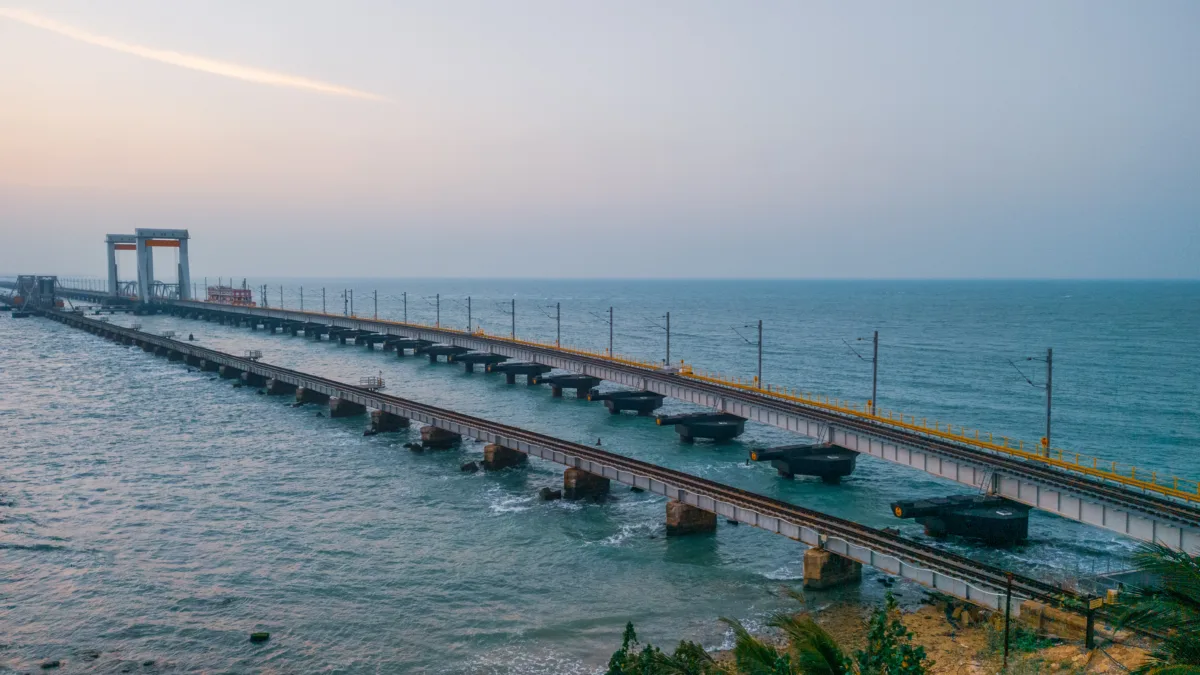
The train is the most memorable way to arrive. Trains run onto Pamban Island again over the new vertical-lift Pamban rail bridge, inaugurated on 6 April 2025 and India’s first vertical lift sea bridge. The new bridge, about 2.08 km long, replaced the old 1914 bridge, closed since December 2022. Daily passenger trains connect Madurai Junction with Rameswaram in about three to three and a half hours, and the Rameswaram–Tambaram Express (16103/16104) links the island directly with Chennai in about eleven and a half hours. Check current train timings on IRCTC before you book.
Once you are on the island, the temple, Agni Theertham and most lodges are close enough to walk between, and autos and taxis cover the rest. If you are combining the trip with Madurai, see our Madurai trip 2-day itinerary.
Best time to visit Rameswaram
The best months are October to March, when the coastal weather is at its most comfortable for temple visits and sightseeing. November to February is the coolest stretch. Summer, from April to June, is hot and humid — if you must come then, do everything early in the morning and rest through the middle of the day.
The north-east monsoon runs roughly from late October into December and can bring heavy coastal rain, so check the forecast before travelling in those weeks. Maha Shivaratri, usually in February or March, draws very large crowds, so expect long queues then unless that is the experience you want.
Day 1 of your Rameswaram trip itinerary: Temple darshan and the 22 theerthams
Start early. The Ramanathaswamy Temple opens at 4 am, and darshan begins at 5 am. The morning session runs until 1 pm, the temple then closes until 3 pm, and evening darshan runs from about 3 pm until the temple closes at 9 pm. The first darshan of the day is the Spatika Linga darshan, from 5 to 6 am, when the crystal lingam is brought out — a counter ticket of about Rs 50 is needed for it. General darshan is free. The temple’s official timings are published on the HR&CE temple website.
The traditional pilgrimage has three steps, and it is worth doing them in order. First, bathe in the sea at Agni Theertham, the shore just in front of the temple, about 200 metres east of the main gopuram. Then come the 22 theerthams — the sacred wells inside the temple — where attendants pour water over you from each well in turn. Theertham bathing runs from 5.30 am to 12.30 pm and again from 3 to 7 pm, and the ticket costs about Rs 25 per person. Allow 45 to 90 minutes for the full circuit, and bring a dry change of clothes, because you go for darshan in dry clothes after the baths.
Inside, worship the Vishwalingam first — the lingam brought by Hanuman — then the main Ramalingam, the sand lingam tradition says Sita made, and then the shrine of Goddess Parvathavardhini. Take your time in the corridors — about 1,200 metres in total, with more than 1,200 carved pillars, the longest temple corridors in India. On a normal day the whole sequence — sea bath, 22 wells and darshan — takes about three to four hours.
After lunch and a rest through the midday closure, spend the afternoon on the smaller temples around town. Gandhamadhana Parvatham, about 3 km from the main temple, is the highest point on Pamban Island. A two-storey mandapam at the top holds Ramar Padam, the footprint of Rama on a chakra, reached by a short climb of about 25 to 30 steps. From the upper level you can see across the island and the sea. Nearby, the Panchamukhi Hanuman Temple, with its five-faced Hanuman idol, is known for the floating stones kept in its courtyard as a reminder of the Setu. If you still have energy, visit Villoondi Theertham, about 7 km from the temple on the road towards Pamban, where a well of sweet water stands in the middle of the sea — tradition says Rama shot an arrow into the sea here to draw fresh water for Sita.
Day 2: Dhanushkodi, Pamban Bridge and the Kalam Memorial
Leave early on day two, because Dhanushkodi is a daytime-only visit. The ghost town lies about 18 to 20 km from Rameswaram town, a drive of 30 to 45 minutes each way. It is open roughly from 6 am to 6 pm, with last entry to the tip usually around 5 pm, and nobody is allowed to stay overnight. The road can be closed altogether when the sea is rough, so ask at your hotel or the checkpost before setting out, especially during the monsoon.
Dhanushkodi was a working port town until a cyclone destroyed it on 22 December 1964. Today you can walk among the ruins of the old church and railway station, and then continue to Arichal Munai, the very tip of the island, where the Bay of Bengal and the Indian Ocean meet. The Kothandaramaswamy Temple, on the Dhanushkodi road, is the one old structure said to have survived the cyclone. There is no entry fee for Dhanushkodi itself. The last stretch to the tip is sand, and local jeeps and vans operate there — a shared ride costs roughly Rs 150 per person, so confirm the arrangement at the checkpost. Allow two to three hours for the whole trip.
On the way back, stop at the Dr A.P.J. Abdul Kalam National Memorial at Pei Karumbu, on the Dhanushkodi road. The memorial, built by the DRDO, honours the former president, who was born in Rameswaram. It holds models of rockets and missiles, photographs and exhibits from his life, and his grave. Entry is free, and it is generally open during daytime hours, commonly listed as 9 am to 5 pm — check the timing on arrival, as published hours vary. Photography inside is not allowed, and shoes must be removed before entering.
Finish the day at the Pamban Bridge. The new rail bridge runs beside the Annai Indira Gandhi road bridge, which has carried road traffic onto the island since 1988. The best views are from the road bridge and the viewpoints near Mandapam, especially in the late afternoon. If you are leaving by the evening train, the crossing over the open sea is a fitting end to the trip. Travellers heading on to Tirupati can follow our Tirupati trip 2-day itinerary for the next leg of the pilgrimage.
Where to stay in Rameswaram
Stay near the temple if you want to walk to the early morning darshan. Budget lodges and guesthouses around the temple generally charge roughly Rs 800 to Rs 2,000 a night, while mid-range hotels run roughly Rs 2,000 to Rs 5,000 a night. Prices rise in the October to March season and on festival weekends, when rooms sell out — book ahead then, and check current rates before you travel.
What to eat in Rameswaram
Rameswaram is a temple town, so vegetarian food dominates around the temple, and it is very good. Start the day with idli, dosa and filter coffee at one of the small eateries on the temple street — most open early for pilgrims. Meals are simple South Indian: rice, sambar, rasam, poriyal and curd. A basic vegetarian meal typically costs roughly Rs 100 to Rs 250 per person.
Near the harbour and the Pamban side of the island you will also find seafood restaurants serving the day’s catch. Carry drinking water for Dhanushkodi and Villoondi Theertham, where there are few shops, and keep some cash handy.
Rameswaram trip cost: a realistic budget
For two people travelling from Madurai, a rough two-day budget looks like this, excluding the journey to Madurai itself. A budget trip — budget stay, buses and autos, temple tickets and simple vegetarian meals — usually works out to roughly Rs 4,000 to Rs 7,000 per person. A comfortable mid-range trip, with a mid-range hotel, a private taxi for local sightseeing and the Dhanushkodi trip, and restaurant meals, usually comes to roughly Rs 9,000 to Rs 15,000 per person.
Behind the totals: a stay of roughly Rs 800 to Rs 2,000 a night at the budget end or Rs 2,000 to Rs 5,000 mid-range; local transport of roughly Rs 1,500 to Rs 4,000 for a taxi covering the island’s sights; temple costs of about Rs 25 for the theertham bath and about Rs 50 for the Spatika Linga darshan, with general darshan free; and food of roughly Rs 300 to Rs 800 a day per person.
Practical tips for your Rameswaram trip
Dress modestly for the temple, and wear traditional clothes if you can — dhotis for men and sarees or salwar suits for women are the norm inside, and shorts and sleeveless tops are best avoided. Mobile phones are not allowed inside the Ramanathaswamy Temple, so leave yours at the hotel or use a cloakroom. Carry a dry change of clothes in a small bag for after the theertham baths.
Plan your day around the temple’s midday closure from 1 to 3 pm, and remember that the sea at Agni Theertham and Dhanushkodi can be rough — do not wade in beyond your depth, and follow the police and local guidance at the Dhanushkodi checkpost. Two days cover the island well — do not squeeze everything into one, as the baths and darshan alone deserve a full morning.