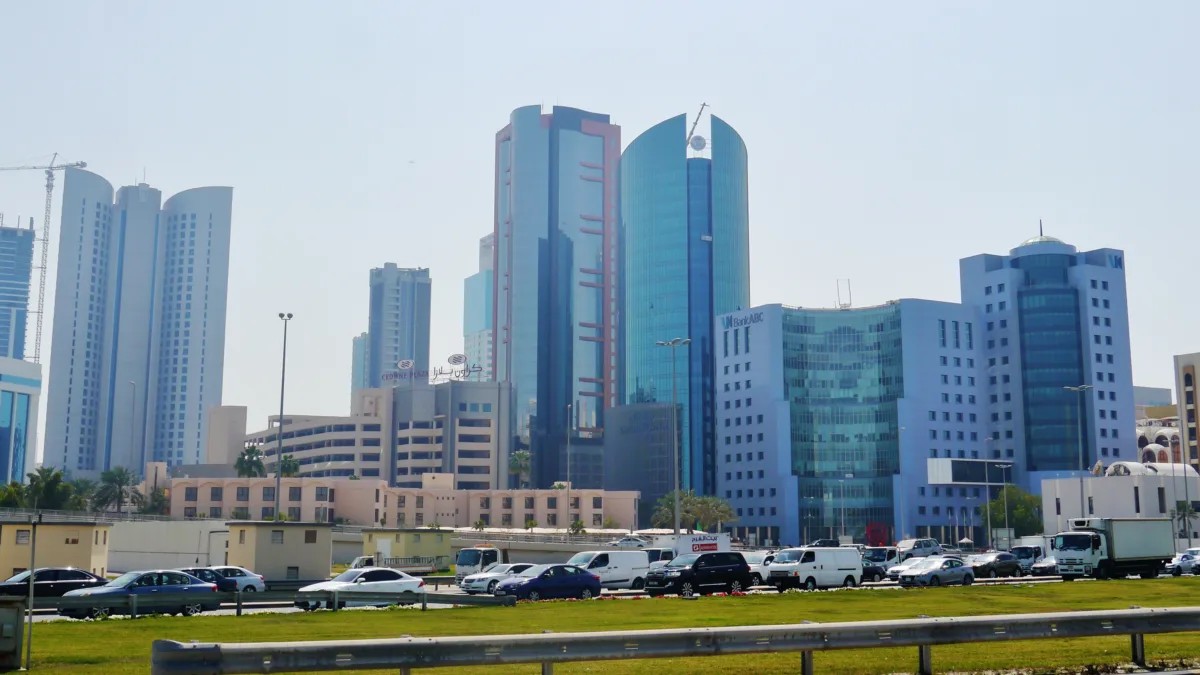
Blasts echoed over Manama, the capital of Bahrain, on Tuesday morning after Iran’s Revolutionary Guards said they had launched drones at a US-operated radar system at Sheikh Isa Air Base — the third Iran drone attack Bahrain has seen in five days.
Bahrain’s state television said the kingdom’s armed forces had intercepted “Iranian aerial attacks in the kingdom’s skies”. The country’s Interior Ministry had earlier sent a mobile phone alert warning residents of a potential threat and urging them to move to the nearest safe location. Bahrain later announced an all-clear.
There was no independent confirmation of any damage to the radar installation, and US authorities had not immediately confirmed Tuesday’s claimed strike or any resulting damage.
01. Iran drone attack Bahrain: what we know so far
Iran’s Islamic Revolutionary Guard Corps (IRGC) said its combat drones carried out a “precision operation” on Tuesday morning, targeting a radar system operated by US forces at Sheikh Isa Air Base, according to a statement published on Sepah News, the Guards’ official website, and carried by Iranian state broadcaster IRIB.
The Guards said the attack was in response to what it called repeated violations of Iranian airspace by US military drones. An AFP journalist in Manama reported hearing blasts over the capital.
Bahrain is home to the US Navy’s Fifth Fleet, and Sheikh Isa Air Base hosts US forces. The base has been the focus of Iranian claims before: on Friday, the IRGC said it had targeted and destroyed a US early-warning radar in Bahrain, a claim the US military rejected. US Central Command said on Friday that its forces had shot down two Iranian attack drones headed for the kingdom, with no injuries and no damage.
02. Third attack in five days
Tuesday’s incident follows a clear pattern. On Friday, 13 November, the IRGC claimed its first strike on a US radar installation in Bahrain, saying it was retaliation for a US strike on a communications tower at Sirik, in southern Iran near the Strait of Hormuz. On Sunday, 15 November, the Guards said they had sent six drones against a US air defence radar at the Al-Riffa helicopter base in Bahrain. Bahrain said its air defences intercepted those drones too.
Each time, the accounts have differed sharply. Iran has claimed successful strikes on US radar systems; Bahrain has said its defences stopped the attacks; and the US has denied that any radar was destroyed. None of the claims about damage has been independently verified.
The attacks come during the US-Israel war on Iran, which began on 28 February 2026, according to Al Jazeera, and has spread across the Gulf. On Monday, two commercial tankers were reported attacked in the Strait of Hormuz, and shipping through the strategic waterway has slowed sharply. A third US aircraft carrier, the USS Theodore Roosevelt, has joined two others in the region.
03. What happens next
Diplomatic efforts have not stopped. Iranian Foreign Minister Abbas Araghchi was travelling to Oman on Tuesday for discussions with Omani officials, and US Vice President JD Vance said on Monday that President Donald Trump would not allow the conflict with Iran to become another “forever war”. There has been no confirmed breakthrough towards ending the fighting.
For readers in the Gulf, the immediate issues are the security alerts, possible flight disruption and oil-market volatility. Brent crude fell to $91.71 a barrel on Tuesday as expectations of increased global supply outweighed concern about the attacks on Gulf shipping.
Newsy will update this story as Bahrain, the United States or Iran release further verified information. Earlier coverage: Bahrain intercepts Iranian drone attacks on US base as Gulf strikes resume and US denies Iran’s claim it destroyed radar in Bahrain. Sources: Al Jazeera and Gulf News.