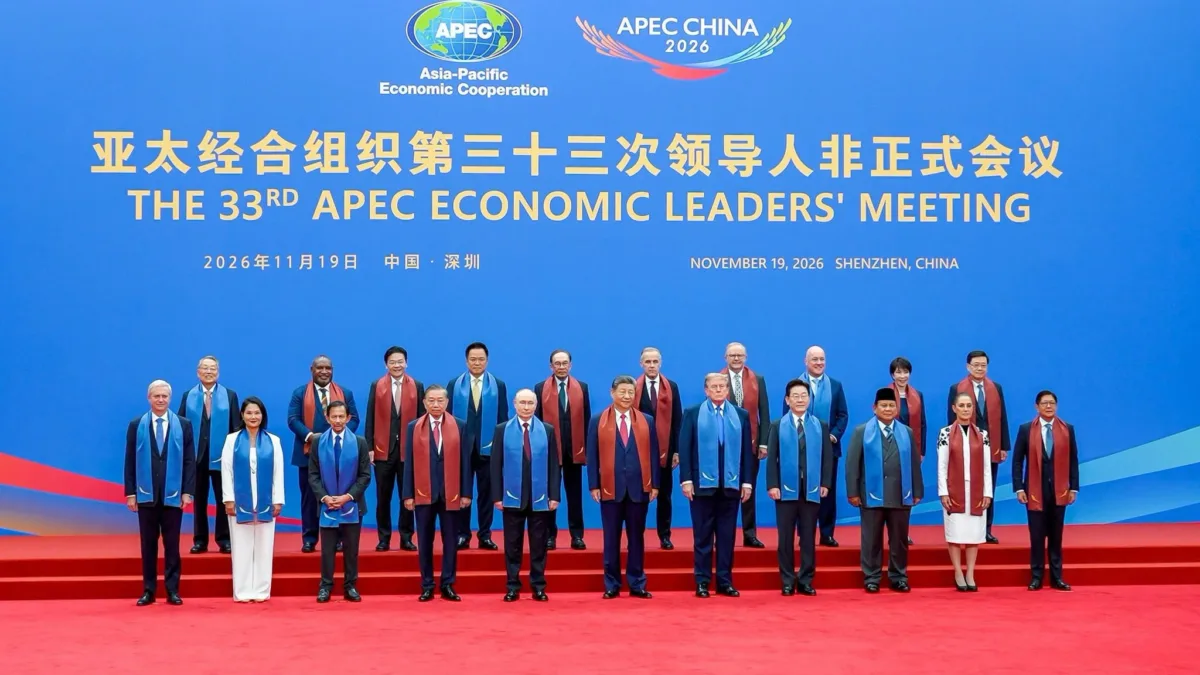
Donald Trump, Xi Jinping and Vladimir Putin have adopted a four-point joint declaration after the first-ever trilateral summit between the leaders of the United States, China and Russia, held in Shenzhen on Thursday, 19 November 2026. The Trump Xi Putin peace declaration, titled “The Russia-China-US Heads of State Declaration Toward Peace”, was published by China’s Xinhua news agency and the Kremlin after about an hour and a half of talks at Kylin Villa on the sidelines of the Asia-Pacific Economic Cooperation (APEC) summit.
The declaration pledges reform of the United Nations, more production and supply of refined petroleum products, respect for the immunity of state officials, and dialogue on reducing nuclear risks. But it contains no mention of Ukraine, no ceasefire terms, and no timelines or mechanisms for putting any of the four pledges into practice.
Trump Xi Putin peace declaration: the four points
The full text of the declaration, as published by Xinhua and reproduced by The National, runs to four numbered points.
1. United Nations reform. As permanent members of the UN Security Council, China, Russia and the United States committed to reform the UN “so that the UN can respond more effectively to global challenges and conform to its fundamental mission of international peace and security”. The text sets out no specific reform plan.
2. Energy. The three countries said they plan to increase the production and supply of refined petroleum products “for the benefit of all nations”, and reaffirmed the importance of stable energy flows. No scale, timeline or mechanism for the increase is given.
3. State immunity and the ICC. The leaders recognised that “the principle of state consent and respect for immunities of State officials are of paramount importance”, and agreed that the International Criminal Court and similar bodies “must not abuse their jurisdiction”. The point matters most for Putin: the ICC issued an arrest warrant for him in March 2023 over the alleged unlawful deportation of Ukrainian children from occupied territory. The warrant itself is not mentioned in the declaration.
4. Nuclear risks. The three heads of state reaffirmed that “a nuclear war cannot be won and must never be fought” and said the three countries “will conduct a dialogue on reducing nuclear risks and preventing the proliferation of nuclear weapons”. The text contains no commitment to cut nuclear arsenals and no date for the dialogue to begin.
What the declaration does not say
Despite its title, the declaration says nothing about Ukraine, a ceasefire, or the terms for ending Russia’s war, according to the Kyiv Independent and other outlets that reviewed the text. It also makes no mention of Iran or the Strait of Hormuz, even though energy supplies and nuclear weapons are both central to the tensions around Iran.
That does not mean Ukraine was not discussed. Putin made clear in his opening remarks that the war would be the focus of his conversation, Al Jazeera reported, and Kremlin aide Yuri Ushakov said it was the main topic of the separate bilateral meeting between Putin and Trump. The Kremlin said before the trilateral session that Ukraine was not a central topic of the three-way talks themselves.
The declaration also sets out no deadlines. As the Economic Times noted, it “did not spell out specific timelines or mechanisms for implementing the commitments” — so for now it is a statement of intent rather than a deal.
How the summit unfolded
The three leaders met at Kylin Villa, a lakeside resort in Shenzhen, sitting at a large round table with the Chinese, American and Russian flags displayed around the room. The session began about two hours behind schedule, with the leaders sitting down just after 3 a.m. Eastern time, Fox News reported.
Opening the meeting, Xi said it “has groundbreaking significance” and that “the world is at peace when great powers live in harmony”, according to Xinhua, as reported by Al Jazeera. Xi also said nuclear weapons “should be comprehensively banned and thoroughly destroyed, building a nuclear-free world”. Trump said the three countries are “uniquely positioned” to discuss nuclear weapons, and told the room: “We are really making history,” according to Fox News.
After brief opening remarks, the leaders retreated behind closed doors. The session lasted about an hour and a half in all, the Kyiv Independent reported. Trump then left the venue immediately, headed for the airport and boarded Air Force One to fly back to Washington, without speaking to reporters. Putin also left Kylin Villa soon after, escorted to his car by Xi, with no comments to the media, according to Russia’s Tass news agency.
Why it matters
The meeting brought together the leaders of the world’s three largest nuclear powers at one table for the first time, on the sidelines of the APEC summit in Shenzhen. Before the talks, analysts quoted by Al Jazeera said the session was unlikely to produce major agreements, given deep differences over Ukraine, Iran, nuclear weapons and trade — and on concrete commitments, that proved largely correct.
What the summit did produce is a shared public text: the three powers now agree, in writing, that a nuclear war cannot be won and must never be fought, and that they will talk about reducing nuclear risks. Whether that dialogue leads anywhere concrete — and whether the UN reform and energy pledges amount to more than words — will only become clear in the weeks ahead. The leaders’ earlier meeting in Shenzhen had been billed as historic before it began; the declaration is the measure of what it actually delivered. For the background to Trump’s arrival in China, see our report on Xi’s airport greeting for Trump.