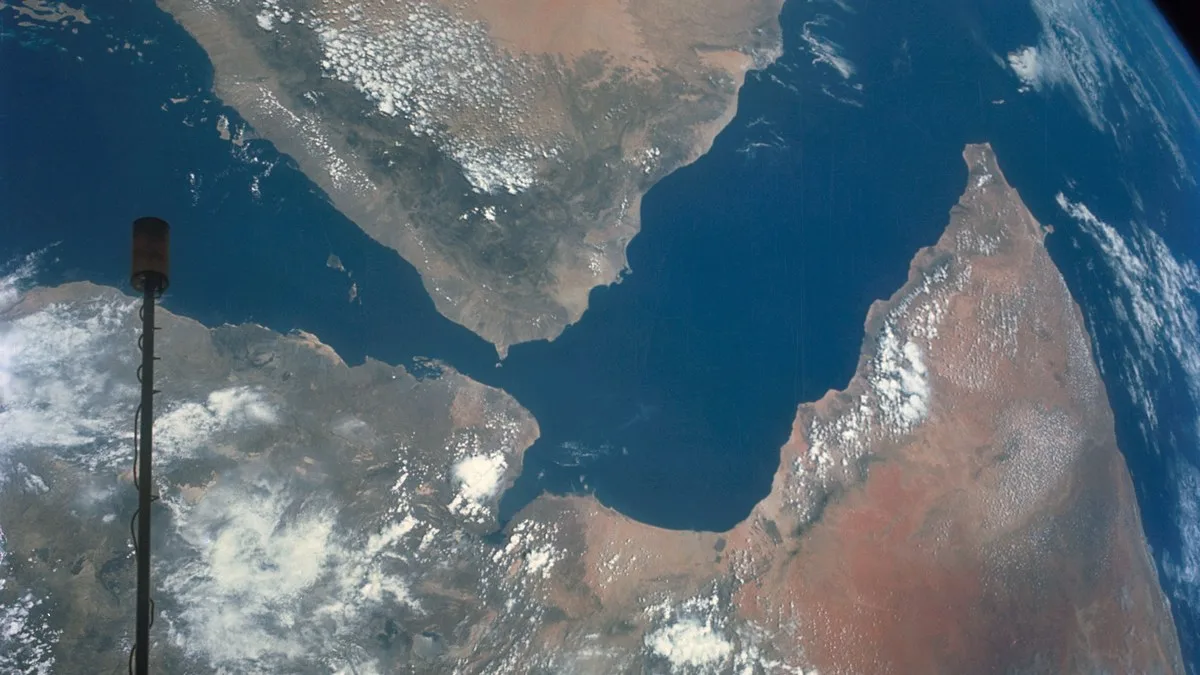
Yemeni government forces have pulled back from the Bab el-Mandeb Strait, leaving the Iran-backed Houthi movement in control of one of the world’s most important shipping chokepoints.
The Southern Armed Forces, the main military force fighting for Yemen’s internationally recognised government in the south, announced on Sunday, 15 November, that it was redeploying troops from Dhubab Airport and the Bab al-Mandeb area, west of Taiz governorate, to defend the interim capital, Aden.
The move ends a six-week government counteroffensive to secure the strait, which the Houthis seized in a surprise offensive in September. Houthi-run media reported later on Sunday that the group had taken control of the territory. Saudi Arabia, the government’s main backer, has not commented.
01. Why the strait matters
The Bab el-Mandeb is the narrow passage at the southern end of the Red Sea, between Yemen on the Arabian Peninsula and Djibouti and Eritrea in the Horn of Africa. It connects the Red Sea to the Gulf of Aden and the Indian Ocean, and most oil and goods travelling between Asia and Europe through the Suez Canal pass through it.
The strait is only 26 kilometres wide at its narrowest point. About 6.2 million barrels of petroleum a day passed through it in 2018, according to US energy data. If shipping through the strait were blocked, tankers from the Persian Gulf would have to sail around the southern tip of Africa, adding days to the journey and pushing up shipping costs.
The Houthis have said they pose no threat to international shipping passing through the waterway, but that they will continue to target vessels from Saudi Arabia.
02. Fighting continues near Aden
The withdrawal does not mean the fighting has stopped. Government forces have redeployed to al-Suqyah, about 150 km west of Aden, and are still trying to push the Houthis from coastal areas nearby, Yemeni military sources told reporters.
On Sunday, a Houthi missile attack killed eight people near Aden and wounded 12 others at a checkpoint in Lahj province, according to Dawn, citing sources. The same report said Houthi fighters had seized two districts in Lahj province and were positioned at the Al-Kharaz camp, about 60 km from Aden.
In a separate development on Sunday, the Houthis released 600 members of Saudi-backed government forces. The International Committee of the Red Cross described it as the largest unilateral prisoner release of the war.
03. What happens next
The situation on the ground remains fluid. The government’s statement did not say how many troops were withdrawn or whether all units had left the Bab el-Mandeb area, and there has been no independent confirmation of the Houthis’ presence at the strait itself.
The retreat raises the prospect of further Houthi advances towards Aden, the base of the internationally recognised government since the Houthis drove it from the capital, Sanaa, more than a decade ago. It also gives the Houthis greater leverage over global shipping at a time when Iran is disrupting traffic through the Strait of Hormuz on the other side of the Arabian Peninsula.
Sources: BBC, The National, Dawn, BusinessWorld.