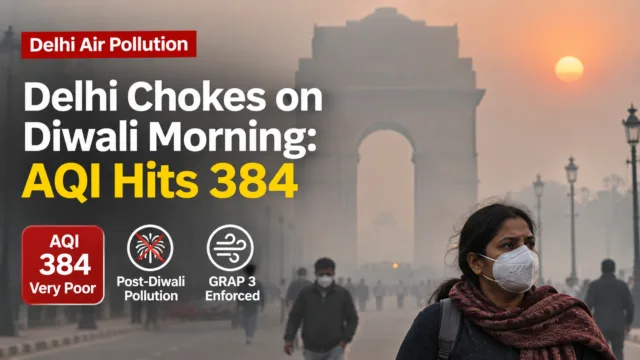
In response to a sharp deterioration in ambient air quality across the National Capital Region (NCR), the Delhi Directorate of Education has issued a mandatory directive requiring all recognized schools—government, aided, and private unaided—to transition classes up to Grade 5 to hybrid mode with immediate effect.
The precautionary emergency measure was enforced after the Commission for Air Quality Management (CAQM) invoked Stage III of the Graded Response Action Plan (GRAP) across Delhi-NCR as the Air Quality Index (AQI) breached the 400-mark into the ‘Severe’ category at multiple monitoring stations including Punjabi Bagh, Jahangirpuri, and Narela. Explore national public infrastructure and fintech developments in our coverage of NPCI Defending UPI MDR Before the Supreme Court.
01. Delhi Air Pollution & GRAP Stage III Emergency Summary
| Parameter | Regulatory & Environmental Detail |
|---|---|
| Air Quality Category | ‘Severe’ (AQI 401–500 across key urban stations) |
| Triggering Regulation | GRAP Stage III invoked by CAQM |
| School Operating Mandate | Mandatory Hybrid Mode for Classes Nursery to 5th (Online + In-Person flexibility) |
| Jurisdiction Covered | Delhi, Noida, Greater Noida, Ghaziabad, Gurugram, Faridabad, and Sonipat |
| Vehicular Restrictions | Strict ban on BS-III petrol and BS-IV diesel four-wheelers across Delhi-NCR |
| Construction Regulations | Complete ban on non-essential demolition, earthwork, trenching, and open RMC plant operations |
| Office Operations | Government offices advised to operate at 50% capacity with work-from-home rotation |
02. Health Precautions & School Compliance Directives
The Directorate of Education emphasized that individual school managements do not have the discretion to waive the hybrid instruction framework:
- Monitoring & District Inspections: Deputy Directors of Education (DDEs) across all administrative zones have been tasked with physical visits to ensure schools offer robust digital infrastructure for primary students remaining indoors.
- Vulnerable Age Group Protection: Pediatric medical advisories warned that elevated particulate matter (PM2.5 and PM10) concentrations cause severe bronchial irritation and acute respiratory distress in children under 10 years of age.
- Festive Season Meteorology: Sub-zero wind speeds, temperature inversions, and seasonal smoke accumulation ahead of Diwali have trapped surface-level particulates, prompting emergency inter-state enforcement.
03. Frequently Asked Questions (FAQ)
Are Delhi schools closed completely due to pollution?
No. Schools are not shut down completely; rather, the Delhi government has mandated a hybrid learning mode for primary classes up to Grade 5, giving parents the option to have children attend classes online.
Which vehicle types are banned under GRAP Stage III in Delhi-NCR?
Under GRAP III, the plying of BS-III petrol and BS-IV diesel light motor vehicles (4-wheelers) is strictly prohibited in Delhi and adjoining NCR districts, carrying a fine of ₹20,000 for violations.
Which cities are covered under the GRAP III hybrid school directive?
The directive applies across the National Capital Region, encompassing Delhi, Gurugram, Faridabad, Noida, Greater Noida, Ghaziabad, and Sonipat.
04. Related NewsY Coverage
Read about economic and digital payment reforms in NPCI Defends UPI MDR Before Supreme Court, explore bilateral defense milestones in Tiger Triumph 2026 Drill Concludes in Visakhapatnam, check cricket retirements in Mohammed Shami Retires from Test Cricket, and track clean tech cooperation in India & EU Conclude Talks on €93.5 Billion Horizon Europe Pact.
05. Sources
- Directorate of Education, Government of NCT of Delhi: Notification on Hybrid Mode Learning for Primary Classes, Old Secretariat, Delhi, November 2026.
- Commission for Air Quality Management (CAQM) & The Times of India: Delhi-NCR Schools Shift to Hybrid Mode Up to Class 5 as AQI Turns Severe; GRAP-3 Invoked, November 2026.
NewsY Environment & Education Desk: Air quality figures, GRAP guidelines, and schooling directives reflect certified releases by CAQM and the Delhi Directorate of Education.