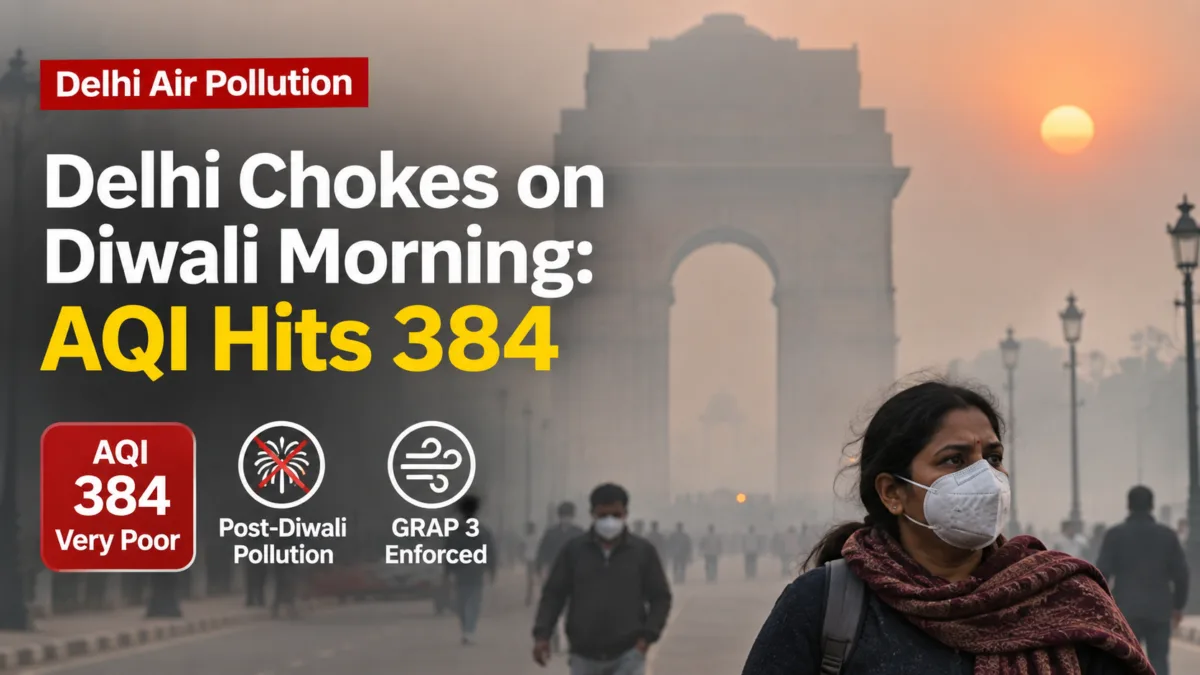
Ambient air quality across the National Capital Region (NCR) deteriorated sharply on Diwali morning, Sunday, 8 November 2026, with Delhi’s 24-hour average Air Quality Index (AQI) touching 384 in the upper ‘Very Poor’ bracket, while key monitoring stations—including Jahangirpuri, Punjabi Bagh, and AIIMS—breached the critical 400-mark into the hazardous ‘Severe’ category.
The worsening atmospheric crisis prompted the Commission for Air Quality Management (CAQM) to enforce strict Stage III restrictions under the Graded Response Action Plan (GRAP), imposing blanket bans on non-essential construction, barring BS-III petrol and BS-IV diesel passenger vehicles, and shifting primary schooling up to Class 5 into hybrid mode. Read our previous environmental report on emergency directives in Delhi Air Pollution: Schools Up to Class 5 Shift to Hybrid Mode as AQI Turns Severe.
01. Delhi-NCR Air Quality Status & GRAP-3 Curbs: Key Metrics
| Monitoring Parameter | Official CPCB & CAQM Telemetry |
|---|---|
| Date & Context | Sunday, 8 November 2026 (Diwali Morning) |
| Delhi Overall City Average AQI | 384 (‘Very Poor’, nearing Severe) |
| Highest Station Readings | Jahangirpuri (450), Punjabi Bagh (449), RK Puram (448), Bawana (446), AIIMS (421) |
| Primary Toxic Pollutant | PM2.5 (Particulate Matter < 2.5 microns) dominating across 54+ stations |
| Emergency Regulatory Action | GRAP Stage III invoked across Delhi, Gurugram, Faridabad, Noida, and Ghaziabad |
| Vehicular Restrictions | Strict ban on BS-III petrol and BS-IV diesel 4-wheelers (₹20,000 fine) |
| Construction & Demolition | Blanket ban on earthwork, drilling, open trenching, and RMC plant operations |
| Public Schooling Mandate | Mandatory hybrid mode for nursery up to Grade 5 |
02. Why Delhi Choked on Diwali: The Confluence of Weather and Emissions
Meteorological agencies, including the India Meteorological Department (IMD) and the Indian Institute of Tropical Meteorology (IITM), identified a confluence of regional factors that trapped heavy pollutants near ground level:
- Severe Atmospheric Inversion & Calm Winds: Surface wind speeds plummeted below 6 km/h over the weekend, creating a dense thermal inversion boundary that prevented surface particulates from dispersing into the upper troposphere.
- Stubble Burning in Neighboring States: Farm fire telemetry from Punjab and Haryana recorded over 2,300 active crop residue burning incidents, contributing significantly to trans-boundary smoke transport into the NCR basin.
- Vehicular & Industrial Dust Load: Pre-Diwali traffic congestion, non-permitted diesel medium goods vehicles, and lingering unpaved road dust exacerbated the particulate load before nighttime festive celebrations.
- Exempted Essential Projects: CAQM clarified that linear critical infrastructure—including metro rail expansions, railways, healthcare facilities, and national security projects—remain exempt from the construction ban under mandatory dust-control protocols.
03. Frequently Asked Questions (FAQ)
What is Delhi’s average AQI on Diwali 2026?
Delhi recorded an overall Air Quality Index (AQI) of 384 in the ‘Very Poor’ category on Diwali morning, with multiple monitoring stations exceeding 440 in the ‘Severe’ category.
Which stations recorded the worst pollution levels in Delhi?
Jahangirpuri recorded the highest PM2.5 levels at 450, followed closely by Punjabi Bagh (449), RK Puram (448), Bawana (446), and AIIMS (421).
What vehicle restrictions are in place under GRAP Stage 3?
GRAP Stage 3 bans the plying of BS-III petrol and BS-IV diesel private cars (4-wheelers) and older medium goods vehicles across Delhi, Gurugram, Faridabad, Ghaziabad, and Gautam Buddh Nagar.
04. Related NewsY Coverage
Read about national capital emergency educational orders in Delhi Air Pollution: Schools Up to Class 5 Shift to Hybrid Mode, explore urban civic safety in Old Delhi Chawri Bazar Collapse: Death Toll Rises to 6, check clean fuel standards in E20 Petrol Meets Quality Standards: Centre Rejects Karnataka Claims, and follow domestic youth cricket milestones in Vaibhav Sooryavanshi Named Bihar Captain at 15 for SMAT.
05. Sources
- Central Pollution Control Board (CPCB): Daily National Air Quality Index Bulletin & Telemetry Data, New Delhi, 8 November 2026.
- Commission for Air Quality Management (CAQM): Statutory Order on Stage III Invocation of GRAP Across Delhi-NCR, November 2026.
- Press Trust of India & The Indian Express: Delhi Chokes on Diwali: AQI Hits 384, Multiple Pockets Enter ‘Severe’ Zone as GRAP-3 Curbs Tighten, 8 November 2026.
NewsY Environment & Public Health Desk: Air quality figures, station telemetry, and regulatory restrictions reflect certified real-time disclosures from the CPCB and the Commission for Air Quality Management.