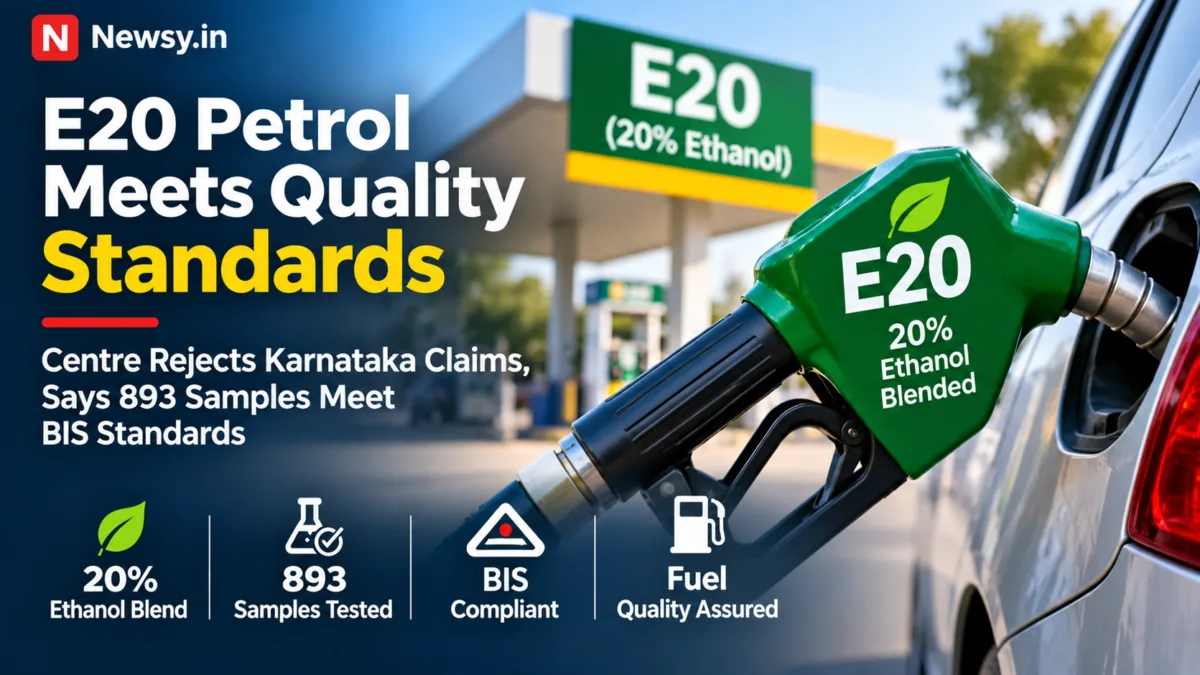
The Ministry of Petroleum and Natural Gas (MoPNG) alongside Public Sector Undertaking (PSU) Oil Marketing Companies (OMCs) has categorically rejected allegations made by the Karnataka government regarding fuel degradation and excessive ethanol blending, confirming that all 893 petrol samples tested nationwide—including 56 from Karnataka—fully complied with Bureau of Indian Standards (BIS) specifications.
The Centre’s detailed clarification comes after Karnataka’s civil food supplies department claimed that state-level testing of 63 fuel retail outlets detected ethanol blending levels soaring up to 31.2%, allegedly causing vehicular damage and mileage drop. PSU refiners—Indian Oil Corporation (IOCL), Bharat Petroleum Corporation (BPCL), and Hindustan Petroleum Corporation (HPCL)—questioned Karnataka’s non-standard sampling methodology, asserting that automated depot blending systems preclude manual or excessive additions. Read our essential commodities coverage in Centre Imposes Rice Stock Holding Limits Across Southern States.
01. E20 Ethanol Blending Quality Audit: Key Findings & Metrics
| Audit Parameter | Official Regulatory & Technical Detail |
|---|---|
| Total Samples Tested Nationwide | 893 Fuel Samples across 27 States and Union Territories |
| Karnataka Samples Audited | 56 Retail Outlet Samples across IOCL, BPCL, and HPCL |
| Recorded Karnataka Ethanol Range | 19.0% to 20.0% (Statewide Average: 19.30%) |
| Quality Benchmark | 100% compliance with BIS IS 2796:2017 (E20 Specifications) |
| Blending Architecture | Microprocessor-controlled calibrated in-line injection at bulk terminal gantries |
| National Ethanol Blended (ESY 2025-26) | 1,134 Crore Litres blended against 5,673 Crore Litres petrol sold |
| Economic Benefit to Farmers | Over ₹1.66 Lakh Crore disbursed directly to agrarian distillers since 2014 |
02. Why OMCs Disputed Karnataka’s 31.2% Ethanol Claim
PSU oil refiners issued a joint technical rebuttal outlining critical standard-operating flaws in the state government’s ad-hoc sampling exercise:
- Non-Standard Testing Bottles & Moisture Infiltration: Ethanol is hygroscopic (absorbs atmospheric water readily). Field samples drawn in unsealed open containers or without standard water-finding paste triggers phase separation, resulting in distorted ethanol concentration readings during laboratory hydrometer analysis.
- Automated Gantry Invalidation: Blending is executed through closed SCADA-controlled mass flow meters at refinery loading bays. Refiners noted that dispensing fuel with 31% ethanol would lead to immediate automated system shutdown due to volumetric pressure trips.
- Rejection of Speculative Mileage Loss Figures: The Ministry dismissed claims of an annual ₹62,000 crore consumer loss, pointing out that over 30 crore two-wheelers and 4 crore four-wheelers have run on E20 fuel for over three years with zero OEM-notified fleet failures.
- Cost Disincentive: Ethanol is procured at regulated benchmark prices; exceeding the 20% mandate increases OMC acquisition costs, eliminating any commercial motivation to over-blend.
03. Macroeconomic & Energy Security Gains of E20
Since the rollout of the Ethanol Blended Petrol (EBP) programme in supply year 2014-15, the Centre noted that national blending achievements have saved more than ₹1.97 lakh crore in foreign exchange reserves, substituted approximately 316 lakh metric tonnes of imported crude oil, and lowered vehicular carbon emissions significantly.
04. Frequently Asked Questions (FAQ)
Did Karnataka petrol samples fail the E20 quality tests?
No. PSU oil marketing companies verified that all 56 samples tested across Karnataka complied strictly with BIS norms, showing an average ethanol concentration of 19.30% (within the permissible 19% to 20% bracket).
Why did Karnataka report ethanol blending as high as 31%?
OMCs stated that Karnataka’s civil supplies department used unscientific, non-standard sampling procedures that caused atmospheric moisture ingress and inaccurate test results.
Can oil companies deliberately over-blend ethanol in petrol?
No. Blending is completely automated via digital terminal injection systems. Moreover, procuring excess ethanol raises fuel production costs for OMCs.
05. Related NewsY Coverage
Read about commodities and market regulations in Centre Imposes Rice Stock Holding Limits Across Southern States, explore civic governance updates in Old Delhi Chawri Bazar Collapse: Death Toll Rises to 6, track emergency environmental orders in Delhi Air Pollution: Schools Up to Class 5 Shift to Hybrid Mode, and review digital banking disputes in NPCI Defends UPI MDR Before Supreme Court.
06. Sources
- Ministry of Petroleum and Natural Gas (MoPNG): Official Rebuttal & Nationwide Fuel Quality Audit on E20 Petrol, New Delhi, 7 November 2026.
- Press Trust of India & The Times of India: E20 Petrol by PSU Firms Meets Prescribed Quality Standards: Oil Ministry Rejects Karnataka Charge, November 2026.
NewsY Energy & Automobiles Desk: Technical blend ratios, BIS tolerances, and audit statistics reflect certified disclosures from the Ministry of Petroleum and Natural Gas and PSU OMCs.