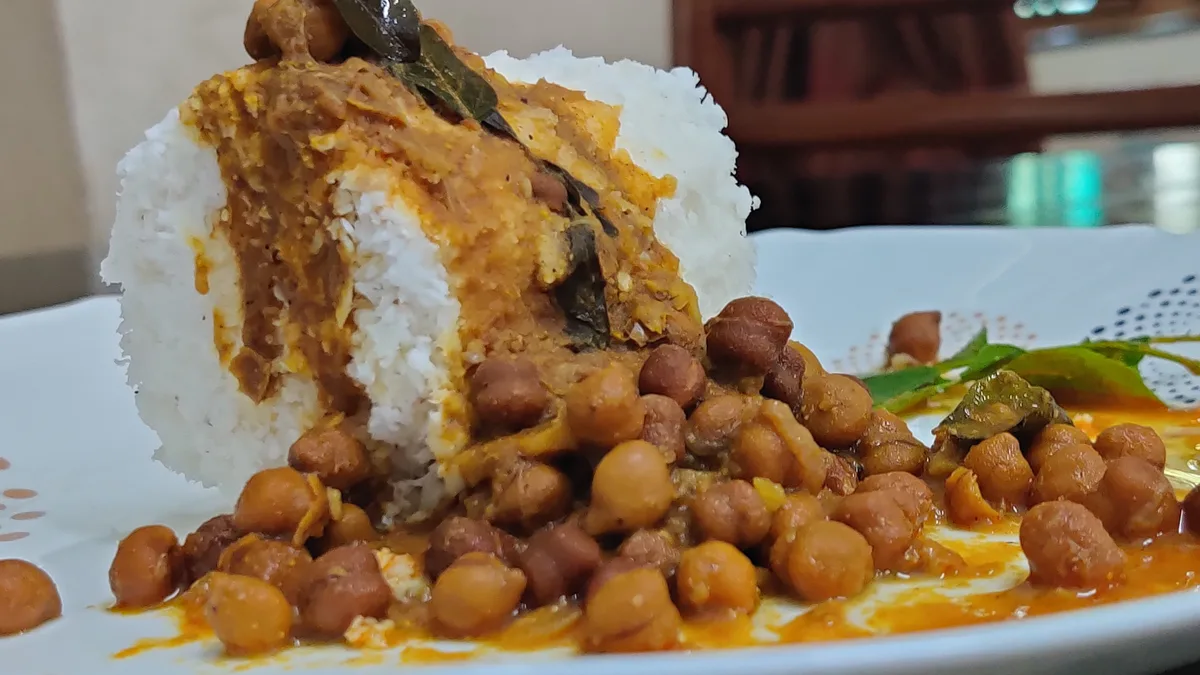
This puttu recipe makes the steamed rice-flour cylinders that are Kerala’s everyday breakfast: puttu flour moistened with just enough water to hold together, layered with grated coconut in a puttu kutti — the tall cylindrical puttu maker — and steamed for five or six minutes until the steam escapes from the top vents and the cylinders slide out soft, crumbly and fragrant. Puttu is the breakfast of Kerala’s homes and tea shops, eaten with kadala curry, the black chickpea curry, or with a ripe banana, or simply with sugar and ghee — and it is the dish that shows how little a great breakfast needs: rice flour, coconut, water, salt and steam. The one skill in it is the water, and both sources judge it the same way: sprinkle the water in gradually, rub the flour with your fingertips, and squeeze a fistful — it should hold its shape when pressed and crumble when pressed again. Too much water and the puttu turns soggy; too little and it comes out dry and hard. Trust the palm test, not the measuring cup.
Prep time: about 10 minutes | Steam time: 5-6 minutes | Total time: about 20 minutes | Makes: 4 puttu
Puttu Ingredients
- 2 cups puttu flour (roasted rice flour)
- ⅔-1 cup water, added gradually
- 1 cup grated coconut (fresh is best)
- ¼ teaspoon salt
- 3 cups water, for steaming
How to Make This Puttu Recipe
Step 1: Mix the flour and salt. Put the puttu flour and salt in a wide bowl and mix them together. Use roasted rice flour sold as puttu flour — raw rice flour does not steam the same way, and the puttu comes out dense.
Step 2: Add the water gradually and test with your palm. Sprinkle the water in a little at a time, rubbing the flour between your fingertips as you go, until the flour is evenly moist. Then do the palm test: squeeze a fistful of the moistened flour — it should hold its shape when you press it, and crumble when you press it again. That is the whole secret of puttu, and it is the same test in both sources. The amount of water depends on the flour, so add it slowly and stop the moment the test passes: about two-thirds of a cup to a cup for two cups of flour.
Step 3: Layer the puttu maker. Put 3 cups of water in the steamer pot and bring it to a boil. In the cylindrical puttu kutti, layer 2 tablespoons of grated coconut, then 3 tablespoons of the moistened flour, and repeat, finishing with coconut on top. Do not press the layers down — the steam has to pass through the flour, and a packed tube steams unevenly. If you do not have a puttu maker, layer the same way on an idli plate, or steam the flour in a steel glass.
Step 4: Steam 5-6 minutes. Fix the puttu kutti on the steamer pot and steam on medium heat for 5 to 6 minutes, until the steam escapes freely from the top vents. A large puttu maker takes longer, up to about 9 minutes. Then switch off the heat and rest the puttu for 2 minutes.
Step 5: Push out and serve. Push the puttu out of the tube with a wooden ladle or a skewer, and serve it at once, while it is hot and soft. The classic partners are kadala curry and a ripe banana; sugar and ghee are the simplest of all. Leftover puttu crumbles well into a stir-fry with coconut and jaggery the next morning, but it is best eaten fresh, while the steam is still in it.
Tips for the Best Puttu
Judge the water by the palm test for this puttu recipe, not by the cup: the two sources disagree slightly on the ratio — one uses three-quarters to a cup of water for two cups of flour, the other a third of a cup per cup of flour, which is a little less — and both say the amount depends on the flour, so this recipe publishes a range of two-thirds to one cup and tells you to stop when the squeezed fist holds and then crumbles. The coconut ratio, by contrast, is exact in both sources: half a cup of coconut per cup of flour, so one cup for this batch. The salt is the one figure the sources genuinely disagree on — a quarter teaspoon for two cups in one, a third of a teaspoon per cup in the other — so this recipe publishes the smaller figure with “or to taste”, and notes that the other source uses more. Do not pack the tube, and do not steam past the point where the steam escapes from the vents: over-steaming dries the puttu out, and under-steaming leaves it raw in the middle. One well-known page’s figures were not used here: it calls for 200 ml of water for a kilogram of flour, far below every other source’s ratio, and a 2-to-3-minute steam, which contradicts the 5-to-9-minute consensus — so neither figure appears in this post.
The method follows Hebbar’s Kitchen’s puttu recipe (2 cups puttu flour, ¼ teaspoon salt, ¾-1 cup water, 1 cup grated coconut, 3 cups water in the steamer pot; mix flour and salt, add water in batches, rub with fingertips until the flour holds shape when pressed in a fist and breaks on further pressing, layer in the puttu kutti — 2 tablespoons coconut, 3 tablespoons flour, repeat, finish with coconut — steam 5 minutes or until steam escapes from the top holes, rest 2 minutes, push out with a wooden ladle; prep 10 minutes, cook 5 minutes, total 15 minutes, serves 4 puttu; alternatives are steaming in a steel glass or on an idli plate, and a pressure cooker can replace the steamer) and Dassana’s Veg Recipes’ puttu (1 cup puttu flour, ⅓ cup water or as required, ⅓ teaspoon salt, ½ cup fresh grated coconut, 2-3 cups water for steaming; sprinkle water, mix with fingertips, same palm test — a pressed lump holds, then crumbles — layer a perforated disc with coconut, flour and coconut in the puttu kudam, steam on medium flame until steam releases from the top vents, then switch off, cool 3-4 minutes, remove with a wooden skewer; prep 4 minutes, cook 16 minutes, total 20 minutes, serves 2 large puttu, 364 kcal; steaming time varies by maker size, about 9 minutes for a large maker and 5-6 minutes for a smaller or regular one; no puttu maker, use an idli pan, layering the idli moulds). The two agree on the palm test, on the coconut ratio of half a cup per cup of flour, on the layering and on the 5-to-6-minute steam for a regular maker, and disagree on the water (the second uses a little less), on the salt and on the total time (15 minutes against 20). This recipe publishes the first source’s quantities with the water as a range that honestly brackets both, the 5-to-6-minute steam with the large-maker caveat, and the 20-minute total, which is the honest figure once the water-boiling and cooling are counted.
Serve this puttu with our appam for a second Kerala breakfast, or with our Malabar chicken curry for a coconut-milk curry to eat it with.