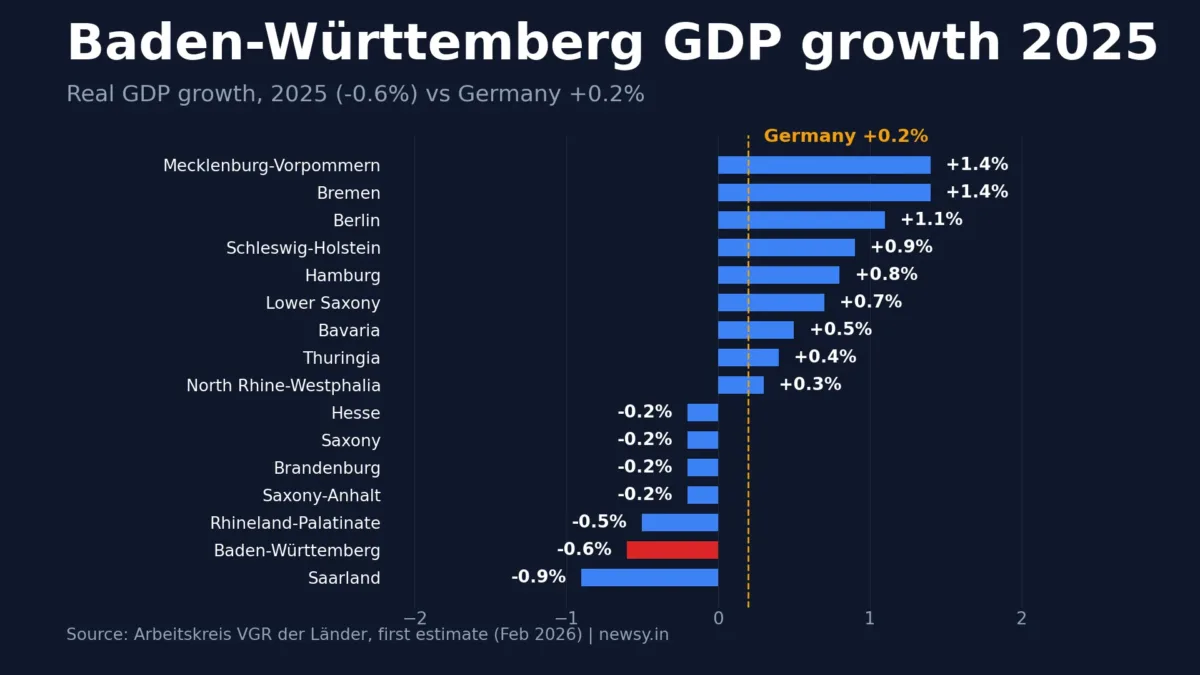
Baden-Wuerttemberg GDP reached €667,105 million (€667.11 billion) in 2025, making Baden-Württemberg the third-largest state economy in Germany. Baden-Württemberg accounts for 14.92% of Germany’s economy, but it shrank 0.6% in real terms in 2025 — the second-worst result of any state, behind only Saarland at minus 0.9% — according to the Arbeitskreis Volkswirtschaftliche Gesamtrechnungen der Länder, first estimate, published on 28 May 2026. The state, in the south-west of Germany with Stuttgart as its capital, is the country’s industrial heartland, and its 2025 contraction says a great deal about the state of German manufacturing.
| GDP, current prices (2025) | €667,105 million (€667.11 billion) |
| Real growth (2025) | −0.6% |
| Nominal growth (2025) | +2.3% |
| GDP per capita (2025) | €59,320 |
| Rank among 16 states | 3rd |
| Share of Germany GDP | 14.92% |
Some terms, explained simply. GDP is the total value of goods and services produced in a state. The headline figure is at current prices, which includes the effect of rising prices. Real growth strips out price rises, so it shows how much the economy actually expanded. GDP per capita divides output by population — a rough picture of average output per person, not average income. Figures are the first estimate for 2025 and may be revised when the Arbeitskreis publishes its next release.
Cars and precision engineering drive Baden-Wuerttemberg GDP
No German state depends more on making things than Baden-Württemberg. Industry accounts for around a third of the state’s economic output, and its three largest industrial branches — mechanical engineering, the automotive industry and electrical engineering — are also the three largest in Germany. Stuttgart is home to Mercedes-Benz and Porsche, and the region around it holds one of the densest automotive clusters in the world, with Bosch, the world’s largest automotive supplier, and ZF Friedrichshafen among the suppliers. Mechanical engineering alone counts more than 1,400 companies and over 220,000 employees in the state, and SAP, Europe’s largest software company, is based in Walldorf.
The state’s strength is also its exposure. When car sales fall and factories cut output, Baden-Württemberg feels it more than any other state, and 2025 was such a year: the shift to electric vehicles, weak demand in export markets and high energy costs all weighed on the car industry and its suppliers. The state is fighting back with research — it invests almost 6% of its GDP in research and development, one of the highest rates in the world, and files twice as many patents per 100,000 inhabitants as the German average. Its exports, worth €248 billion a year according to the state economics ministry, still make it one of Europe’s great exporting regions. But the 2025 figures show that inventiveness alone does not protect an economy built on cars when the car market turns.
Baden-Wuerttemberg GDP per capita
At €59,320, Baden-Württemberg’s GDP per person sits comfortably above the national average of €53,482, even after a year in which the economy shrank. It ranks behind Bavaria (€62,212) and Hesse (€60,567) among the large states, and ahead of Berlin (€59,233) and Lower Saxony (€49,646). The figure reflects the state’s high-value industry: cars, machinery and precision engineering generate more output per worker than most other sectors, so a state built on them stays prosperous even in a bad year. The gap with Bavaria, though, has widened — Bavaria grew 0.5% in 2025 while Baden-Württemberg shrank 0.6% — and the state will need its research spending to turn into new products if it is to close it. Germany’s place in the world economy is on the Countries by GDP 2026 ranking.
Neighbouring states in the ranking: Bavaria GDP, Lower Saxony GDP. Compare them on the Germany states by GDP 2025 ranking page, which covers all 16 states with the same figures.
Sources: Arbeitskreis Volkswirtschaftliche Gesamtrechnungen der Länder (VGR der Länder), first estimate for 2025, calculation status February 2026, published by IT.NRW in press release 145/26 on 28 May 2026. No population figures are published here: GDP divided by GDP per capita gives inconsistent totals across states, so population is omitted unless verified directly from Destatis. The official state table is published by the Arbeitskreis (IT.NRW), and the national figure by Destatis.
Last updated: 30 November 2026.