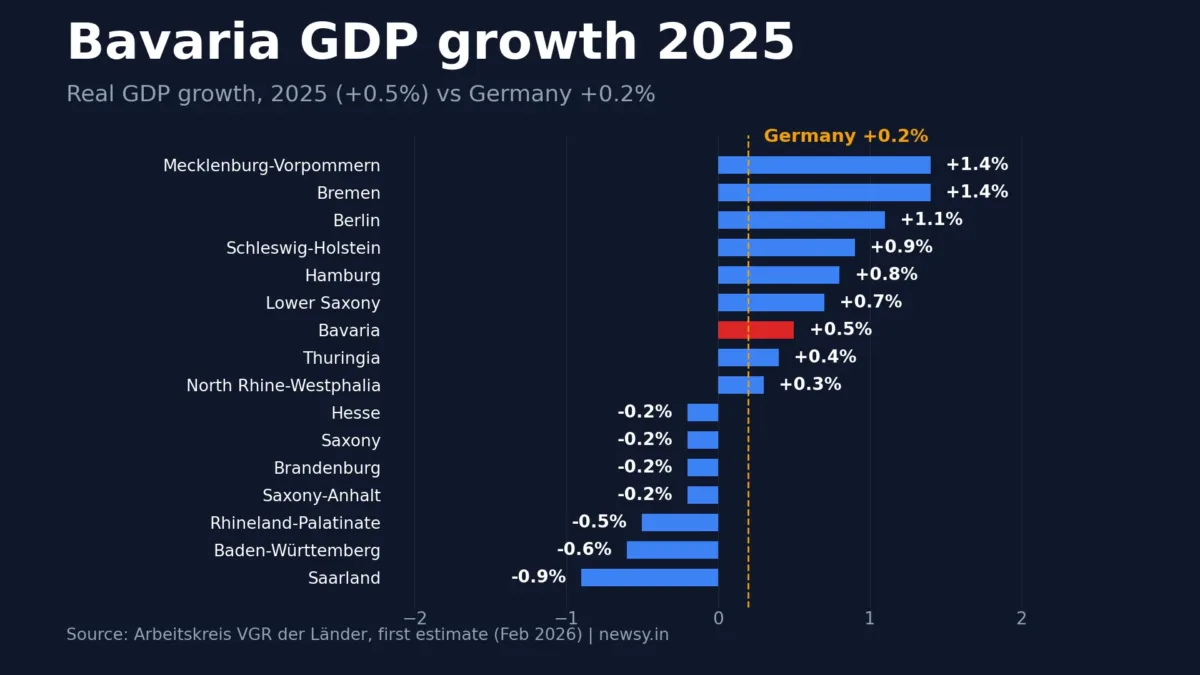
Bavaria GDP reached €824,243 million (€824.24 billion) in 2025, making Bavaria the second-largest state economy in Germany. Bavaria accounts for 18.44% of Germany’s economy — nearly a fifth — and grew 0.5% in real terms in 2025, more than twice the national rate of 0.2%, according to the Arbeitskreis Volkswirtschaftliche Gesamtrechnungen der Länder, first estimate, published on 28 May 2026. Bavaria is Germany’s largest state by area, covering 70,550 square kilometres in the south-east of the country, and Munich, its capital, is Germany’s third-largest city.
| GDP, current prices (2025) | €824,243 million (€824.24 billion) |
| Real growth (2025) | +0.5% |
| Nominal growth (2025) | +3.5% |
| GDP per capita (2025) | €62,212 |
| Rank among 16 states | 2nd |
| Share of Germany GDP | 18.44% |
Some terms, explained simply. GDP is the total value of goods and services produced in a state. The headline figure is at current prices, which includes the effect of rising prices. Real growth strips out price rises, so it shows how much the economy actually expanded. GDP per capita divides output by population — a rough picture of average output per person, not average income. Figures are the first estimate for 2025 and may be revised when the Arbeitskreis publishes its next release.
Cars, technology and engineering drive Bavaria GDP
Bavaria’s economy rests on manufacturing more than any other large German state. Vehicle construction is the best-known part of it: BMW is headquartered in Munich, Audi builds cars in Ingolstadt, and MAN makes trucks in Munich, with a supplier network that reaches into almost every town in the state. Around them sits a second layer of global companies — Siemens, Infineon and Adidas are all headquartered in Bavaria, and Allianz and Munich Re make Munich one of Europe’s insurance capitals. Manufacturing, excluding construction, accounts for roughly a quarter of the state’s gross value added, a higher share than in most of Germany.
The state’s newer strengths sit alongside the old ones. Bavaria is home to nearly 550 aerospace companies employing around 36,000 people, about a third of the sector’s total in Germany, with Airbus Defence and Space and MTU Aero Engines among the leading names. Munich has also become one of Europe’s leading centres for information technology and artificial intelligence, and Bavaria’s exports — cars, machinery, electronics and chemicals — were worth around €229 billion in 2023, roughly half of what the state produces. That export strength is also a vulnerability: when global demand for cars and machinery weakens, Bavaria feels it first, which is one reason its growth, at 0.5%, stayed modest in 2025 even while it beat the national rate.
Bavaria GDP per capita
At €62,212, Bavaria’s GDP per person is well above the national average of €53,482 — the second-highest of any state in Germany, behind only Hamburg (€90,359), and ahead of Bremen (€61,019). It ranks ahead of Hesse (€60,567) and Baden-Württemberg (€59,320) and far ahead of North Rhine-Westphalia (€49,682), the only state with a larger total economy. Bavaria combines the two things that usually pull in opposite directions: a very large economy and a very high output per person, because its industries — cars, engineering, technology and finance — are among the highest-value in the country. Germany’s place in the world economy is on the Countries by GDP 2026 ranking.
Neighbouring states in the ranking: North Rhine-Westphalia GDP, Baden-Württemberg GDP. Compare them on the Germany states by GDP 2025 ranking page, which covers all 16 states with the same figures.
Sources: Arbeitskreis Volkswirtschaftliche Gesamtrechnungen der Länder (VGR der Länder), first estimate for 2025, calculation status February 2026, published by IT.NRW in press release 145/26 on 28 May 2026. No population figures are published here: GDP divided by GDP per capita gives inconsistent totals across states, so population is omitted unless verified directly from Destatis. The official state table is published by the Arbeitskreis (IT.NRW), and the national figure by Destatis.
Last updated: 30 November 2026.