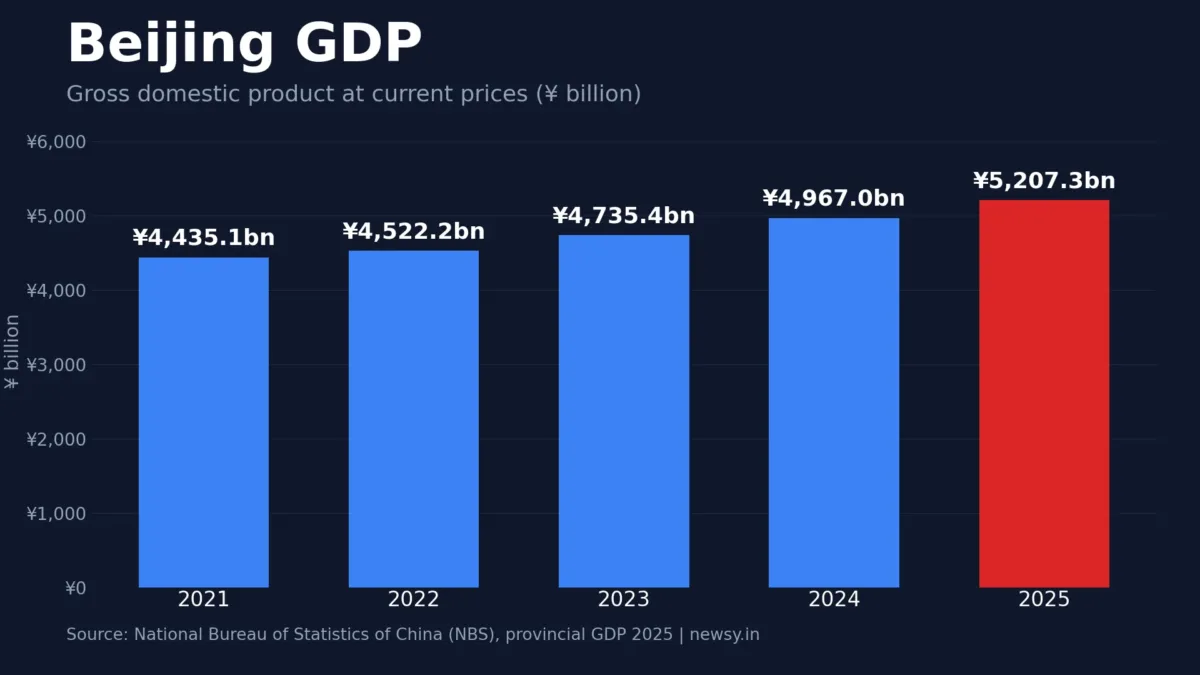
Beijing GDP reached ¥5,207.30 billion ($729.0 billion) in 2025, passing the ¥5 trillion mark for the first time and making the capital the twelfth-largest provincial-level economy in China. The city grew 5.4% in real terms, ahead of the national rate of 5.0%. But total size is not Beijing’s story: at ¥238,705 ($33,418) per person, it has the highest GDP per capita in China, with only Shanghai coming close, according to the National Bureau of Statistics (NBS).
| GDP, current prices (2025) | ¥5,207.30 billion ($729.02 billion) |
| GDP, current prices (2024) | ¥4,967.02 billion ($695.38 billion) |
| Real growth (2025) | 5.4% |
| Nominal change (2025) | 4.84% |
| Population (mid-2025) | 21.82 million |
| GDP per capita (2025) | ¥238,705 ($33,418) |
| Rank among 31 provinces | 12th |
| Rank by GDP per capita | 1st |
| Share of China GDP | 3.71% |
Some terms, explained simply. GDP is the total value of goods and services produced in a province. The headline figure is at current prices, which includes the effect of rising prices. Real growth strips out price rises, so it shows how much the economy actually expanded. GDP per capita divides output by population — a rough picture of average output per person, not average income. Dollar figures use the NBS 2025 average exchange rate of 7.1429 yuan to the dollar.
Beijing GDP growth in 2025
In money terms, Beijing added ¥240.28 billion of output in 2025, rising from ¥4,967.02 billion to ¥5,207.30 billion. Over five years the economy has grown 17.4%, from ¥4,435.1 billion in 2021 — the slowest five-year rise of the eight provinces in this group, which is what a mature, services-led economy looks like: steady growth from a very high base, with little of the factory-driven surge seen in Anhui or Hunan. The full NBS release behind these figures is at NBS Statistical Communiqué on 2025 National Economic and Social Development.
A services and technology economy
Beijing is a services city first. The digital economy accounts for more than 40% of the city’s GDP, and the tertiary sector — dominated by high-tech and services industries — drives almost all of its growth. Zhongguancun, in the Haidian district, is China’s best-known technology cluster, home to the country’s leading artificial-intelligence companies; Beijing leads the nation in the number of large AI models filed and launched, and on average more than 300 technology enterprises are established in the city every day. The universities behind that pipeline, Peking University and Tsinghua University, are both here. Most of the city’s newer manufacturing, including car and biotechnology plants, sits in the Beijing Economic-Technological Development Area (Yizhuang) in the south-east of the city, rather than in the centre.
Beijing GDP per capita
At ¥238,705, Beijing’s GDP per person is nearly two and a half times the national average of ¥99,665, and it leads Shanghai, in second place, by more than ¥10,000. Beijing and Shanghai are the only two provinces above $30,000 per person. The lead reflects the concentration of very high-value work in the capital: government, finance, headquarters, research and artificial intelligence pay far above the national average, and the city’s population of 21.82 million is small for an economy of this size. See where China as a whole sits in the world on the Countries by GDP 2026 ranking.
Neighbouring provinces in the ranking: Anhui GDP, Hebei GDP. Compare them on the China provinces by GDP 2025 ranking page, which covers all 31 provinces with the same figures.
Sources: National Bureau of Statistics of China (NBS), provincial GDP 2025 (preliminary data); population from NBS mid-year estimates.
Last updated: 26 November 2026.