Hebei GDP reached ¥4,930.52 billion ($690.3 billion) in 2025, the thirteenth-largest provincial economy in China and 3.52% of national output. The province grew 5.6% in real terms — the fastest of the eight provinces in this group, and ahead of the national rate of 5.0% — leaving it just short of the ¥5 trillion mark. Hebei is the province that wraps around Beijing and Tianjin, and its economy is still defined by the heavy industry that serves them: it has been China’s largest steel-producing province for many years, according to the National Bureau of Statistics (NBS).
| GDP, current prices (2025) | ¥4,930.52 billion ($690.27 billion) |
| GDP, current prices (2024) | ¥4,744.81 billion ($664.27 billion) |
| Real growth (2025) | 5.6% |
| Nominal change (2025) | 3.91% |
| Population (mid-2025) | 73.66 million |
| GDP per capita (2025) | ¥66,936 ($9,371) |
| Rank among 31 provinces | 13th |
| Rank by GDP per capita | 26th |
| Share of China GDP | 3.52% |
Some terms, explained simply. GDP is the total value of goods and services produced in a province. The headline figure is at current prices, which includes the effect of rising prices. Real growth strips out price rises, so it shows how much the economy actually expanded. GDP per capita divides output by population — a rough picture of average output per person, not average income. Dollar figures use the NBS 2025 average exchange rate of 7.1429 yuan to the dollar.
Hebei GDP growth in 2025
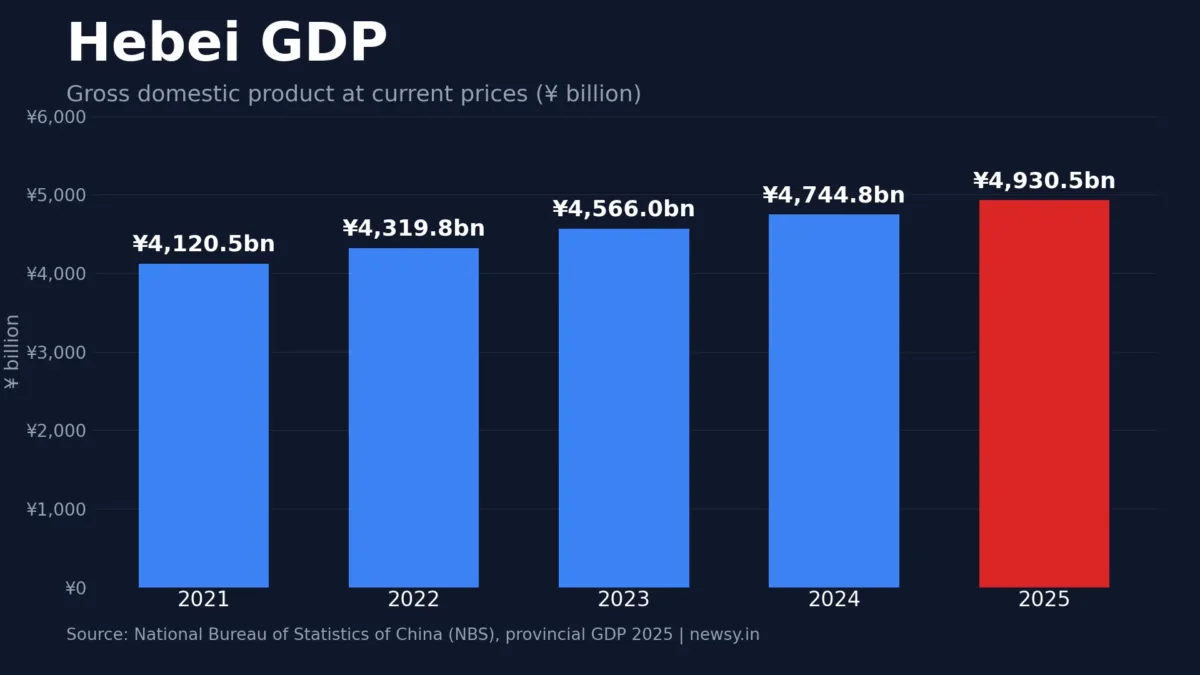
In money terms, Hebei added ¥185.71 billion of output in 2025, rising from ¥4,744.81 billion to ¥4,930.52 billion. Nominal growth of 3.91% was lower than real growth of 5.6%, which reflects falling prices in the province’s heavy-industry products over the year. Over five years the economy has grown 19.7%, from ¥4,120.5 billion in 2021 to ¥4,930.5 billion in 2025. The full NBS release behind these figures is at NBS Statistical Communiqué on 2025 National Economic and Social Development.
Steel still defines Hebei — and Xiong’an points to what’s next
Steel is the first fact about Hebei’s economy: the province produced 212 million tonnes of crude steel in 2022, and its mills are concentrated around Tangshan and Handan. But the structure is shifting. Services produced ¥2.72 trillion in 2025, or 55.1% of the economy, against ¥1.76 trillion (35.7%) from industry and construction and ¥451.5 billion (9.2%) from agriculture, forestry and fisheries. The capital, Shijiazhuang, is a pharmaceuticals centre, and the province’s ports on the Bohai Sea — Qinhuangdao, Tangshan and Huanghua — are among the country’s largest for coal and iron ore. The biggest bet on the future is the Xiong’an New Area, created in 2017 south-west of Beijing to take on universities, research institutes and companies moved out of the capital; accumulated investment there passed ¥1 trillion during the 2021–25 plan period. Hebei is also a leader in the energy transition: renewable capacity reached 140 million kilowatts, 72.3% of its total power capacity, and the province’s pumped-storage hydro scale ranks first in the country.
Hebei GDP per capita
At ¥66,936, Hebei’s GDP per person ranks 26th among the 31 provinces — the lowest of the eight provinces in this group, and well below the national average of ¥99,665. The gap between Hebei’s size ranking (13th) and its per capita ranking (26th) is the widest in this group, and the reason is straightforward: 73.66 million people, the sixth-largest provincial population, share an economy still weighted towards steel, coal and farming. See where China as a whole sits in the world on the Countries by GDP 2026 ranking.
Neighbouring provinces in the ranking: Beijing GDP, Shaanxi GDP. Compare them on the China provinces by GDP 2025 ranking page, which covers all 31 provinces with the same figures.
Sources: National Bureau of Statistics of China (NBS), provincial GDP 2025 (preliminary data); population from NBS mid-year estimates.
Last updated: 26 November 2026.