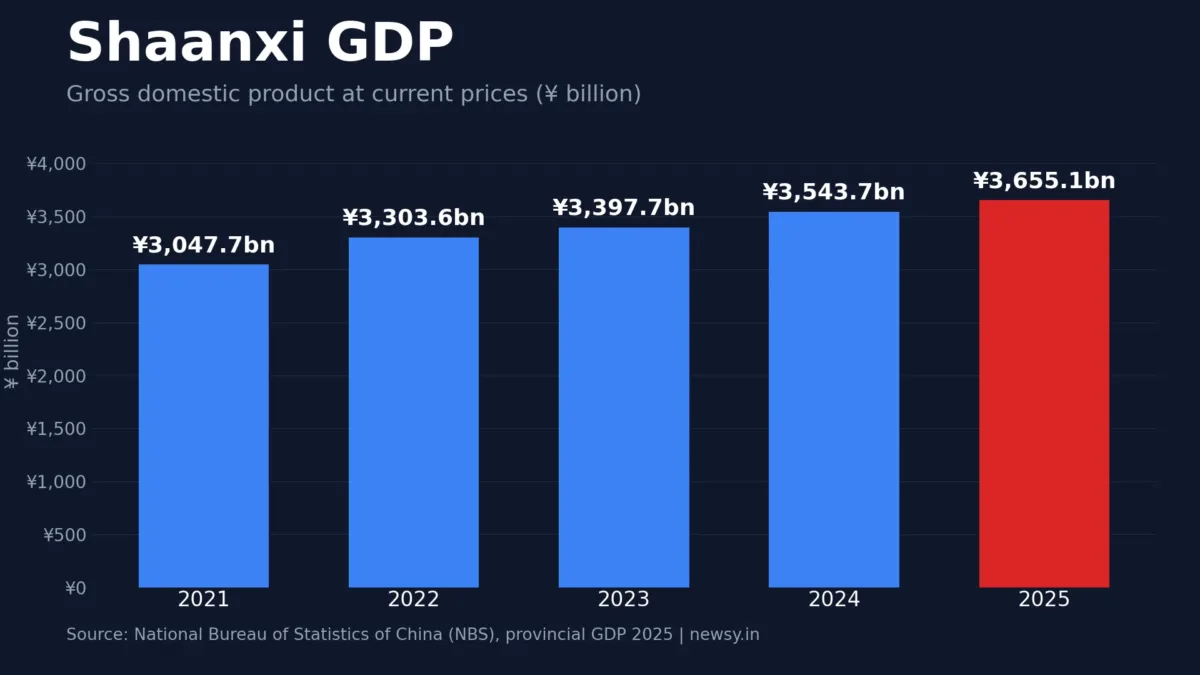
Shaanxi GDP reached ¥3,655.11 billion ($511.7 billion) in 2025, the fourteenth-largest provincial economy in China and 2.61% of national output. The province grew 5.1% in real terms, just ahead of the national rate of 5.0%. Its capital, Xi’an, is an ancient capital that has become one of China’s most important technology cities: it builds memory chips for the world and aeroplanes for the country, and its factories now turn out hundreds of thousands of electric cars a year, according to the National Bureau of Statistics (NBS).
| GDP, current prices (2025) | ¥3,655.11 billion ($511.71 billion) |
| GDP, current prices (2024) | ¥3,543.71 billion ($496.12 billion) |
| Real growth (2025) | 5.1% |
| Nominal change (2025) | 3.14% |
| Population (mid-2025) | 39.45 million |
| GDP per capita (2025) | ¥92,663 ($12,973) |
| Rank among 31 provinces | 14th |
| Rank by GDP per capita | 12th |
| Share of China GDP | 2.61% |
Some terms, explained simply. GDP is the total value of goods and services produced in a province. The headline figure is at current prices, which includes the effect of rising prices. Real growth strips out price rises, so it shows how much the economy actually expanded. GDP per capita divides output by population — a rough picture of average output per person, not average income. Dollar figures use the NBS 2025 average exchange rate of 7.1429 yuan to the dollar.
Shaanxi GDP growth in 2025
In money terms, Shaanxi added ¥111.40 billion of output in 2025, rising from ¥3,543.71 billion to ¥3,655.11 billion. Over five years the economy has grown 19.9%, from ¥3,047.7 billion in 2021 — including a sharp jump in 2022, when output rose by more than ¥250 billion in a single year as energy prices surged. Growth has steadied since then, and Jiangxi, in 15th place, is now only ¥53.11 billion behind, so the contest for 14th place is close. The full NBS release behind these figures is at NBS Statistical Communiqué on 2025 National Economic and Social Development.
Chips and jets: what drives the Shaanxi economy
Xi’an’s semiconductor industry is built around one factory: Samsung’s plant there is the company’s only memory-chip fabrication plant outside South Korea, producing about 40% of Samsung’s global NAND flash memory, with cumulative investment of about $29.3 billion by mid-2024. Micron, the American chipmaker, also operates in Xi’an and announced plans in 2023 to invest more than ¥4.3 billion there over several years. The city’s whole semiconductor industry was worth ¥140.65 billion in 2024, now on the same scale as its long-established aerospace manufacturing base, whose cluster exceeds ¥150 billion. Xi’an’s other pillar is cars: the city built 771,100 new energy vehicles in the first eight months of 2025, up 19.9% year on year, and local chip designers now supply BYD and Huawei. Beyond the city, northern Shaanxi’s coal, oil and gas fields anchor the energy side of the economy, and the China-Europe freight trains that leave from Xi’an carry the province’s goods west.
Shaanxi GDP per capita
At ¥92,663, Shaanxi’s GDP per person ranks 12th among the 31 provinces — ahead of its size ranking of 14th, and ahead of larger provinces such as Hunan and Anhui. That is the pattern of an economy whose output is concentrated in high-value work — chips, aerospace and cars — spread across a middling population of 39.45 million. It still sits below the national average of ¥99,665. See where China as a whole sits in the world on the Countries by GDP 2026 ranking.
Neighbouring provinces in the ranking: Hebei GDP, Jiangxi GDP. Compare them on the China provinces by GDP 2025 ranking page, which covers all 31 provinces with the same figures.
Sources: National Bureau of Statistics of China (NBS), provincial GDP 2025 (preliminary data); population from NBS mid-year estimates.
Last updated: 26 November 2026.