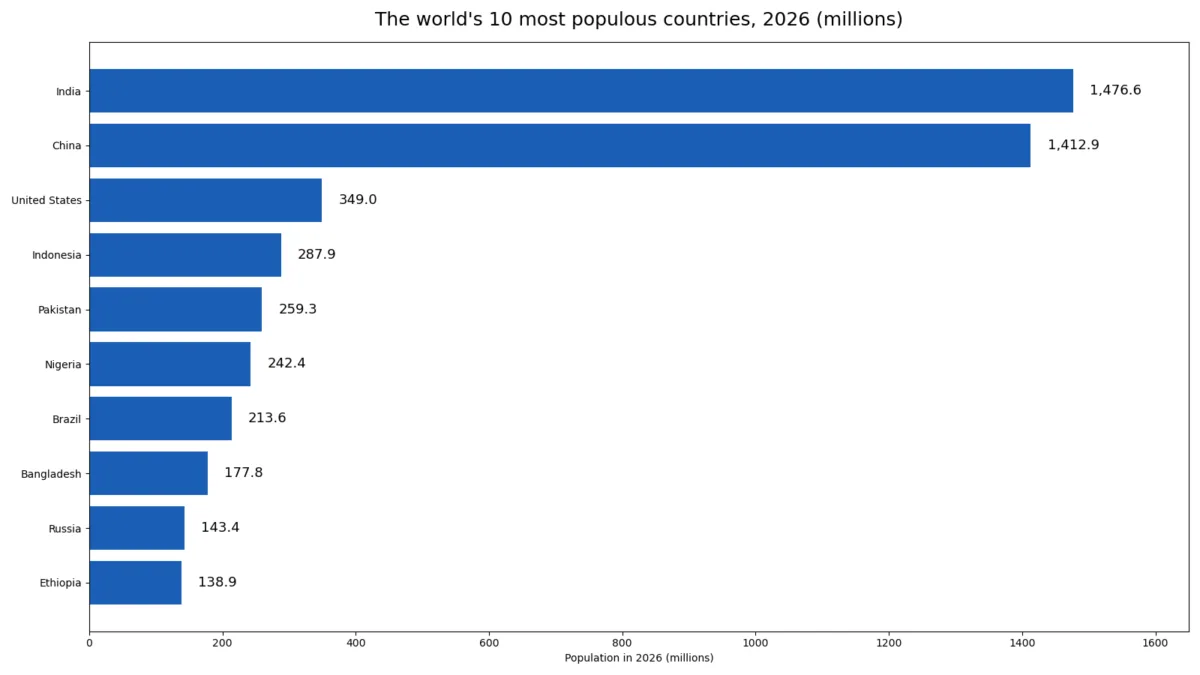
India is the world’s most populous country in 2026, with about 1.48 billion people — and the gap over China is now widening every year. This ranking of countries by population uses the United Nations’ World Population Prospects 2024, the standard global source for population figures. All figures below are the UN’s medium-variant projections for 1 July 2026, not census counts.
The world as a whole has reached about 8.30 billion people, up by roughly 69 million on 2025. Growth has slowed to 0.84% a year, down from more than 2% a year in the late 1960s, but the planet is still adding close to 189,000 people a day. The ten largest countries alone hold 56.6% of humanity, and the top 50 in the table below account for 86.3%.
Countries by population: the full top 50 table
| Rank | Country | Population 2026 (millions) | Share of world population (%) | Change vs 2025 (millions) |
|---|---|---|---|---|
| 1 | India | 1,476.6 | 17.79 | +12.74 |
| 2 | China | 1,412.9 | 17.02 | −3.12 |
| 3 | United States | 349.0 | 4.20 | +1.77 |
| 4 | Indonesia | 287.9 | 3.47 | +2.17 |
| 5 | Pakistan | 259.3 | 3.12 | +4.08 |
| 6 | Nigeria | 242.4 | 2.92 | +4.89 |
| 7 | Brazil | 213.6 | 2.57 | +0.74 |
| 8 | Bangladesh | 177.8 | 2.14 | +2.13 |
| 9 | Russia | 143.4 | 1.73 | −0.60 |
| 10 | Ethiopia | 138.9 | 1.67 | +3.43 |
| 11 | Mexico | 133.0 | 1.60 | +1.06 |
| 12 | Japan | 122.4 | 1.47 | −0.68 |
| 13 | Egypt | 120.1 | 1.45 | +1.74 |
| 14 | Philippines | 117.7 | 1.42 | +0.93 |
| 15 | DR Congo | 116.5 | 1.40 | +3.62 |
| 16 | Vietnam | 102.2 | 1.23 | +0.58 |
| 17 | Iran | 93.2 | 1.12 | +0.75 |
| 18 | Türkiye | 87.9 | 1.06 | +0.24 |
| 19 | Germany | 83.6 | 1.01 | −0.43 |
| 20 | Tanzania | 72.6 | 0.87 | +2.02 |
| 21 | Thailand | 71.6 | 0.86 | −0.06 |
| 22 | United Kingdom | 69.9 | 0.84 | +0.38 |
| 23 | France | 66.7 | 0.80 | +0.09 |
| 24 | South Africa | 65.5 | 0.79 | +0.71 |
| 25 | Italy | 58.9 | 0.71 | −0.22 |
| 26 | Kenya | 58.6 | 0.71 | +1.10 |
| 27 | Myanmar | 55.2 | 0.66 | +0.33 |
| 28 | Colombia | 53.9 | 0.65 | +0.51 |
| 29 | Sudan | 53.3 | 0.64 | +1.62 |
| 30 | Uganda | 52.8 | 0.64 | +1.38 |
| 31 | South Korea | 51.6 | 0.62 | −0.07 |
| 32 | Algeria | 48.0 | 0.58 | +0.59 |
| 33 | Iraq | 48.0 | 0.58 | +0.99 |
| 34 | Spain | 47.9 | 0.58 | −0.04 |
| 35 | Argentina | 46.0 | 0.55 | +0.15 |
| 36 | Afghanistan | 45.0 | 0.54 | +1.20 |
| 37 | Yemen | 43.0 | 0.52 | +1.19 |
| 38 | Canada | 40.5 | 0.49 | +0.34 |
| 39 | Angola | 40.2 | 0.48 | +1.18 |
| 40 | Ukraine | 39.5 | 0.48 | +0.56 |
| 41 | Morocco | 38.8 | 0.47 | +0.33 |
| 42 | Poland | 37.8 | 0.46 | −0.30 |
| 43 | Uzbekistan | 37.7 | 0.45 | +0.67 |
| 44 | Mozambique | 36.6 | 0.44 | +1.01 |
| 45 | Malaysia | 36.4 | 0.44 | +0.41 |
| 46 | Ghana | 35.7 | 0.43 | +0.63 |
| 47 | Saudi Arabia | 35.2 | 0.42 | +0.60 |
| 48 | Peru | 34.9 | 0.42 | +0.35 |
| 49 | Madagascar | 33.5 | 0.40 | +0.78 |
| 50 | Côte d’Ivoire | 33.5 | 0.40 | +0.78 |
How to read the table: populations are UN World Population Prospects 2024 medium-variant projections for 1 July 2026. Shares are calculated against a world population of 8,300.7 million. Change vs 2025 is derived from the UN’s published annual growth rate for each country, so figures are rounded to two decimals.
India has pulled away from China
India passed China as the world’s most populous country in mid-2022, according to the UN. Four years on, the lead is no longer close. India is projected at 1,476.6 million people in mid-2026 against China’s 1,412.9 million — a gap of 63.7 million, roughly the population of the United Kingdom.
The two countries are now moving in opposite directions. India added about 12.8 million people over the past year, growing at 0.87%, while China’s population fell by about 3.2 million, shrinking at 0.22% a year. The UN’s medium projection has the gap widening sharply: by 2050 India is expected to reach 1,679.6 million while China falls to 1,260.3 million.
Age explains much of the difference. India’s median age is 29.2 years, against 40.6 in China, so a far larger share of Indians are in, or approaching, their childbearing years. That demographic momentum means India’s population keeps growing even as its fertility rate falls. China, with a fertility rate of about 1.0 child per woman, is ageing fast.
Africa is where the growth is
Sixteen of the 50 countries in the table are African, and the fastest growth rates in the top 50 are almost all African. The Democratic Republic of the Congo is growing at 3.21% a year, Sudan at 3.14% and Angola at 3.01%. Nigeria, already sixth in the world at 242.4 million, is adding people at 2.06% a year, and Ethiopia, tenth at 138.9 million, at 2.53%.
The UN expects Africa to account for almost two-thirds of global population growth between 2026 and 2050. Nigeria is projected to reach 359.2 million by 2050, Ethiopia 225.0 million and the Democratic Republic of the Congo 218.2 million. By then, the ranking will look very different: Pakistan, at a projected 371.9 million, is expected to pass Indonesia, and Ethiopia and the Democratic Republic of the Congo will both be in the world’s top ten.
That growth is a double-edged fact. Young, fast-growing populations can deliver a large workforce and a growing consumer market, but only where jobs, schools, housing and health services keep pace. For much of Africa, the next 25 years will be decided by whether investment in those basics matches the pace of population growth.
Nine of the top 50 countries are shrinking
Population decline is no longer a story about one or two countries. Nine of the 50 largest countries shrank over the past year: China, Russia, Japan, Germany, Thailand, Italy, South Korea, Spain and Poland. Japan is falling fastest among the large economies at 0.55% a year, followed by Germany at 0.51% and Poland at 0.78%.
The pattern is familiar: birth rates well below replacement level, and not enough immigration to offset the shortfall. Japan’s population is projected at 105.1 million by 2050, down from 122.4 million today. Germany is expected to fall to 78.3 million. Even the United Kingdom, still growing at 0.55% a year, owes most of that growth to immigration rather than births.
Shrinking populations bring their own pressures — fewer workers supporting more retirees, towns losing young people, and health and pension systems built for a growing population having to adapt. It is the mirror image of Africa’s challenge: too few young people rather than too many.
What the numbers mean for the world economy — and for India
Population size is not wealth, and a big population can be a burden as easily as an advantage. But size does shape markets. The United States, third in the ranking at 349.0 million, remains far smaller than India or China, yet its economy is larger than either — a reminder that productivity, not headcount, decides living standards.
For India, the figures carry a clear message. A median age under 30 and a workforce that will keep growing for decades is a genuine advantage over China, Japan and Europe, all of which are ageing. But the advantage only pays off if those workers find productive jobs. India’s unemployment rate fell to 5.1% in July–September 2026, with rural jobs leading the improvement, yet creating enough good jobs for a population still growing by nearly 13 million a year remains the country’s central economic test. You can read our report on the latest jobs figures here.
For the world, the centre of gravity is shifting south. The UN projects the world population will pass 9 billion in 2037 and peak at about 10.29 billion in 2084 before declining slightly. Most of the growth between now and then will come from Africa and South Asia, while Europe and East Asia shrink. Trade, migration, food demand and climate policy will all have to adjust to a world in which a growing share of humanity lives in Africa and Asia — and in which India, already the most populous country, keeps pulling further ahead.
Frequently asked questions
Which country has the largest population?
India, with a projected 1,476.6 million people in mid-2026, according to the United Nations. China is second with 1,412.9 million.
How many people are there in the world in 2026?
About 8.30 billion, the UN’s mid-2026 figure — 8,300,678,395 people on 1 July 2026, growing by about 69 million a year.
When did India overtake China?
The UN’s figures show India passing China in mid-2022. By mid-2026 the lead has grown to about 63.7 million people.
Related rankings
- Countries by GDP 2026
- GDP per Capita by Country 2026
- Countries by GDP (PPP) 2026
- Fastest Growing Economies 2026
- IPL Points Table 2026
- Top Programming Languages 2026
- Indian States by GDP 2025
Last updated: 18 November 2026
Source: United Nations, Department of Economic and Social Affairs, Population Division, World Population Prospects 2024 (medium variant, 1 July 2026 projections). Figures cross-checked against Worldometer’s UN-based 2026 ranking. These are projections, not census counts, and will be revised in later UN editions.