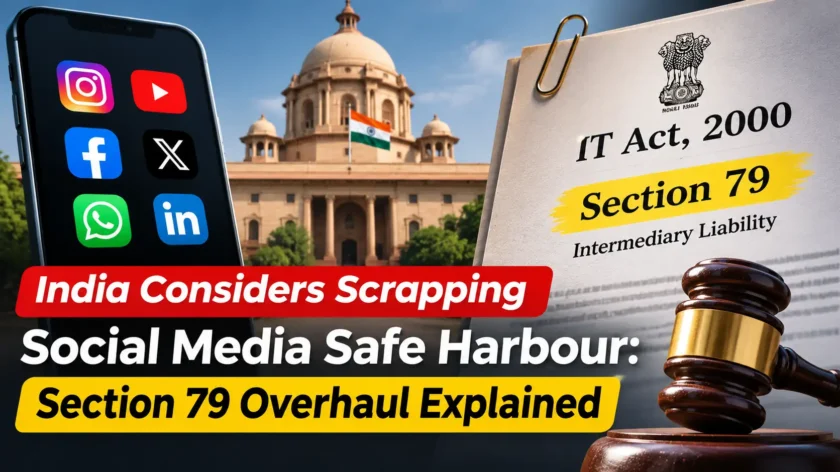
The Ministry of Electronics and Information Technology (MeitY) has initiated formal inter-ministerial consultations to overhaul India’s digital regulatory architecture, proposing the withdrawal of statutory “safe harbour” legal immunity currently granted to social media intermediaries under Section 79 of the Information Technology (IT) Act, 2000.
The proposed amendment could fundamentally change the operating model of major tech platforms—including Meta (Facebook, Instagram, WhatsApp), Alphabet (YouTube), and X (formerly Twitter)—by making them legally liable and subject to prosecution for unlawful user-generated content, algorithmic dissemination of hate speech, deepfakes, and child sexual abuse material (CSAM). Explore our mobile operating system analysis in our report on the Xiaomi HyperOS 4 Android 17 Global Rollout.
01. What Is Section 79 Safe Harbour Immunity?
Enacted under the Information Technology Act, 2000 (and strengthened via amendments in 2008), Section 79 shields internet service providers and social media intermediaries from criminal and civil liability for third-party information, data, or communication links hosted by them.
Currently, platforms are classified as passive conduits: they cannot be sued for defamatory posts, copyrighted piracy, or illegal content uploaded by users, provided they maintain due diligence and take down unlawful content within 36 hours of receiving a formal court order or government takedown notice.
02. Why Is the Government Proposing to Scrap Safe Harbour?
| Key Catalyst | Government Concern | Proposed Regulatory Shift |
|---|---|---|
| Algorithmic Amplification | Platforms no longer act as passive pipes; proprietary recommendation algorithms actively curate, amplify, and monetize sensationalist and polarizing content. | Platforms could be treated as publishers or co-producers of curated feeds rather than neutral passive intermediaries. |
| Generative AI & Deepfakes | Rapid weaponization of hyper-realistic synthetic video and voice deepfakes during elections and financial market cycles. | Mandatory cryptographic watermarking and strict liability if deepfake content is amplified through automated recommendation engines. |
| Child Safety & CSAM Violations | Multiple recent law enforcement probes into child sexual abuse material circulating across encrypted and public social platforms. | Direct criminal liability and executive accountability for platform grievance officers in non-compliance cases. |
| Sovereign Digital Architecture | Ensuring global Big Tech platforms adhere to Indian judicial jurisdiction rather than claiming foreign safe-harbour exemptions. | Graduated safe harbour tied to strict adherence to the upcoming Digital India Act (DIA) framework. |
03. Global Big Tech vs Regulatory Pushback
The proposed revocation sets the stage for a major legal and geopolitical showdown between global tech giants and Indian regulators. Tech industry associations, including the Internet and Mobile Association of India (IAMAI) and US-India business councils, have expressed grave reservations, cautioning that:
- Excessive Censorship & Pre-Moderation: Exposing platforms to criminal liability will force companies to implement aggressive automated filtering, potentially suppressing free speech, legitimate journalism, and civic debate.
- Startup Bottlenecks: While trillion-dollar conglomerates can deploy large content moderation forces, emerging Indian startups and discussion forums may struggle under compliance costs and legal exposure.
- Encrypted Communications: Repercussions on end-to-end encrypted messaging services like WhatsApp, Signal, and Telegram, which cannot inspect message contents without breaking cryptographic integrity.
04. Frequently Asked Questions (FAQ)
What is Section 79 of the IT Act?
Section 79 provides “safe harbour” legal immunity to internet and social media intermediaries, protecting them from prosecution for user-generated content provided they comply with government takedown notices.
Which platforms would be affected by the safe harbour withdrawal?
Major social networks, video streaming platforms, and discussion forums operating in India, including Meta (Facebook, Instagram), X, YouTube, Reddit, and Telegram.
What happens if social media platforms lose legal immunity?
Platforms and their resident executives could face direct criminal and civil prosecution, copyright damages, and legal liability for illegal or defamatory content published by their users.
05. Related NewsY Coverage
Explore software and AI advancements in our Bengaluru and Pune Enterprise Tech Report, follow commercial market trends in our report on Ashok Leyland’s 10% Share Price Surge, and read about statewide public policy shifts in the Karnataka Bus Fare Revision Analysis.
06. Sources
- Ministry of Electronics and Information Technology (MeitY): Inter-Ministerial Policy Consultations on Digital Intermediary Liability, New Delhi, November 2026.
- The Indian Express & Press Trust of India: Centre Considers Scrapping Safe Harbour Legal Immunity for Social Media Platforms, 5 November 2026.
NewsY Tech Policy Desk: Regulatory updates and legislative proposals reflect official ministerial briefings and ongoing consultations on the draft Digital India Act.