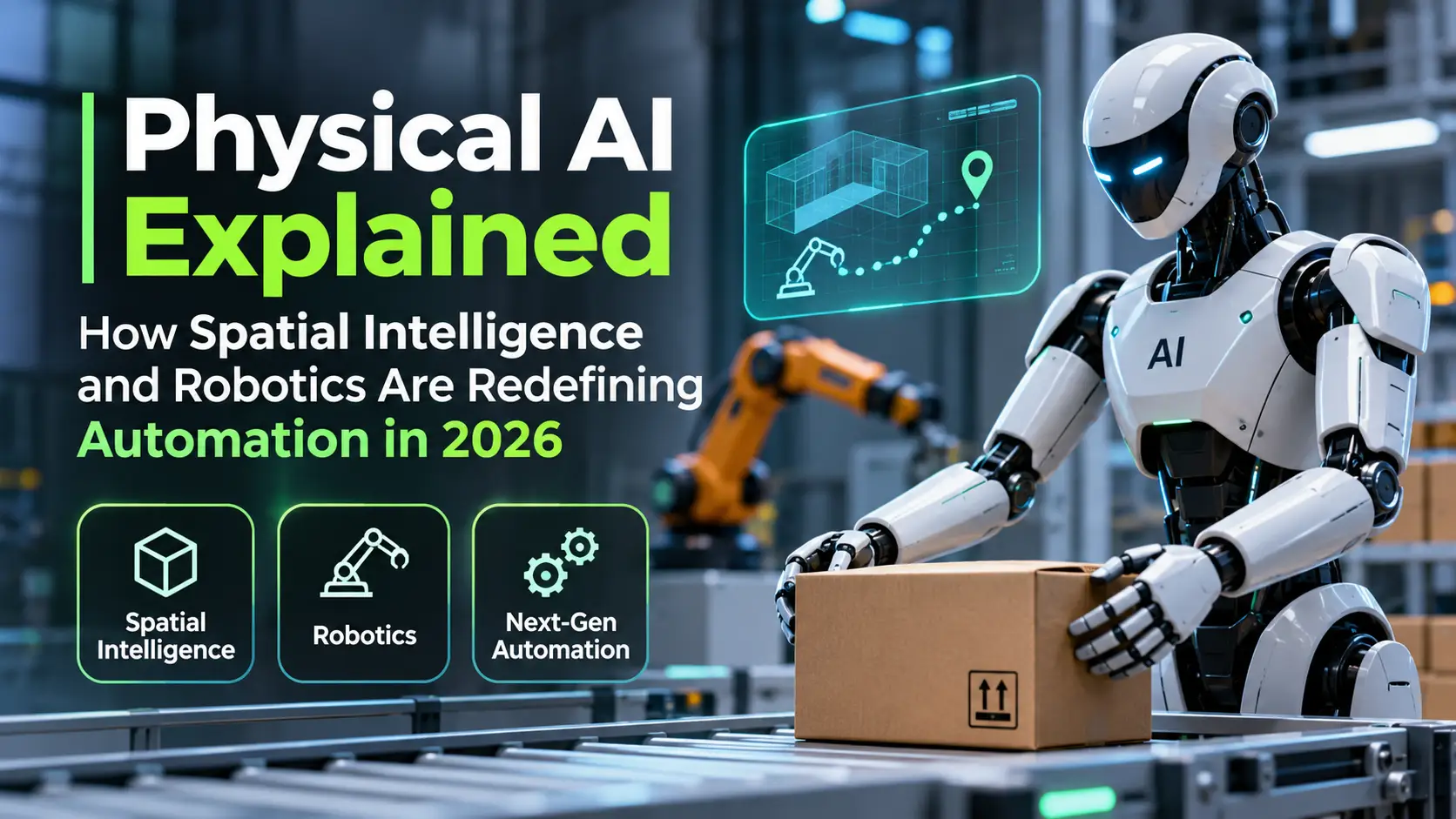
The artificial intelligence industry is crossing a major hardware boundary as foundation models merge with embodied robotics and physical sensor arrays, establishing “Physical AI” as a distinct commercial market projected to exceed $2,129 billion globally by 2035.
Driven by breakthrough Vision-Language-Action (VLA) models, real-time spatial intelligence, and industrial robotics integration, enterprise hardware deployments are shifting from rigid pre-programmed logic to machines capable of perceiving unstructured physical environments and executing real-world manipulation.
01. Key Metrics: The Rapid Expansion of Physical AI
- Market Momentum: The Physical AI market is accelerating rapidly in 2026, with North America representing a 37.2% regional market share driven by advanced industrial automation, followed by Asia-Pacific and Europe.
- Vision-Language-Action (VLA) Frameworks: Modern physical AI leverages single, unified neural networks that process camera feeds and spatial depth data to output direct robotic joint actuations and navigation controls.
- Synthetic Training & Physics Simulation: Because real-world hardware failure carries significant cost, robotics companies are utilizing photorealistic physics simulators to train physical AI agents across millions of synthetic edge cases before real-world staging.
- Surging Industrial Installations: Global industrial robot density continues to climb, with European manufacturing reaching an average of 267 robots per 10,000 employees while logistics robotics shipments expand by over 20% year-on-year.
02. Core Differences: Digital AI vs. Physical AI
| Feature / Dimension | Digital & Generative AI | Physical AI (Embodied Intelligence) |
|---|---|---|
| Operating Domain | Virtual interfaces, text synthesis, data lakes, code syntax | Real-world environments, physical warehouse floors, dynamic logistics |
| Sensory Inputs | Text tokens, uploaded image files, audio streams | LiDAR, stereoscopic vision cameras, IMU sensors, force feedback |
| Core Models | LLMs (Large Language Models), Multimodal Diffusion | VLAs (Vision-Language-Action), Spatial Foundation Models |
| Primary Hardware | Hyperscale cloud data centres & GPUs | Edge-AI NPUs, Autonomous Mobile Robots (AMRs), robotic arms |
03. Primary Commercial Deployment Sectors
While humanoid robotics continues to capture public attention, practical enterprise rollouts in 2026 are heavily anchored in three high-utility sectors:
- Warehouse & Logistics Automation: Autonomous Mobile Robots (AMRs) equipped with spatial vision dynamically navigate complex fulfillment centers alongside human staff without needing pre-laid magnetic floor tracks.
- Precision Manufacturing & Assembly: Automotive and electronics factories utilize vision-guided robotic arms capable of adapting to microscopic part variances on high-speed conveyor lines.
- Commercial Maintenance & Infrastructure: Heavy-duty autonomous scrubbers, inspection drones, and pipeline crawlers operate independently in high-hazard or continuous-shift facilities.
04. Frequently Asked Questions (FAQ)
What is Physical AI?
Physical AI (often referred to as Embodied AI) is the integration of advanced artificial intelligence models with physical machinery, enabling robots and autonomous vehicles to sense, navigate, and interact with unstructured real-world environments.
What are Vision-Language-Action (VLA) models?
VLA models are end-to-end neural networks that interpret visual sensor data, understand natural language instructions, and translate them directly into real-time robotic motor commands and physical actions.
05. Related NewsY Coverage
Read about practical robotics investments in our Bengaluru and Pune Enterprise AI & Robotics Expansion Report, track software automation in our Agentic AI Analysis, and visit our Technology Section.
06. Sources
- Globe Market Research — Physical AI Statistics: Market Size, Investment & Growth 2026–2035, October 2026.
- Persistence Market Research — Physical AI Market Size, Regional Share & Industry Trends, 2026.
NewsY Tech Note: Robotics installation metrics, market sizing projections, and technical model definitions reflect validated robotics research reports and international industrial data.