Bali is the easiest big international holiday most Indian travellers can plan — non-stop flights from Delhi and Bengaluru, a visa bought on arrival, and an island small enough to cover in five days. A Bali trip from India works for a first foreign holiday, a honeymoon or a friends’ getaway. Figures below reflect rules and prices in force in November 2026 — check the official sites before you travel.
How to reach Bali from India
You fly into Ngurah Rai International Airport (DPS) in Denpasar. Air India flies non-stop from Delhi in about seven and a half to eight hours, and IndiGo flies non-stop from Bengaluru in about seven hours. From Mumbai, IndiGo runs a same-aircraft service with a stop in Chennai that takes about nine hours. From other cities you connect through Singapore, Kuala Lumpur or Bangkok, putting the total journey at nine to fourteen hours.
Overnight departures are common, so you land in the morning and still get a full first day. Bali is two and a half hours ahead of India. From the airport, Seminyak is about 10–12 km away (20–45 minutes); Ubud is about 36 km (one to two hours). The official airport taxi counter charges roughly IDR 150,000–250,000 to Seminyak and IDR 400,000–500,000 to Ubud. Grab and Gojek are cheaper, but you must walk to a designated pick-up area.
Planning more Southeast Asia holidays? See our Singapore trip from India and Bangkok trip from India guides.
Visa rules for Indian passport holders
Indian passport holders need a visa for Bali, but it is a simple one. Indonesia gives Indians a visa on arrival — or the same visa online as an e-VOA — for IDR 500,000 per person. It allows a 30-day stay, extendable once by 30 days. Your passport must be valid for at least six months, and carry a return ticket and proof of stay.
Apply for the e-VOA before you fly at the official immigration portal, evisa.imigrasi.go.id — the fee is the same as at the airport counter, and you skip the payment queue. Do not pay on any other website. Indonesia announced plans in August 2026 to raise the visa fee, but no start date has been set.
Two more steps sit alongside the visa: the free All Indonesia arrival card, filled in online within three days before arrival. And Bali charges every foreign tourist a separate tourist levy of IDR 150,000 per person, once per trip. Pay it before you fly at lovebali.baliprov.go.id, the official Love Bali portal, or at a counter at the airport. Payment is cashless only, and you get a QR voucher by email. The levy is not the visa.
Best time for a Bali trip from India
Bali’s dry season runs from April to October, and that is the best time to go. Skies are clear, humidity drops, and the sea is calm enough for the Nusa Penida boats to run reliably. May, June and September are the sweet spot — the same weather, thinner crowds, cheaper hotels. July and August are the driest months — and the busiest and most expensive.
The wet season, November to March, brings short, heavy downpours and the cheapest rates. Bali is warm all year, with daytime highs of 29–32°C in every month. One date to watch: Nyepi, the Balinese day of silence, falls on 8 March in 2027, when the airport shuts for 24 hours — check the date for your travel year before booking.
Day 1: Arrive in Seminyak and settle in
Land at Denpasar, clear immigration with your e-VOA, and head straight to Seminyak. Keep this day light: check in, walk to the beach for your first sunset, and have dinner at a warung — a small family-run eatery — where nasi goreng or mie goreng costs about IDR 25,000–45,000 a plate. The streets behind the beach are Bali’s best for shops and cafés, and the easiest place to find vegetarian and Indian food.
Day 2: Uluwatu Temple and the Kecak fire dance
Keep the morning slow — a late breakfast, a swim, maybe a spa treatment. In the afternoon, head south to Uluwatu Temple, about 45 minutes to an hour from Seminyak. The temple sits on a cliff some 70 metres above the Indian Ocean. Entry is about IDR 50,000–60,000 for foreign adults, and the temple is open daily from 7am to 7pm.
Stay for the Kecak fire dance, which starts at about 6pm in the open-air amphitheatre beside the temple. Dozens of men chant while dancers act out a story from the Ramayana, ending around a fire as the sun sets. Tickets are separate from temple entry — about IDR 150,000 for adults — and the gate opens at about 4pm, so arrive by 4–5pm to get a seat on the sunset side. Watch your belongings: the temple’s monkeys are famous for snatching sunglasses. Bring cash in small notes, because the counters often do not accept foreign cards.
Day 3: Ubud, rice terraces and temples
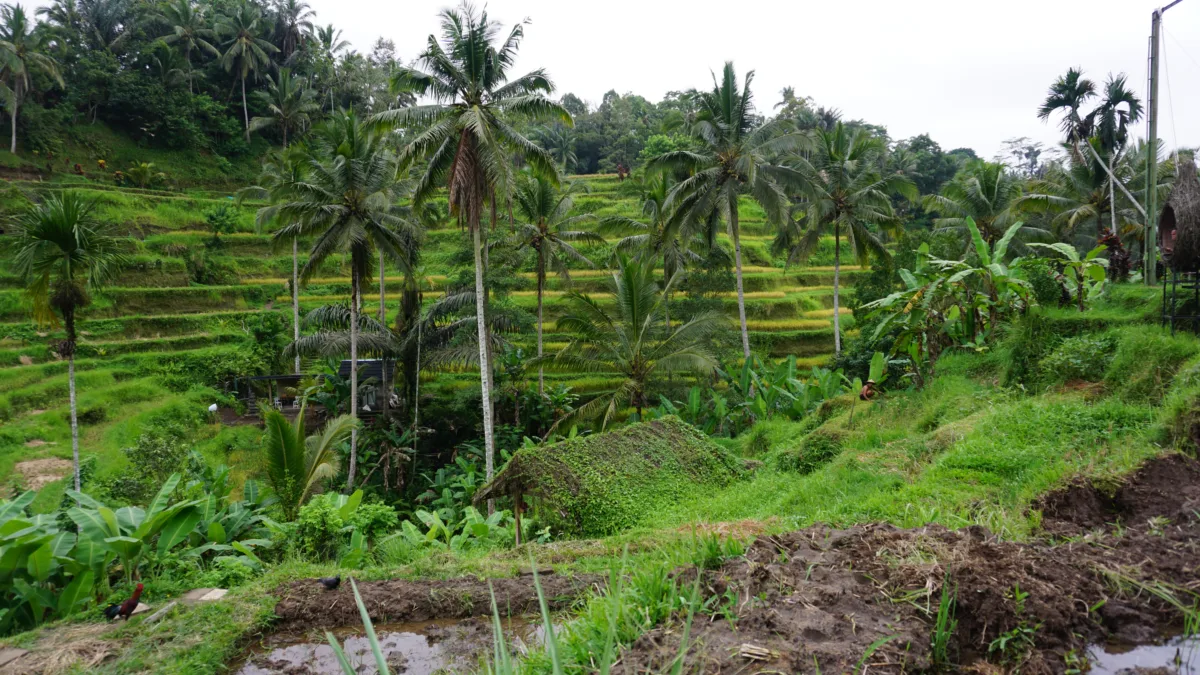
Move to Ubud in the morning — the drive takes one to two hours, so leave before 11am to beat the worst of the Denpasar traffic. Ubud is Bali’s cultural heart: cooler, greener and quieter than the coast. Start at the Tegalalang Rice Terrace, about 9–10 km north of town and a 20–30 minute drive. Go before 9am, when the light is soft and the tour buses have not arrived. There is no single official ticket: booths and farmers along the paths ask for about IDR 15,000–25,000 per person in cash.
Spend the afternoon in central Ubud. Walk the Campuhan Ridge, browse the art market, and visit the Saraswati Temple and its lotus pond. Ubud is also the best place in Bali for a cooking class or a Balinese massage.
Day 4: Nusa Penida day trip
Day four is the big one. Nusa Penida, off Bali’s south-east coast, is famous for the Kelingking Beach cliff viewpoint, the rock arch at Broken Beach and the rock pools at Angel’s Billabong. Fast boats leave from Sanur harbour from about 6:30–7:30am and take 30–45 minutes to cross. A return ticket booked online costs about IDR 250,000–350,000; at the harbour on the morning it can cost up to IDR 100,000 more each way, so book ahead.
On the island, hire a private car with a driver for the day — about IDR 550,000–900,000 for the vehicle — because the roads are rough and the sights are far apart. Budget for the island levy of IDR 25,000 per person, plus about IDR 25,000 at each main site, a charge introduced in 2026. Take a morning boat out and an afternoon boat back (around 3:30–4pm) — the last boats at 5pm fill fast and are the first to be cancelled if the sea turns rough.
Day 5: Tanah Lot and the flight home
On your last day, check out of Ubud and head back towards the airport with a stop at Tanah Lot, the sea temple on a rock off Bali’s west coast. It is about an hour from Ubud and 45 minutes from Seminyak. Entry is IDR 75,000 for foreign adults, cash only, and the grounds are open from 7am to 7pm. Non-Hindus cannot enter the inner shrine, but at low tide you can walk to the base of the rock. If your flight is in the evening, time your visit for the late afternoon — but arrive by 4:30pm, because the sunset crowds build fast.
Leave plenty of time for the airport — Bali’s traffic is unpredictable, and the road from Tanah Lot can take well over an hour in the evening. Reach the airport at least three hours before an international flight.
Where to stay in Bali
Split your stay: two nights on the south coast, two nights in Ubud. Seminyak suits first-timers who want beaches, restaurants and nightlife within walking distance. Kuta, just south of it, is louder and cheaper. Ubud suits anyone who wants temples, jungle and a slower pace. Sanur, on the east coast, is quieter and handy for the Nusa Penida boats.
Budget guesthouses and homestays with a pool cost about ₹1,000–3,500 a night; mid-range hotels ₹3,000–8,000; and a private pool villa for two about ₹5,000–8,000 a night in the shoulder season.
Food in Bali
Nasi goreng and mie goreng are everywhere, along with satay, gado-gado (vegetables with peanut sauce) and ayam betutu (slow-cooked chicken). A meal at a warung costs about IDR 25,000–45,000 a dish, while a café lunch in Ubud or Canggu runs IDR 75,000–150,000. A mid-range dinner for two is about IDR 400,000.
Vegetarians do well: tempeh and tofu appear on almost every menu, and Ubud is full of vegetarian and vegan cafés. Indian restaurants are easy to find in Seminyak, Kuta and Ubud. Drink bottled water, not tap water, and be careful with ice from street stalls.
What the trip costs
For five days, a budget traveller can manage on about ₹45,000–65,000 per person including flights, staying in guesthouses and eating at warungs. A comfortable mid-range trip — decent hotels, a private driver, café meals and the Nusa Penida day trip — works out to about ₹70,000–1,10,000 per person. A premium trip with pool villas and private tours runs about ₹1,30,000 or more per person. July and August cost the most; February and March are the cheapest months to fly.
The fixed costs are small: the visa IDR 500,000 (about ₹2,600) and the tourist levy IDR 150,000 (about ₹800) per person. A full-day car with a driver costs about IDR 500,000–700,000, good value split between two or more people. Scooters rent for about IDR 60,000–150,000 a day. As a rough guide, ₹1 buys about IDR 190–195, but the rate moves — check it the week you travel, and carry cash as well as cards.
Practical tips for a Bali trip from India
Think twice before renting a scooter. You legally need your Indian motorcycle licence plus an International Driving Permit with a motorcycle endorsement — a car-only licence does not cover a scooter, and an Indian licence alone is not valid in Indonesia. Police checks are common, fines run IDR 250,000–1,000,000, and your travel insurance may not cover a crash if you were riding without the right papers. If you do not have the permit, use a car with a driver or a ride-hailing app instead.
There is no practical public transport, so plan your days around a driver or an app taxi. Dress modestly at temples — shoulders and knees covered — and a sarong is usually provided at the entrance. Bargaining is normal in markets but not in restaurants or malls. Buy travel insurance that covers medical evacuation, and download your hotel, visa and levy documents offline — phone signal is patchy on Nusa Penida and in the hills around Ubud.