A Bangkok trip from India is one of the easiest first trips abroad. The flight takes about 4 to 5 hours, the food is cheap and the temples are grand. Four days is enough for the old city, the markets, a floating market and a day trip to Ayutthaya.
This plan starts with the visa rules, because they changed in September 2026. Prices and fees below are in Thai baht unless stated, and they are ranges, not fixed figures. Check them before you travel, because fees and hours change.
01. Bangkok trip from India: visa rules
The 60-day visa-free stay for Indians ended on 14 September 2026. From 15 September 2026, Indian ordinary passport holders travelling for tourism get a visa exemption of up to 30 days, free, with no advance application. You can extend it once by 30 days at an immigration office, for 1,900 THB. The exemption through land borders can be used no more than twice per calendar year.
Visa on arrival is not available to Indians, so do not queue at the visa-on-arrival counters. Your passport must be valid for at least 6 months from arrival. Carry a confirmed return ticket, a hotel booking and a travel itinerary. You may also be asked to show proof of funds of at least THB 20,000 in cash per person, or THB 40,000 per family, and cards may not be accepted as proof.
The Thailand Digital Arrival Card, or TDAC, is mandatory. Every non-Thai national must submit it online within 3 days before arrival, with the arrival day counting. It is free, and the only official site is tdac.immigration.go.th. It replaced the paper TM.6 form on 1 May 2025, and it is not a visa. Children and infants need their own card, and copycat sites that charge US$20 to US$90 should be avoided.
For stays longer than 30 days, or travel for a purpose other than tourism, apply for an e-visa at thaievisa.go.th. A single-entry tourist visa costs ₹3,000, is valid for 3 months and allows up to 60 days per entry. A multiple-entry tourist visa costs ₹13,500, is valid for 6 months and allows 60 days per entry. Processing takes 3 to 5 working days by some accounts and up to 14 by others, and fees are not refunded if the visa is refused. Re-check the rules at tatnews.org before you travel.
02. Flights from India to Bangkok
Delhi to Bangkok takes about 4 hours 20 minutes to 4 hours 55 minutes. Mumbai to Bangkok takes about 4 hours 15 minutes to 4 hours 45 minutes. IndiGo, Air India and Thai Airways fly nonstop into Suvarnabhumi (BKK), about 25 to 30 km east of the city, while Thai AirAsia X and SpiceJet also fly into Don Mueang (DMK), about 22 to 29 km north.
From Suvarnabhumi, the Airport Rail Link costs 15 to 45 THB and takes about 26 to 30 minutes. A metered taxi costs about 350 to 650 THB all in and takes 40 to 60 minutes. From Don Mueang, the SRT Red Line costs 12 to 42 THB. Bangkok is 1.5 hours ahead of India.
03. Best time to visit Bangkok
The best time to visit Bangkok is November to February, the cool, dry season, with daytime highs of about 32 to 34°C and nights of about 21 to 25°C. December is the driest and coolest month. Peak season brings the highest hotel rates and the worst PM2.5 haze, roughly December to March. The hot season runs from March to May, with April the hottest month at about 36°C and up to 40°C, and the Songkran water festival in mid-April. The rainy season runs from about May to October, with short, intense downpours, and hotel rates 20 to 40 percent below peak.
04. Day 1: the old city, Grand Palace and Wat Arun
Morning, the Grand Palace and Wat Phra Kaew: Start at 08:30. The Grand Palace and the Temple of the Emerald Buddha cost 500 THB for foreign visitors, and the ticket covers the palace grounds and Wat Phra Kaew. Thai nationals enter free with ID. The palace is open daily from 08:30 to 16:30, and ticket sales end at 15:30. The dress code is strict: shoulders and knees must be covered. A sarong can be rented near the entrance. If anyone outside tells you the palace is closed today, ignore them. That is a well-known scam.
Midday, Wat Pho: Wat Pho is a 5-minute walk from the Grand Palace. It costs 300 THB and is open daily from 08:00 to 19:30. The Reclining Buddha is 46 metres long and 15 metres high, covered in gold leaf, with mother-of-pearl feet. Wat Pho is the birthplace of Thai massage. Dress modestly, with shoulders and knees covered.
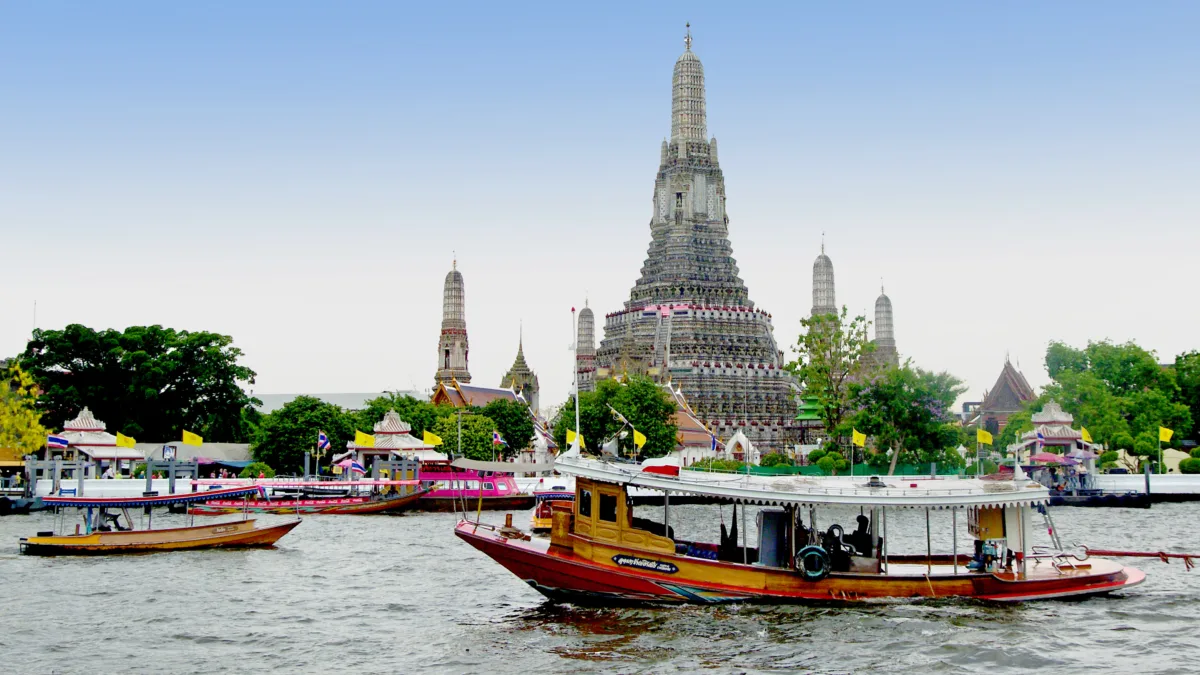
Afternoon, Wat Arun: Cross the Chao Phraya by ferry from Tha Tien pier to Wat Arun, the Temple of Dawn. Entry costs 200 THB, and it is open daily from 08:00 to 18:00. The central prang is encrusted with coloured porcelain and is about 80 metres high. The main prang was completed in 1851 and restored from 2013 to 2017. The steps are steep, and the best light is at sunset.
05. Day 2: markets, malls and Chinatown
Morning, Chatuchak Weekend Market: This works only if Day 2 is a Saturday or Sunday. Chatuchak, also called JJ Market, is open on Saturday and Sunday from 09:00 to 18:00, and entry is free. Reach it by MRT to Kamphaeng Phet or BTS to Mo Chit, and arrive by 10:00, before the heat and the crowds. There are thousands of stalls across more than 25 sections. Without a weekend, swap this for a mall.
Afternoon, Siam malls: MBK Center, at 444 Phayathai Road in Siam, is open daily from 10:00 to 22:00. It has 8 floors and more than 2,000 shops, and bargaining is common. Reach it by BTS to National Stadium. ICONSIAM, on the river, is also open daily from 10:00 to 22:00, with more than 500 shops and fountain shows at about 19:00, 20:00 and 21:00. Reach it by the BTS Gold Line or the free shuttle boat from Sathorn Pier.
Evening, Yaowarat, Chinatown: Yaowarat is Bangkok’s night street-food street. Eat where the locals eat, because the same dish can cost two to three times more on the tourist streets. Try pad thai, pad kra pao, tom yum, som tam and mango sticky rice. Most street-food plates cost about 40 to 80 THB, and pad thai about 50 to 80 THB at local stalls. A street meal with a drink costs about 100 to 150 THB.
06. Day 3: floating market and the river
Early morning, Damnoen Saduak floating market: Leave Bangkok by about 05:30 to 06:00 for the 100 km drive, 1.5 to 2 hours each way. Entry is free, and the best time is 07:00 to 09:00. A paddle boat costs about 150 to 300 THB per person, or about 300 to 600 THB per boat per hour. A guided half-day tour costs about 690 to 1,500 THB.
Afternoon, the Chao Phraya river: Take the blue-flag tourist boat: 40 THB for a single trip or 150 THB for a day pass, daily from about 08:30 to 19:45. Board at Sathorn Pier, beside BTS Saphan Taksin. The orange-flag boat costs 19 THB flat. Key piers are Tha Tien for Wat Pho and Tha Chang for the Grand Palace. In the evening, walk Khao San Road, the backpacker street. Entry is free, and the bars run past 02:00. There is no BTS or MRT nearby.
07. Day 4: Ayutthaya day trip
Ayutthaya, about 80 km north, is a UNESCO World Heritage site since 1991 and was the capital of Siam for 417 years until 1767. The local 3rd class train costs 20 THB and takes about 1 hour 45 minutes from Hua Lamphong. A rapid train from Krung Thep Aphiwat takes about an hour, with 2nd class at about 61 THB. Hire a tuk-tuk for about 200 to 400 THB an hour, or a bicycle for about 50 THB a day. Temple entry fees are small and vary, so check them on the day. Take the evening train back.
08. Where to stay in Bangkok
Sukhumvit is the best all-round area. A hostel bed costs about 380 to 900 THB a night, a mid-range room about 1,500 to 3,200 THB, and a 4-star hotel about 2,500 to 5,000 THB. Silom and Sathorn have both BTS and MRT. A hostel costs about 350 to 800 THB and a 3-star hotel about 1,500 to 3,000 THB. The Riverside is for views, with 5-star hotels at about 6,000 to 15,000 THB. Khao San and the Old City are the cheapest, with hostel beds at about 200 to 600 THB and guesthouse doubles at about 600 to 1,500 THB. Peak season adds about 20 to 50 percent.
09. Getting around Bangkok
The BTS costs about 16 to 65 THB per trip and runs from about 05:15 to 00:30. The MRT Blue Line costs about 17 to 45 THB and runs from about 06:00 to 24:00. The two are separate systems, so you need separate tickets at interchanges. Grab or Bolt cars cost about 80 to 200 THB in town. A metered taxi starts at 35 THB, then about 6.50 THB per kilometre. Insist on the meter. A tuk-tuk has no meter, so negotiate before you board, and beware the gem-shop detour scam.
10. How much does a Bangkok trip from India cost?
All figures below are per person for 4 days and 3 nights, excluding flights, and they are ranges. As a rough guide, 1 THB is about ₹2.87.
Budget, about 2,800 to 6,000 THB: a hostel dorm at 300 to 600 THB a night, food at 200 to 350 THB a day, transport at 80 to 180 THB a day, and attractions at 100 to 300 THB a day. Mid-range, about 10,000 to 20,000 THB: a 3 to 4 star hotel at 1,800 to 3,500 THB a night, food at 500 to 900 THB a day, transport at 150 to 300 THB a day, and attractions at 300 to 700 THB a day. Carry about 8,000 to 10,000 THB in cash per person for 4 days, because small stalls often do not take cards.
If you like international trips from India, also read our Dubai trip from India, 4-day itinerary, and for a beach trip closer to home, our Goa trip, 3-day North Goa itinerary.
11. Tips before you go
Submit your TDAC within 3 days before arrival, and carry THB 20,000 in cash per person. Re-check the visa rules before you travel, because they changed in September 2026 and many guides are out of date. Dress for the temples before you leave the hotel, and insist on the meter in taxis.