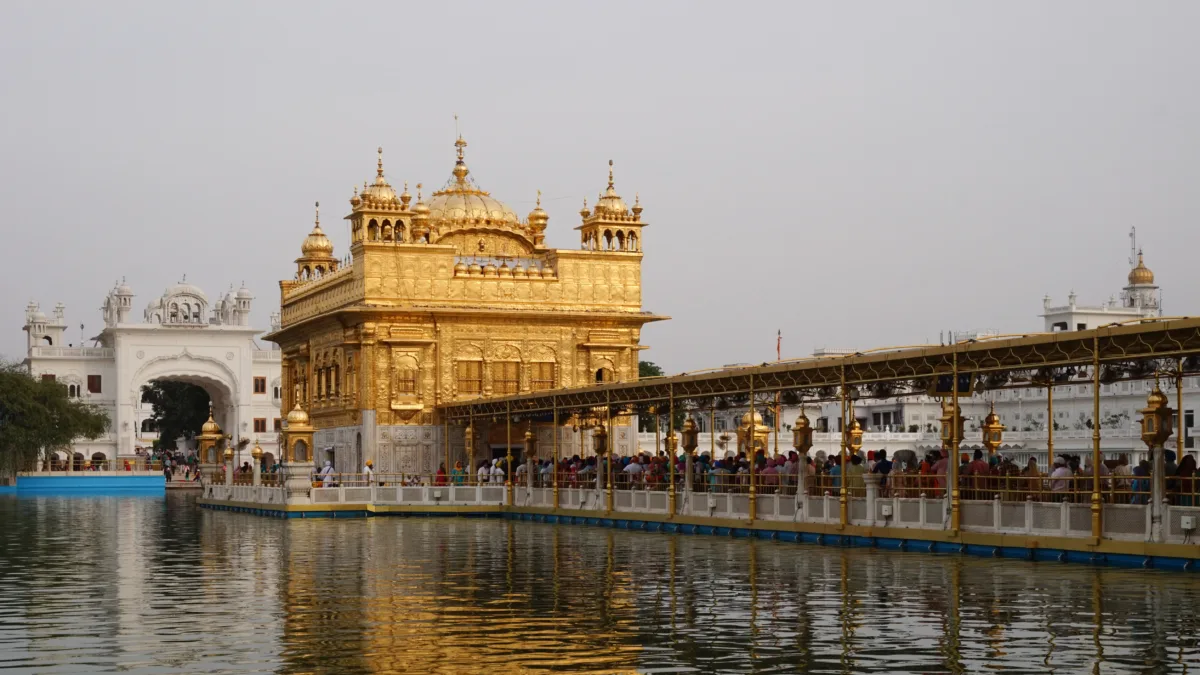
An Amritsar trip is one of the most rewarding short trips from Delhi. The Golden Temple is open through the night, the langar feeds everyone for free, and Jallianwala Bagh, the Partition Museum and the Wagah border ceremony are all within a short distance. This Amritsar trip 2 day itinerary starts with the Golden Temple and the old city on Day 1, and covers the forts, the Durgiana Temple and Wagah on Day 2.
Prices and timings below are ranges, not fixed figures. Check them before you travel, because entry fees, train times and ceremony timings change. One date to know: Guru Nanak Jayanti falls on Tuesday, 24 November 2026, and the Golden Temple will be lit up, with the Akhand Path starting around 22 November and the Nagar Kirtan around 23 November.
01. How to reach Amritsar from Delhi
By train: The rail distance is about 446 to 447 km, and the train is the best way to reach Amritsar. The Vande Bharat Express (22487) leaves Delhi at 15:15 and reaches Amritsar at 20:45, in 5 hours and 30 minutes, and it does not run on Fridays. The return train (22488) leaves Amritsar at 08:20 and reaches Delhi at 13:50. The Swarn Shatabdi (12029) leaves New Delhi at 07:20 and reaches Amritsar at 13:30, and the return (12030) leaves Amritsar at 16:50 and reaches New Delhi at 22:50. The Amritsar Shatabdi (12013) leaves New Delhi at 16:30 and reaches Amritsar at 23:05. Train fares vary by class and date, so check them on IRCTC when you book. For a morning arrival, take the Swarn Shatabdi. For a same-day return, the Vande Bharat works well.
By road: Amritsar is about 450 to 460 km from Delhi via NH-44, the Grand Trunk Road, through Panipat, Karnal, Ambala, Ludhiana and Jalandhar. The drive takes 7 to 9 hours, most often 7 to 8 hours. Tolls apply through FASTag. Buses take 8 to 9 hours, and fares range widely, from about ₹490 for an ordinary bus to about ₹1,980 or more for a sleeper, so check before you book.
By air: Sri Guru Ram Dass Jee International Airport is about 11 km north-west of the city centre, a taxi ride of 20 to 30 minutes. Flights from Delhi take about an hour, but in December and January, fog can delay morning flights and trains, so keep that in mind.
02. Best time to visit Amritsar
The best time to visit Amritsar is October to March. Winter days are pleasant, with temperatures from about 4 to 5°C at night to about 25°C in the day, though December and January nights are cold and foggy. Summer, April to June, regularly crosses 40°C and can reach 44 to 45°C, so avoid midday sightseeing. The monsoon, July to September, is warm and humid at about 25 to 35°C, with showers.
03. Day 1 of this Amritsar trip 2 day itinerary: the Golden Temple and the old city
Morning, the Golden Temple: Start at the Golden Temple, Sri Harmandir Sahib. Entry is free, and the complex is open 24 hours a day. The inner sanctum is not open all night. It opens at about 4 AM and closes at about 10 PM, with the morning Prakash ceremony at about 3:00 to 4:30 AM and the closing Sukhasan ceremony at about 9:30 to 10:30 PM, varying by season. Kirtan, the devotional singing, runs from about 4:30 AM to 9:30 PM.
Before you enter, cover your head. A head covering is mandatory for everyone, and free scarves are available at the entrance. Remove your shoes and socks and leave them free at the Joda Ghar, and wash your feet in the foot-bath. Dress modestly, with shoulders and legs covered. No smoking, alcohol, tobacco or non-vegetarian food is allowed in the complex. You can read the official guidance on the SGPC site at sgpc.net.
Midday, the langar: The Guru ka Langar, the free community kitchen, runs 24 hours a day and serves about 50,000 to 100,000 meals a day on ordinary days, and more on festivals and weekends. Everyone is welcome, and the meal is free. Sit on the floor, eat what is served, and return your plate when you finish. It is one of the largest free kitchens in the world, and it is worth experiencing even if you eat only once.
Afternoon, Jallianwala Bagh and the Partition Museum: Jallianwala Bagh is about a 5-minute walk from the Golden Temple, via Heritage Street. Entry is free. This is where the massacre of 13 April 1919 took place, and the bullet marks and the Martyrs’ Well are still there. Timings are reported differently by different sources, so use a safe range. The garden is generally open from about 6:30 AM to 7:30 PM, and the museum and gallery hours are shorter, roughly 9 or 10 AM to 5 PM. Check at the gate.
The Partition Museum is in the Town Hall on Hall Road, also about a 5-minute walk from the Golden Temple. It opened on 25 August 2017 and has 14 galleries telling the story of Partition through objects, letters and voices. It is open Tuesday to Sunday, 10:00 AM to 6:00 PM, and closed on Mondays. The fee on the museum’s own site is ₹10 for Indian citizens and ₹250 for foreign visitors, and children up to 5 are free. Some guides list older fees, so use the official figure and check before you travel. See partitionmuseum.org for the latest details.
Evening, Heritage Street and dinner: Walk Heritage Street and Hall Bazaar in the evening, then eat in the old city. Kesar Da Dhaba, near the Town Hall at Chowk Passian, has served vegetarian food since 1916. Its dal makhani, laccha paratha, phirni and chole are famous, and a meal costs about ₹200 to ₹400. Its hours are reported differently, so check on the day. Bharawan Da Dhaba, also near the Town Hall, dates to 1912. For breakfast the next morning, try an Amritsari kulcha at All India Famous Amritsari Kulcha, Bhai Kulwant Singh Kulchian Wale, or Pehalwan Kulcha Shop near Chatiwind Gate. End the day with a night visit to the Golden Temple, when the gold reflects in the water and the crowds thin out.
04. Day 2: forts, temples and the Wagah border ceremony
Morning, Durgiana Temple and Gobindgarh Fort: Start at the Durgiana Temple, near Hathi Gate Chowk and about 1.5 km from Amritsar Junction station. It is dedicated to Goddess Durga, with Lakshmi and Vishnu also worshipped, and its architecture is similar to the Golden Temple. It is open from 6:00 AM to 10:00 PM daily, and entry is free.
Then go to Gobindgarh Fort, which is open daily from 10:00 AM to 10:00 PM. The fort has museums, a 7D show and an evening light-and-sound show. The entry fee is reported differently by different sources, so use a package range of about ₹175 to ₹358, and check at the gate. The light-and-sound show runs at about 6:00 PM in winter and about 7:00 PM in summer, but confirm the time on the day.
Afternoon, the Wagah border ceremony: Leave central Amritsar by 2:30 to 3:00 PM for the Attari border, 28 to 30 km west of the city, a drive of 45 to 60 minutes. The Beating Retreat ceremony runs every day at sunset and lasts 30 to 45 minutes. Entry is free, and there is no official paid VIP ticket. The time shifts with the seasons, so do not rely on a single clock time. In late autumn and winter it runs at about 5:00 to 5:30 PM, and in summer at about 5:15 to 6:30 PM. Confirm the time with your hotel or driver on the day. Arrive 1 to 2 hours early for a seat, and allow 3.5 hours before the ceremony on busy days. The ceremony resumed in May 2025 after a suspension, and it runs daily now.
Evening, dinner and departure: Return to Amritsar for dinner, or take the evening Vande Bharat or Shatabdi back to Delhi. If you are staying another night, the Golden Temple at dawn is worth a second visit.
05. Where to stay in Amritsar
Near the Golden Temple and Heritage Street is best for dawn and evening visits, 200 to 500 m from the temple, in a pedestrianised area. Budget hotels here cost about ₹650 to ₹2,500 a night. Mid-range hotels cost about ₹3,500 to ₹8,200 a night. Mall Road and Ranjit Avenue, about 3 to 5.5 km from the temple, have more modern hotels and cafes, and premium hotels cost about ₹8,800 to ₹24,000 a night.
The SGPC also runs sarais, guesthouses near the temple, including Sri Guru Ram Das Niwas and Guru Arjan Dev Niwas. Beds in the dormitory are free, and private rooms cost about ₹500 to ₹1,100. Book only through the official site, sgpcsarai.com, because fake sarai-booking sites have cheated devotees by asking for QR-code payments.
06. How much does an Amritsar trip cost?
All figures below are per person for 2 days in Amritsar, and they are ranges. Check before you travel.
Budget, about ₹3,000 to ₹5,500 per person: a free SGPC sarai bed or a budget room, the free langar and dhabas at ₹50 to ₹200 a meal, autos and e-rickshaws, and a shared taxi to Wagah at about ₹200 to ₹300 return. Mid-range, about ₹8,000 to ₹15,000 per person: a mid-range hotel, restaurant meals at ₹400 to ₹600, and a private cab, with the Wagah round trip at about ₹1,200 to ₹1,600. Entry fees are low. The Partition Museum costs ₹10 for Indian citizens, and a Gobindgarh Fort package costs about ₹175 to ₹358. Add the Delhi return on top: about ₹1,000 to ₹3,000 by bus or ordinary train for a budget trip, and about ₹2,000 to ₹5,000 by Vande Bharat, Shatabdi or flight for a mid-range trip.
If you like pilgrimage towns, also read our Varanasi trip, 2-day itinerary, and for another weekend trip from Delhi, our Jaipur weekend trip from Delhi.
07. Tips before you go
Do not plan the Partition Museum on a Monday, because it is closed. Carry a scarf or buy one at the Golden Temple entrance. Confirm the Wagah ceremony time on the day, because it shifts with sunset. Book sarai rooms only on the official SGPC site. And if you travel in December or January, allow extra time for fog, which can delay morning flights and trains.