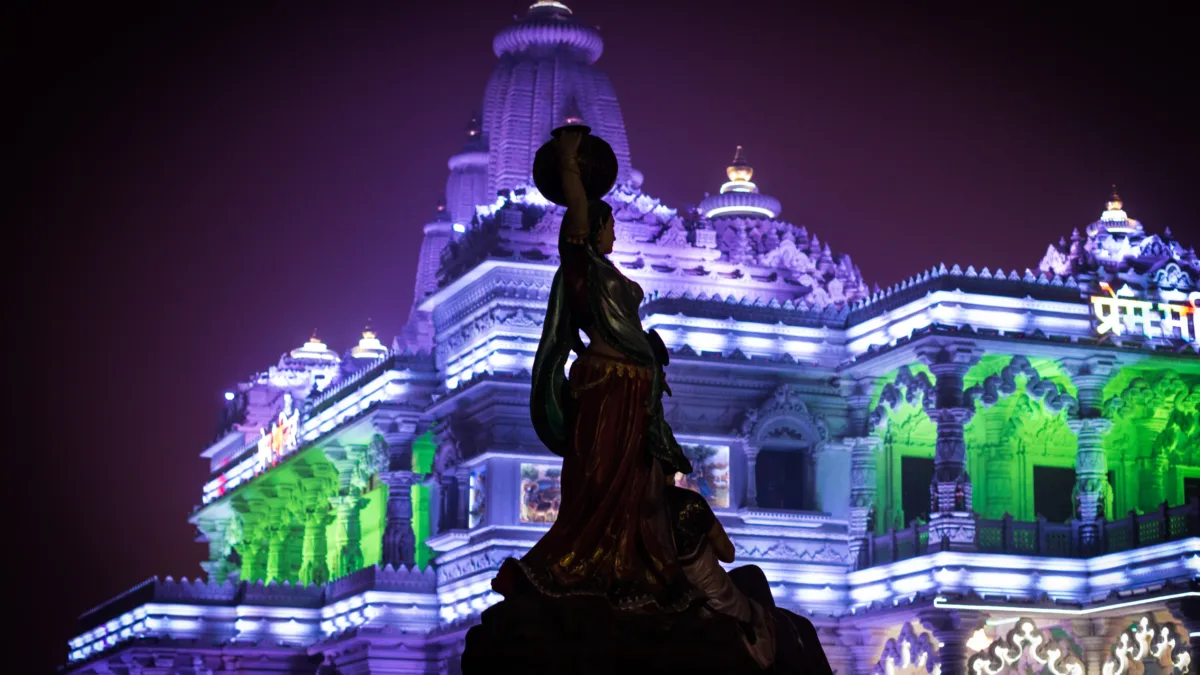
A Mathura Vrindavan weekend trip from Delhi is the easiest pilgrimage you can take from the capital. In under two hours by train or about three hours by road, you reach the town where Krishna is believed to have been born, and Vrindavan, where he is believed to have spent his childhood. Two days is the right amount of time: one day for Mathura’s temples and ghats, and a second for Vrindavan’s temples, groves and the evening light show at Prem Mandir. Entry to every major temple is free. Prices change, so check before you travel.
How to reach Mathura and Vrindavan from Delhi
Mathura sits about 150 to 160 km south of Delhi on the Yamuna river, and the train is the best way to get there for a weekend trip.
By train. The Bhopal Shatabdi (12002) leaves New Delhi at 06:00 and reaches Mathura Junction at 07:19. The Gatimaan Express (12050) leaves Hazrat Nizamuddin at 08:10 and reaches Mathura Junction in under two hours. Fares in AC Chair Car start at roughly Rs 395 on the Shatabdi and roughly Rs 750 on the Gatimaan, and they move with demand, so check IRCTC for your date and book early in the October to March season.
By road. The Yamuna Expressway is a six-lane, access-controlled road from Greater Noida towards Agra, and the drive from Delhi to Mathura takes 2.5 to 3.5 hours depending on where you start and on weekend traffic. The expressway is tolled, so carry a FASTag, and leave early on a Saturday, because the traffic near Greater Noida is the slowest part of the drive.
By air. The nearest airport is Agra (AGR), about 55 to 60 km from Mathura, but it has very limited flights. Most visitors fly into Delhi’s IGI Airport, about 150 to 170 km away, and continue by train or road.
Mathura to Vrindavan. Vrindavan is about 11 to 12 km from Mathura, a 25 to 45 minute drive. Shared autos charge roughly Rs 20 to Rs 40 per person, and a private auto costs roughly Rs 150 to Rs 250. Inside Vrindavan, the old town lanes are too narrow for cars, so the last stretch to Banke Bihari and the other old temples is on foot or by e-rickshaw. Hiring an e-rickshaw for a circuit of the temples costs roughly Rs 200 to Rs 350.
Best time to visit Mathura and Vrindavan
October to March is the best time to visit. Days are dry and mild, with temperatures roughly between 8°C and 28°C, and long walks between temples feel easy. October and November, just after the monsoon, give the best balance of clear skies and pleasant weather. April to June is best avoided: summer afternoons regularly pass 40°C, and the long midday temple closures make sightseeing hard.
Festivals change the trip completely. The main Holi falls on Monday, 22 March 2027, with Holika Dahan on the evening of Sunday, 21 March, and Braj Holi runs for about a week before that, town by town, with Lathmar Holi at Barsana and Nandgaon and the flower Holi at Banke Bihari in Vrindavan. The exact dates of the Braj Holi events are announced by the temples and can shift by a day, so confirm them nearer the time. Janmashtami, in August or September, brings the heaviest crowds of the year.
Day 1: Mathura — Krishna Janmabhoomi, Dwarkadhish and Vishram Ghat
Morning: Shri Krishna Janmabhoomi Temple. Start at the complex that marks the spot where Krishna is believed to have been born, in the prison cell of King Kansa. In summer it is open roughly 5:00 AM to 12:00 noon and 4:00 PM to 9:30 PM; in winter, roughly 5:30 AM to 12:00 noon and 3:00 PM to 8:30 PM. Entry is free, and the morning aarti is at about 6:30 AM. Phones, cameras, bags and all electronics are banned inside, and there is a deposit counter outside, so carry as little as possible.
Late morning: Dwarkadhish Temple and Vishram Ghat. Take an e-rickshaw to Dwarkadhish Temple, near Vishram Ghat, where Krishna is worshipped as the king of Dwarka. Darshan happens in short windows, roughly 6:30 AM to 10:30 AM in the morning and 4:00 PM to 7:00 PM in the evening, and entry is free. From the temple, step out to Vishram Ghat, the most sacred of Mathura’s ghats, where Krishna is believed to have rested after defeating Kansa. A short boat ride on the Yamuna is the best way to see the riverfront.
Evening: Yamuna aarti at Vishram Ghat. Come back to the ghat for the evening Yamuna aarti, held at dusk, roughly 6:30 PM to 7:00 PM, when priests raise tiered lamps over the river and small leaf boats of flowers and flame are set adrift on the water. Arrive by 6:15 PM for a place on the steps.
Day 2: Vrindavan — Banke Bihari, ISKCON, Nidhivan and Prem Mandir
Morning: Banke Bihari Temple. Reach Vrindavan early and go straight to Banke Bihari, the most visited temple in the town. Darshan happens through a curtain that opens and closes every few minutes. The temple’s hours were extended in September 2025: in summer, darshan runs roughly 7:00 AM to 12:30 PM and 4:15 PM to 9:30 PM; in winter, roughly 8:00 AM to 1:30 PM and 4:00 PM to 9:00 PM. Entry is free, and there is no official VIP darshan, so do not pay anyone who offers one. Weekends are extremely crowded, so allow an hour including the queue. The temple’s official site is bihariji.org.
Late morning: ISKCON Temple and Nidhivan. From Banke Bihari, walk or take an e-rickshaw to the ISKCON temple, the Sri Sri Krishna Balaram Mandir, founded in 1975. Darshan runs 4:10 AM to 12:45 PM and 4:30 PM to 8:45 PM, with the Mangala Aarti at 4:30 AM in the main temple and the evening Gaura Aarti at about 7:00 PM. Entry is free. Afterwards, visit Nidhivan, the walled grove of twisted tulsi trees where, by local belief, Radha and Krishna perform the raas leela every night. In summer it is open roughly 5:00 AM to 1:00 PM and 3:30 PM to 8:00 PM; in winter, roughly 6:00 AM to 1:00 PM and 3:30 PM to 7:30 PM. Entry is free. The grove is cleared and locked before sunset; no one stays inside after dark.
Evening: Prem Mandir. Vrindavan’s temples close in the afternoon, so use the break for lunch and rest, then return to Prem Mandir in the early evening. This is the white marble temple of Radha-Krishna built by Jagadguru Kripalu Maharaj, and it is at its best after dark. It is open 8:30 AM to 12:00 noon and 4:30 PM to 8:30 PM every day, and entry is free. The musical fountain show runs 7:30 PM to 8:00 PM in summer (April to September) and 7:00 PM to 7:30 PM in winter (October to March), when the marble is lit in changing colours and water jets move in time with devotional music.
Where to stay in Mathura and Vrindavan
Most visitors stay in Mathura, which has the widest choice of hotels, from budget guesthouses near the station to mid-range hotels near the ghats. Budget rooms in the October to February season run roughly Rs 800 to Rs 2,000 a night, so book ahead for weekends.
What to eat in Mathura and Vrindavan
Mathura and Vrindavan are strictly vegetarian towns, and the food is satvik, cooked without onion and garlic in most temple kitchens and restaurants. Mathura peda is the sweet the town is known for: a soft, brown, milk-based sweet sold by the kilo, and Brijwasi is the best-known shop. Lassi is the other local classic, thick and served in earthen cups, and the lassi shops near Krishna Janmabhoomi are busiest in the morning. Kachori and sabzi is the local breakfast: hot, puffed kachoris with a spicy potato curry, eaten standing at the old city stalls. Satvik thalis are the main meal: simple plates of dal, seasonal vegetables, rice and roti, served at temple kitchens, ashram dining halls and restaurants like the ISKCON-run Govinda’s garden cafe in Vrindavan.
How much does a Mathura Vrindavan weekend trip from Delhi cost?
Mathura and Vrindavan are among the cheapest weekend trips you can take from Delhi, because every major temple is free to enter. The figures below are ranges built from the fares and prices in this guide, excluding your hotel, which varies too much by season to fix in print. Check current prices before you travel.
- Train, return: roughly Rs 800 to Rs 1,500 per person in AC Chair Car on the Shatabdi or Gatimaan; slower trains and second sitting cost far less.
- Driving: fuel plus expressway tolls for the round trip; a private cab from Delhi costs roughly Rs 3,000 to Rs 5,000 for the weekend.
- Local transport: roughly Rs 500 to Rs 1,000 per person for two days of shared autos, e-rickshaws and the Mathura to Vrindavan hops.
- Temples: free entry at Krishna Janmabhoomi, Dwarkadhish, Banke Bihari, ISKCON, Prem Mandir and Nidhivan.
- Food: roughly Rs 800 to Rs 1,500 per person for two days of satvik thalis, street food and lassi.
Put together, a traveller doing this Mathura Vrindavan weekend trip from Delhi by train should expect roughly Rs 2,000 to Rs 4,000 per person for two days, excluding the hotel.
Practical tips for Mathura and Vrindavan
- Go at opening time. Banke Bihari and Krishna Janmabhoomi are calmest in the first hour after opening. On weekends, the queues at Banke Bihari can run to an hour or more.
- Leave your phone behind at Krishna Janmabhoomi. Phones and electronics are banned inside, and the deposit queue can be longer than the darshan queue. Carry one small bag and nothing else.
- Do not pay for darshan. Entry is free at every major temple, and there is no official VIP darshan at Banke Bihari. Anyone charging you is not official.
- Watch out for monkeys. Vrindavan’s monkeys are bold and quick, and they snatch glasses, bags and food from visitors’ hands. Hold your belongings close, especially near Banke Bihari and Nidhivan.
- Confirm timings on the morning of your visit. Temple hours shift with the season and on festival days, and Banke Bihari’s hours in particular have changed recently. A quick check before you set out saves a wasted trip.
Two days in Mathura and Vrindavan gives you the birthplace of Krishna, the most loved temple in Braj, the kirtan of ISKCON, the mystery of Nidhivan and the lights of Prem Mandir. If you liked this Mathura Vrindavan weekend trip from Delhi plan, our Agra weekend trip from Delhi follows the same two-day pattern just an hour further down the expressway, and our Varanasi two-day trip is the next step up in distance and depth.