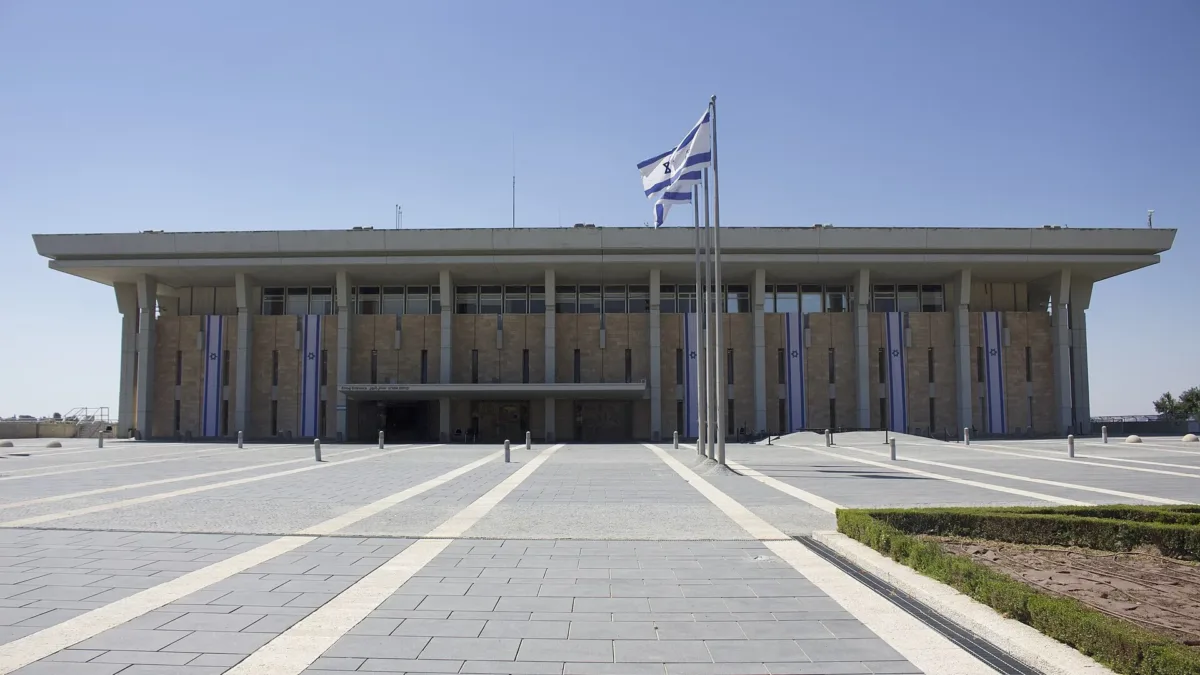
The Israel Knesset speaker election ended late on Tuesday with Matan Kahana, an ally of Gadi Eisenkot, winning the post by 66 votes to 52 — a result that hands the opposition bloc control of parliament’s agenda as it tries to replace Benjamin Netanyahu as prime minister.
Kahana, a member of Eisenkot’s centre-right Yashar party, becomes the Knesset’s 26th speaker, replacing Amir Ohana of Netanyahu’s Likud party. The vote followed hours of stormy debate, with lawmakers from Netanyahu’s bloc filibustering to delay the outcome. Lawmakers voted separately on each candidate rather than in a head-to-head ballot: Kahana received 66 votes and Likud’s candidate, coalition whip Ofir Katz, received 52. Both men abstained.
01. Israel Knesset speaker election: what the 66-52 vote changes
In Israel’s 120-seat parliament, the speaker is a powerful post. The speaker decides which legislation comes to a vote, so Kahana will be able to advance bills prioritised by the Eisenkot-led bloc and the parties backing the former general’s bid to become prime minister.
The vote is the first significant move by that bloc since the inconclusive election on 27 October, in which Netanyahu and his allies lost their parliamentary majority. His coalition of right-wing and ultra-Orthodox parties won 53 seats; the opposition holds 67, including 48 across four Jewish parties and a record 19 for the two Arab parties, the Joint List and Ra’am. Parliament was sworn in on 10 November without a new government, and Netanyahu remains caretaker prime minister until one is formed. President Isaac Herzog tasked Eisenkot with forming the next government earlier this month, and he has up to four and a half more weeks to do it.
Kahana won with the backing of Yashar, Together, the Democrats and Yisrael Beiteinu, along with Ra’am and the Joint List. The ultra-Orthodox United Torah Judaism party backed Katz. Before the vote, Religious Zionism had offered to support Kahana if he agreed not to appoint deputies from parties that do not define Hamas as a terrorist organisation, and to step down if a new government is formed. Kahana rejected the conditions and urged the parties to respect the democratic process and its results.
Eisenkot said on Tuesday that Kahana’s appointment was “a proper democratic move which reflects the absolute majority who voted for change.” Likud condemned the outcome, calling it “a low point in the history of the Knesset” and saying Kahana had been elected with what it called “the votes of terror supporters” — a reference to the Arab parties, whose support Netanyahu’s own allies have themselves repeatedly sought in the past, as CNN noted.
Avigdor Liberman, leader of Yisrael Beiteinu and now chair of the Foreign Affairs and Defense Committee, has said he will summon the security chiefs for briefings. But Eisenkot’s path to a government remains difficult: Liberman has vetoed any government that relies on the Arab parties, and is pushing for talks with the ultra-Orthodox Shas and United Torah Judaism parties, which have traditionally allied with Netanyahu. Former prime minister Naftali Bennett is also reported to favour talks on a unity government with Likud over an alliance with the Arab or ultra-Orthodox parties. For now, the speaker’s chair gives the anti-Netanyahu bloc its first real lever over the Knesset — and a test of whether it can hold together long enough to form a government.
The election comes as Israel’s parliament also weighs the country’s wider security picture: Britain sanctioned eight Israeli firms this week over West Bank settlements and the Gaza aid blockade, while the United States struck an Iranian missile site on Qeshm Island after Tehran’s drone attack on a US radar base in Bahrain. Full reporting on the vote is available from Reuters and the Associated Press.