A Bhutan trip from India is one of the easiest international holidays an Indian traveller can take. There is no visa to arrange, Indian rupees work at par with the ngultrum, and you can fly into Paro in about two hours from Delhi or drive in through the border town of Phuentsholing. What Bhutan does ask for is an entry permit, a nightly fee called the Sustainable Development Fee, and — under the current rules — a licensed guide once you travel beyond the border towns. This guide explains all three, then lays out a 4-day itinerary for Thimphu, Paro, the Tiger’s Nest and Punakha.
Bhutan Trip from India: Entry Permit, SDF and Documents
Indian nationals do not need a visa for Bhutan. Instead, every Indian traveller needs an entry permit, issued by Bhutan’s Department of Immigration. The permit itself is free. You can apply online in advance through the Immigration Services Portal at immi.gov.bt, or get the permit on arrival at Phuentsholing or at Paro International Airport. Applying online first cuts the wait at the border or airport.
For the permit, adults need one of two documents: a valid Indian passport with at least six months of validity, or an original voter ID card issued by the Election Commission of India. Children under 18 can enter with a passport or a birth certificate, and must travel with a parent or legal guardian. Aadhaar is not accepted as a travel document for entry into Bhutan, and neither are PAN cards, driving licences or photocopies of a passport. Do not set out with Aadhaar as your only ID.
On top of the permit, Indian nationals pay the Sustainable Development Fee, or SDF, of Rs 1,200 per person per night. Children aged 6 to 11 pay half, Rs 600 a night, and children under 6 pay nothing. The fee is paid when the permit is processed, and it is charged for every night you spend in Bhutan — so three nights inside Bhutan works out to Rs 3,600 per adult. Fees in Bhutan change with little notice, so check the current figure on immi.gov.bt or bhutan.travel before you book anything non-refundable.
One more rule catches many first-time visitors by surprise. Indian travellers do not have to book through a tour operator, and you can arrange your own hotels and transport. But under Bhutan’s current tourism rules, a licensed Bhutanese guide must accompany you once you travel beyond the border towns. Older guides and blogs still say Indians can travel fully independently, because that was true until a Department of Tourism notice in April 2026 tightened the guide requirement. Confirm the current position on the official tourism site before you travel, and budget for a guide in your plans.
How to Reach Bhutan from India
There are two ways in: fly to Paro, or drive in through Phuentsholing.
Only two airlines fly to Bhutan — Drukair, the national carrier, and Bhutan Airlines — and every international flight lands at Paro, the country’s only international airport. Both airlines fly daily from Delhi (about 2 hours 10 minutes) and Kolkata (about 1 hour 20 minutes). Drukair also flies from Guwahati about three times a week (under an hour) and from Bagdogra twice a week (about 45 minutes). Return fares from Delhi or Kolkata generally fall in the range of roughly Rs 25,000 to Rs 55,000, depending on the season and how early you book, with Guwahati and Bagdogra usually cheaper. Seats are limited, so book early. Paro is a visual flight-rules airport in a deep valley, so morning flights are sometimes delayed by weather.
The road route starts at Bagdogra airport near Siliguri. From there it is roughly 150 to 170 km, about 4 to 5 hours by car, to Jaigaon on the Indian side and Phuentsholing just across the border, where you get your entry permit. From Phuentsholing the mountain road climbs to Thimphu, about 150 to 176 km and 5 to 7 hours of winding driving. The road suits travellers combining Bhutan with Darjeeling or Sikkim, but it costs most of a day each way. If you drive your own Indian-registered car into Bhutan, budget for a green tax of about Nu 4,500 per vehicle per day, and be ready for steep, narrow mountain roads.
Best Time to Visit Bhutan
The best time for a Bhutan trip from India is October to November or March to May. Autumn brings the clearest skies and the driest days, and the Thimphu Tshechu festival usually falls in September or October. Spring is mild, with rhododendrons in bloom and the Paro Tshechu festival in March or April. Daytime temperatures in Thimphu and Paro sit around 17 to 24°C in these months, with cool nights.
Winter, from December to February, is sunny and quiet with cold nights, while Punakha stays mild — a good season for lower prices and empty temples. The monsoon, June to September, brings heavy rain, cloudy views and occasional landslides on mountain roads. If you can choose, pick October or March.
Bhutan Trip from India: 4-Day Itinerary
This itinerary assumes you fly into Paro, which gives you the most sightseeing in four days. If you travel by road, add a day at each end for the drive through Phuentsholing.
Day 1: Arrive in Paro, drive to Thimphu
Land at Paro in the morning and drive to Thimphu, about 50 to 65 km and 1 to 1.5 hours. Spend the afternoon walking around town and getting used to the altitude — Thimphu sits at about 2,300 metres. Visit the National Memorial Chorten and the giant Buddha Dordenma statue on the hill above the city. In the evening, walk the craft bazaar and try ema datshi, chillies cooked in yak cheese.
Day 2: Thimphu sightseeing, then Punakha
Start at Tashichho Dzong, the fortress that houses the king’s offices and the central monk body, and the Folk Heritage Museum for a look at traditional Bhutanese life. Then drive to Punakha, about 72 to 77 km and 2.5 to 3 hours over the Dochula Pass, at about 3,100 metres, where 108 small chortens stand on a clear day against the high Himalaya. In Punakha, visit the Punakha Dzong, built in the 1630s where two rivers meet and still one of the most beautiful fortresses in the country. Stay the night in Punakha, which sits much lower and warmer than Thimphu.
Day 3: Punakha to Paro
After breakfast, drive back over Dochula Pass to Paro, a journey of about 3.5 to 4 hours. In Paro town, visit the Rinpung Dzong and the National Museum, housed in an old watchtower above the dzong, and walk the small main street for handicrafts. Have an early night: tomorrow starts before dawn.
Day 4: Tiger’s Nest hike and departure
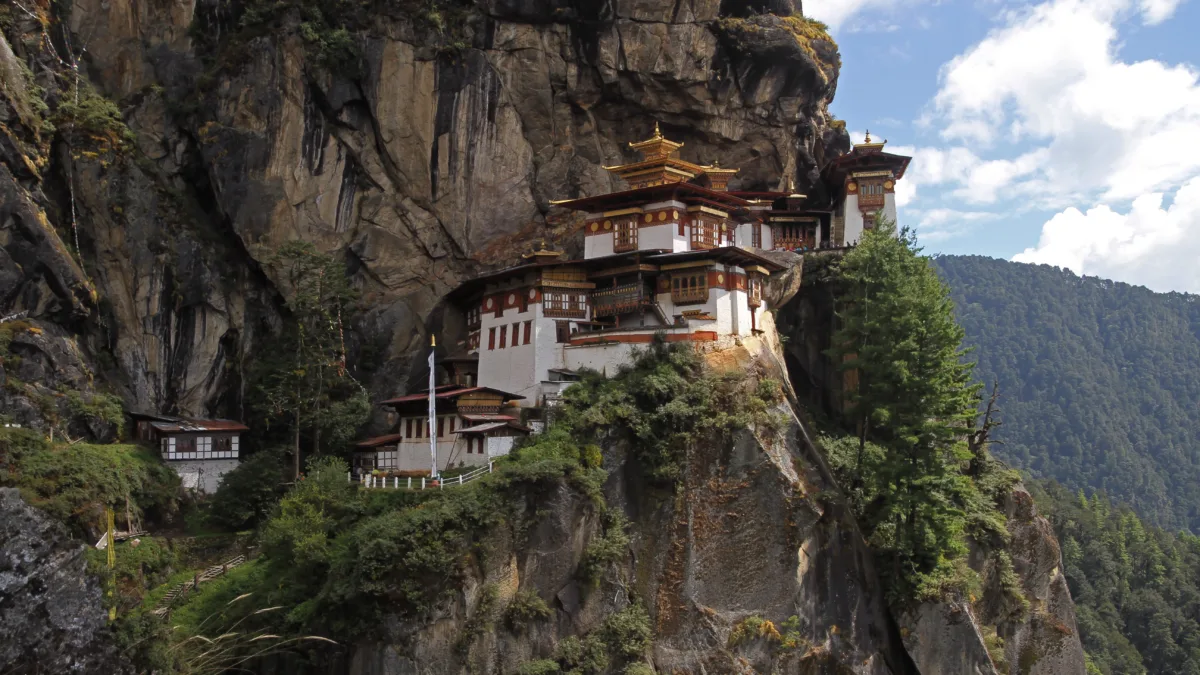
The Tiger’s Nest, or Paro Taktsang, is the monastery built in 1692 on a cliff about 900 metres above the Paro valley, at roughly 3,120 metres. The trail is about 4 km each way, climbing steadily through pine forest to a cafeteria at the halfway point and then on to the viewpoint and the monastery itself. Most people take 2 to 3 hours to walk up and 4 to 6 hours for the whole visit, including time inside. Start by 7 or 8 in the morning to beat the crowds and the afternoon cloud. The monastery is usually open from about 8 am to 5 pm with a lunch break in the middle of the day. Leave cameras and phones in the lockers at the gate, and cover your shoulders and knees inside. Entry costs about Nu 1,000 to Nu 2,000 per adult — sources disagree after a fee revision in September 2026, so carry cash and confirm at the ticket counter. After the hike, drive to Paro airport for your flight home.
Where to Stay in Bhutan
Tourists in Bhutan may stay only in hotels and homestays certified by the Department of Tourism, so book through the official directory or a licensed operator and keep your booking confirmation for the permit. Budget rooms in Thimphu and Paro generally cost about Rs 1,500 to Rs 3,000 a night, mid-range hotels about Rs 4,000 to Rs 8,000, and four-star and luxury stays much more. Paro is usually the priciest, thanks to the Tiger’s Nest. Most Bhutanese hotels include breakfast and dinner. Book early for October and festival weeks.
What to Eat in Bhutan
Bhutanese food is built on chillies, cheese and red rice. Ema datshi, the chilli-and-cheese stew, appears on almost every menu, along with buckwheat noodles, momos and pork or chicken cooked with radish and dried chillies. Vegetarian travellers eat well: most hotels cook a full vegetarian spread on request, and the cafeteria at the Tiger’s Nest serves a simple vegetarian buffet. Meals cost roughly Rs 500 to Rs 1,500 per person a day, and hotel dinners are usually included in the room rate. Carry cash for small eateries and the trail cafeteria — cards are not always accepted outside the main towns.
Bhutan Trip Cost from India: Budget Ranges
For a 4-day trip, a budget traveller going by road from Bagdogra should plan on roughly Rs 25,000 to Rs 40,000 per person, including the SDF, certified hotels, a car and guide, food and the drive to the border. Flying into Paro and staying in standard certified hotels, the same trip generally costs roughly Rs 50,000 to Rs 80,000 per person, with flights the biggest single cost. Keep aside about Nu 1,000 to Nu 2,000 per adult for the Tiger’s Nest and around Nu 500 to Nu 1,000 for the Punakha Dzong. Every figure here is a range, not a fixed price: fees, fares and hotel rates in Bhutan change, so re-check them before you pay for anything.
Practical Tips for Your Bhutan Trip from India
Apply for your entry permit online at immi.gov.bt well before you travel, and carry the original passport or voter ID you applied with. The ngultrum trades at par with the rupee, Indian rupees are widely accepted, and the Embassy of India advises carrying Indian currency only in notes up to Rs 500 and up to a total of Rs 25,000. Pack layers: days are mild but mornings and evenings are cold, and the Tiger’s Nest trail climbs to over 3,000 metres, so walk slowly and drink water. At temples, remove shoes and hats, dress modestly, and ask before photographing people. Finally, confirm the SDF, the guide rule and the monument fees on the official tourism site before you go. Bhutan’s rules have changed more than once in the last two years, and the current figures are the ones that matter. If you are weighing other short international trips from India, our Nepal trip from India follows the same 4-day format with no SDF at all.